Price Waterhouse Coopers Pvt. Ltd. Vs CIT (Supreme Court of India)
Supreme Court of India has overturned a penalty imposed on Price Waterhouse Coopers Pvt. Ltd. (PwC) under Section 271(1)(c) of the Income Tax Act, 1961, for an inadvertent error in its income tax return for the assessment year 2000-2001. The apex court found that the imposition of the penalty was not justified given the specific facts of the case.
The judgment, delivered by a bench of the Supreme Court, set aside the order of the Calcutta High Court which had upheld the penalty, albeit with a reduced quantum.
PwC, a globally recognized management consultancy firm, had filed its return of income along with the statutorily required tax audit report in Form 3CD. In Column 17(i) of this statement, it was explicitly mentioned that the provision for gratuity payment was not allowable as a deduction under Section 40A(7) of the Income Tax Act.
Despite this clear statement in the tax audit report, PwC inadvertently claimed a deduction for the gratuity provision in its income tax return. Subsequently, the assessment order under Section 143(3) was passed, seemingly without the Assessing Officer noticing this discrepancy.
Later, the Assessing Officer issued a notice under Section 148 to reopen the assessment, stating that income had escaped assessment. In response, PwC filed a return under protest and sought the reasons for reopening. The reasons provided by the Assessing Officer specifically pointed out the non-addition of the gratuity provision, amounting to an underassessment of income.
Upon receiving the reasons for reopening, PwC acknowledged the mistake and informed the Assessing Officer that it was a genuine error, which had also been overlooked by the officer during the initial assessment. PwC then filed a revised return and paid the due tax along with interest.
However, the Assessing Officer initiated penalty proceedings under Section 271(1)(c) for allegedly furnishing inaccurate particulars of income. The penalty was levied at 300% of the tax sought to be evaded.
The Commissioner of Income Tax (Appeals) and subsequently the Income Tax Appellate Tribunal upheld the imposition of the penalty, although the Tribunal reduced the quantum to 100%, describing the mistake as a “silly mistake” but noting that a firm of PwC’s caliber was not expected to commit such errors.
The Calcutta High Court dismissed PwC’s appeal, stating that as a well-known Chartered Accountant firm and tax consultant, PwC had a strict liability to furnish true and correct particulars and that willful concealment was not a necessary ingredient for imposing civil penalties under Section 271(1)(c).
Before the Supreme Court, PwC explained through an affidavit that the error might have occurred due to a lack of awareness by the person preparing the return regarding the status of some employees who were taken over upon acquisition and were not part of the approved gratuity fund, unlike other employees. The return was prepared by a non-Chartered Accountant and signed by a director who relied on its accuracy.
The Supreme Court acknowledged PwC’s reputation and expertise but also recognized that even such an organization could make an inadvertent mistake, as conceded by the Tribunal and the High Court.
The crucial factor, according to the Supreme Court, was the presence of the clear statement in the tax audit report, filed along with the return, explicitly stating the non-allowability of the gratuity provision. This indicated that there was no intention on the part of PwC to conceal income or furnish inaccurate particulars. The error was merely a computation mistake in the return, which was also overlooked by the Assessing Officer.
The Supreme Court held that the error was a bona fide and inadvertent human error, and the caliber of the assessee was irrelevant to the nature of this particular mistake. While due care was expected, the absence of it in this specific context did not equate to furnishing inaccurate particulars or attempting to conceal income.
Relying on its earlier decision in Dilip N. Shroff v. Joint Commissioner of Income Tax, Mumbai, the Supreme Court reiterated that penalty under Section 271(1)(c) is imposed when the assessee has concealed the particulars of his income or furnished inaccurate particulars thereof. The court found that in this case, the clear disclosure in the tax audit report negated any intention to conceal or furnish inaccurate particulars.
The Supreme Court concluded that the imposition of the penalty was not justified on the peculiar facts of the case, as the error was inadvertent and bona fide, without any intention to conceal income or furnish inaccurate particulars.
FULL TEXT OF THE SUPREME COURT JUDGMENT/ORDER
1. Leave granted.
2. The assessee is aggrieved by a judgment and order dated 18.12.2008 passed by the High Court of Calcutta in ITA No.120 of 2006. By the impugned judgment, a penalty imposed on the assessee under Section 271(1)(c) of the Income Tax Act, 1961 was upheld, though the quantum was reduced. We are of the view that on the facts of the case the imposition was not justified.
3. We are concerned with the assessment year 2000-2001. The assessee provides multi-disciplinary management consultancy services and has a worldwide reputation. It filed its return of income on 30.11.2000 under Section 139(6) read with Section 139(6A) of the Income Tax Act (for short, ‘the Act’). As statutorily required by Section 139(6A) of the Act, the assessee also filed its tax audit report under Section 44AB of the Act. The Statement of Particulars filed by the assessee was in Form 3CD as required by Rule 6G(2) of the Income Tax Rules, 1962 and is, in a sense, an integral part of the return.
4. In Column 17(i) of the Statement, it was stated as follows: –
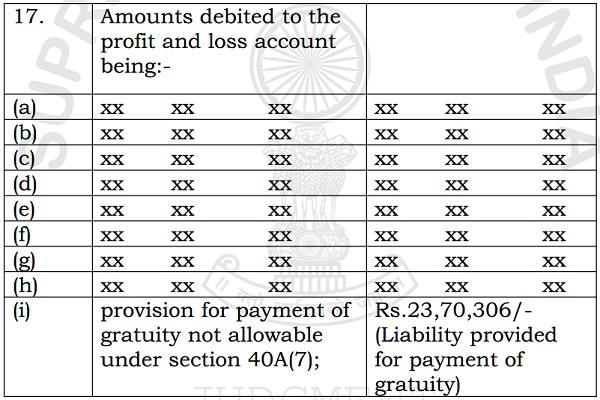
5. Even though the Statement indicated that the provision towards payment of gratuity was not allowable, the assessee claimed a deduction thereon in its return of income. On the basis of the return and the Statement, an assessment order was passed under Section 143(3) of the Act on 26.03.2003. According to the assessee, the claim for deduction was inadvertent and it also seems to have been overlooked by the Assessing Officer.
6. Much later, the Assessing Officer issued a notice to the assessee under Section 148 of the Act on 22.01.2004 for reopening the assessment. The notice did not indicate any reason why it was issued except to state that income for the assessment year 2000-2001 had escaped assessment.
7. In response to the notice, the assessee filed its return under protest on 16.02.2004 and also requested for the grounds for reopening the assessment.
8. By a letter dated 16.12.2004, the assessee was furnished the reasons for reopening the assessment, which read as under:-
“A. Rea sons f or-opening u /s 147 r elevant to A .Y. 2 000-01
In this case, regular assessment was completed under Section 143(3) on 26.03.03 at a total income of Rs.24,42,91,550/-.
On perusal of the assessment records, it is seen from Clause 17(i) of the Tax Audit Report that Rs.23,70,306/- being liabilities provided for payment of gratuity, was provided for during the year. This provision is not allowable u/s 40A(7) and was required to be added back. However, the same has not been added by the assessee in its computation, thereby leading to underassessment of income by Rs.23,70,306/-.”
9. Soon after the assessee was communicated the reasons for re-opening the assessment, it realized that a mistake had been committed and accordingly by a letter dated 20.01.2005 the Assessing Officer was informed that there was no willful suppression of facts by the assessee but that a genuine mistake or omission had been committed which also appears to have been overlooked by the Assessing Officer before whom the Tax Audit Report was placed. Accordingly, the assessee filed a revised return on the same day. A re-assessment was passed on the same day and the assessee then paid the tax due as well as the interest thereon.
10. Unfortunately for the assessee, the Assessing Officer thereafter initiated penalty proceedings under Section 271(1)(c) of the Act.
11. After obtaining a response from the assessee, the Assessing Officer saddled the assessee with penalty at 300% on the tax sought to be evaded by the assessee by furnishing inaccurate particulars. The quantum of the penalty was determined at Rs.27,37,689/-.
12. Feeling aggrieved, the assessee preferred an appeal, but the Commissioner of Income Tax (Appeals) rejected the appeal and upheld the penalty imposed on the assessee. In a further appeal, the Income Tax Appellate Tribunal (for short the Tribunal) upheld the imposition. Significantly, the Tribunal mentions that the assessee had made a mistake, which could be described as a silly mistake, but since the assessee is a high-calibre and competent organization, it was not expected to make such a mistake. Accordingly, the Tribunal reduced the penalty to 100%.
13. Against the order of the Tribunal, the assessee approached the Calcutta High Court which dismissed its appeal filed under Section 260-A of the Act by the impugned order. The only reason given by the High Court for dismissing the appeal reads as under:-
“After analysing the facts of this case, considering the submissions made by the learned Advocates for the parties and the materials placed before us, we cannot brush aside the fact that the assessee company is a well known and reputed Chartered Accountant firm and a tax consultant. We also do not find any substance in the submissions made by Dr. Pal; on the contrary, in our considered opinion, we find that Section 271(1)(c) of the Act has specifically stated about the concealment of the particulars of income or furnishing of inaccurate particulars of such income which has to be read “either” – “or” and on the given facts of this case would automatically come within the four corners of Section 271(1)(c) of the Act and we come to the conclusion that the appellant have failed to discharge their strict liability to furnish their true and correct particulars of accounts while filing the return. We are also of the opinion that the penalty under that provision is a civil liability and wilful concealment is not an essential ingredient for attracting civil liability as in the matter of prosecution under section 276C, as has been held by the Hon’ble Supreme Court. We also find that the mens rea is not an essential element for imposing penalty for breach of civil obligations or liabilities. We, therefore, accept the contention of Mr. Shome and dismiss the appeal answering the questions in the negative.”
14. During the course of hearing this appeal against the judgment and order of the Calcutta High Court, we had required the assessee to explain to us how and why the mistake was committed.
15. The assessee has filed an affidavit dated 14th September, 2012 in which it is stated that the assessee is engaged in Multidisciplinary Management Consulting Services and in the relevant year it employed around 1000 employees. It has a separate accounts department which maintains day to day accounts, pay rolls etc. It is stated in the affidavit that perhaps there was some confusion because the person preparing the return was unaware of the fact that the services of some employees had been taken over upon acquisition of a business, but they were not members of an approved gratuity fund unlike other employees of the assessee. Under these circumstances, the tax return was finalized and filled in by a named person who was not a Chartered Accountant and was a common resource.
16. It is further stated in the affidavit that the return was signed by a director of the assessee who proceeded on the basis that the return was correctly drawn up and so did not notice the discrepancy between the Tax Audit Report and the return of income.
17. Having heard learned counsel for the parties, we are of the view that the facts of the case are rather peculiar and somewhat unique. The assessee is undoubtedly a reputed firm and has great expertise available with it. Notwithstanding this, it is possible that even the assessee could make a “silly” mistake and indeed this has been acknowledged both by the Tribunal as well as by the High Court.
18. The fact that the Tax Audit Report was filed along with the return and that it unequivocally stated that the provision for payment was not allowable under Section 40A(7) of the Act indicates that the assessee made a computation error in its return of income. Apart from the fact that the assessee did not notice the error, it was not even noticed even by the Assessing Officer who framed the assessment order. In that sense, even the Assessing Officer seems to have made a mistake in overlooking the contents of the Tax Audit Report.
19. The contents of the Tax Audit Report suggest that there is no question of the assessee concealing its income. There is also no question of the assessee furnishing any inaccurate particulars. It appears to us that all that has happened in the present case is that through a bona fide and inadvertent error, the assessee while submitting its return, failed to add the provision for gratuity to its total income. This can only be described as a human error which we are all prone to make. The caliber and expertise of the assessee has little or nothing to do with the inadvertent error. That the assessee should have been careful cannot be doubted, but the absence of due care, in a case such as the present, does not mean that the assessee is guilty of either furnishing inaccurate particulars or attempting to conceal its income.
20. We are of the opinion, given the peculiar facts of this case, that the imposition of penalty on the assessee is not justified. We are satisfied that the assessee had committed an inadvertent and bona fide error and had not intended to or attempted to either conceal its income or furnish inaccurate particulars.
21. Under these circumstances, the appeal is allowed and the order passed by the Calcutta High Court is set aside. No costs.