GST Cancellation Notices Based Solely on NIL Returns: Are Such Show Cause Notices Legally Sustainable?
Introduction
Across the country, GST-registered taxpayers are increasingly receiving Show Cause Notices (SCNs) proposing cancellation of GST registration merely because they have reported NIL turnover and NIL tax liability for four consecutive tax periods.
The notice reproduced above is a typical example. It states that since the taxpayer has furnished NIL turnover and NIL tax liability continuously for the last four tax periods, the proper officer has reason to believe that the business may have been discontinued or that the taxpayer is no longer liable to remain registered under the GST law. The taxpayer is therefore called upon to explain why the registration should not be cancelled.
While tax authorities are justified in identifying dormant registrations, an important legal question arises:
- Can GST registration be cancelled merely because a taxpayer has filed NIL returns for four consecutive tax periods?
- Is Filing NIL Returns a Ground for Cancellation?
- NIL Return Does Not Mean Business Has Closed
- "Reason to Believe" Cannot Be Mechanical
- Does the Notice Contain Proper Reasons?
- Use of "and/or" Creates Ambiguity
- Automated Notices Must Still Meet Legal Standards
- What Should Taxpayers Do?
- Larger Legal Issue
- Conclusion
- Extract of the Show Cause Notices Received (Verbatim)
Can GST registration be cancelled merely because a taxpayer has filed NIL returns for four consecutive tax periods?
The answer is far from straightforward.
What the Notice States
The notice records the following:
- The taxpayer has filed NIL turnover and NIL tax liability in GSTR-1/GSTR-3B for four consecutive tax periods.
- This allegedly indicates that the business may have been discontinued.
- Registration is proposed to be cancelled under Section 29(1)(a) and/or Section 29(1)(c) of the GST Act read with Rule 22.
- The taxpayer is required to file a reply in Form GST REG-18 within seven working days.
The notice further asks the taxpayer to explain:
- Whether the business has been discontinued.
- Whether the taxpayer continues to be liable for registration.
- Any other facts or documents supporting the reply.
Is Filing NIL Returns a Ground for Cancellation?
A careful reading of Section 29 of the CGST Act suggests that the answer is No.
Section 29 permits cancellation in specified situations such as:
- Business discontinued;
- Business transferred;
- Change in constitution;
- Taxpayer no longer liable for registration;
- Contravention of GST provisions;
- Non-filing of returns for prescribed periods;
- Registration obtained by fraud or suppression.
Nowhere does the Act provide that filing NIL returns for four consecutive periods is itself a ground for cancellation.
There is an obvious distinction between:
- Non-filing of returns, and
- Filing NIL returns.
The legislature has consciously treated these differently.
NIL Return Does Not Mean Business Has Closed
One of the assumptions in the notice is:
NIL turnover = Business discontinued.
This assumption may not always be correct.
Businesses may legitimately report NIL turnover because:
- seasonal nature of business;
- temporary market slowdown;
- project yet to commence;
- regulatory approvals pending;
- business restructuring;
- temporary suspension of operations;
- export orders delayed;
- litigation affecting operations;
- start-up still in preparatory stage.
In all such situations, the business may continue to exist even though turnover remains NIL.
Therefore, NIL turnover by itself does not establish discontinuance of business.
“Reason to Believe” Cannot Be Mechanical
The notice states that the officer has “reason to believe” that registration is liable to be cancelled.
However, the “reason to believe” contemplated under the law requires application of mind.
Merely because an automated system identifies four NIL returns does not necessarily establish:
- discontinuance of business,
- cessation of liability for registration, or
- satisfaction of statutory conditions.
An opinion based solely on a computer-generated parameter without examining surrounding facts may be vulnerable to challenge.
Does the Notice Contain Proper Reasons?
Another significant issue is whether the notice satisfies the principles governing a valid Show Cause Notice.
A proper SCN should normally disclose:
- precise allegations;
- statutory provisions invoked;
- factual basis;
- reasons supporting the proposed action.
The present notice merely states that NIL returns “prima facie indicate” discontinuance of business.
It does not disclose:
- any field inquiry;
- inspection;
- adverse material;
- intelligence input;
- verification report;
- evidence suggesting closure of business.
The entire proposal appears to rest only on the filing pattern of returns.
Use of “and/or” Creates Ambiguity
The notice proposes cancellation under:
Section 29(1)(a) and/or Section 29(1)(c).
This raises another legal concern.
The taxpayer is not clearly informed:
- whether the allegation is discontinuance of business;
- or cessation of liability for registration;
- or both.
A notice requiring the taxpayer to guess the precise allegation may not satisfy the requirement of a meaningful opportunity of defence.
Automated Notices Must Still Meet Legal Standards
GST administration increasingly relies upon system-generated notices.
Automation undoubtedly improves compliance monitoring.
However, automation cannot dilute statutory safeguards.
Even an auto-generated notice must satisfy:
- proper application of law;
- clear allegations;
- disclosure of relevant facts;
- opportunity for an effective reply.
Technology cannot replace statutory requirements.
What Should Taxpayers Do?
Receipt of such a notice should not be ignored.
The taxpayer should file a detailed reply explaining, wherever applicable:
- business is continuing;
- reasons for NIL turnover;
- present status of operations;
- future business plans;
- evidence of business activity;
- bank transactions;
- invoices, purchase orders or agreements, if available;
- proof of business premises;
- any other supporting documents demonstrating continuation of business.
Where the taxpayer continues to be liable for registration, this should be specifically explained.
Larger Legal Issue
The larger issue is not whether inactive registrations should remain on the GST portal.
The real issue is whether registration can be cancelled merely because returns disclose NIL turnover.
The statutory scheme appears to require satisfaction of specific conditions prescribed under Section 29. Filing NIL returns may trigger verification, but it does not automatically establish that those statutory conditions exist.
If cancellation proceedings are initiated solely on the basis of NIL returns without any independent material or proper reasoning, the validity of such notices may become open to judicial scrutiny.
Conclusion
The objective of identifying genuinely inactive registrations is understandable. However, cancellation of GST registration carries significant civil consequences and cannot be founded merely on assumptions drawn from NIL returns.
A legally sustainable Show Cause Notice should clearly disclose the factual basis and statutory grounds for the proposed action. Generic notices based solely on consecutive NIL returns, without identifying any independent material indicating discontinuance of business or loss of liability for registration, may not fully satisfy the requirements of natural justice or the statutory framework of Section 29.
As automated compliance measures become increasingly common, it remains essential that procedural fairness and statutory safeguards continue to govern every cancellation proceeding.
Extract of the Show Cause Notices Received (Verbatim)
SHOW CAUSE NOTICE FOR CANCELLATION OF REGISTRATION
Whereas, on the basis of information available on the GST Common Portal, it is observed that you have furnished NIL turnover and NIL tax liability in your returns (Form GSTR-1/GSTR-3B, as applicable) continuously for the last 4 consecutive tax periods.
The above facts prima facie indicate that your business may have been discontinued or that you may no longer be liable to remain registered under the provisions of Section 22 or Section 24 of the RGST Act, 2017. Accordingly, I have reasons to believe that your registration is liable to be cancelled under the provisions of Section 29(1)(a) and/or Section 29(1)(c) of the RGST Act, 2017, read with Rule 22 of the RGST Rules, 2017.
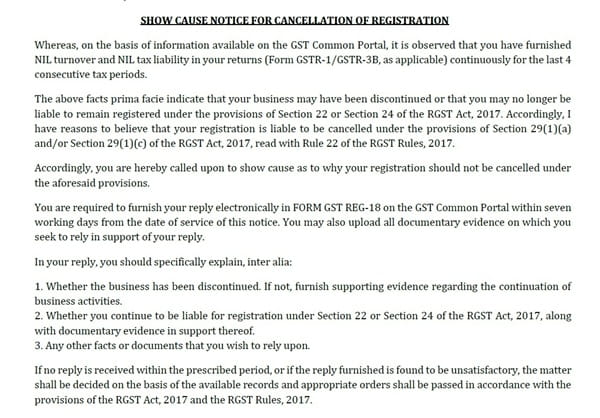
Accordingly, you are hereby called upon to show cause as to why your registration should not be cancelled under the aforesaid provisions.
You are required to furnish your reply electronically in FORM GST REG-18 on the GST Common Portal within seven working days from the date of service of this notice. You may also upload all documentary evidence on which you seek to rely in support of your reply.
In your reply, you should specifically explain, inter alia:
- Whether the business has been discontinued. If not, furnish supporting evidence regarding the continuation of business activities.
- Whether you continue to be liable for registration under Section 22 or Section 24 of the RGST Act, 2017, along with documentary evidence in support thereof.
- Any other facts or documents that you wish to rely upon.
If no reply is received within the prescribed period, or if the reply furnished is found to be unsatisfactory, the matter shall be decided on the basis of the available records and appropriate orders shall be passed in accordance with the provisions of the RGST Act, 2017 and the RGST Rules, 2017.