
The Income-tax Act, 2025, effective from tax year 2026–27, replaces the earlier assessment-year framework with a unified “tax year” and consolidates presumptive taxation provisions into a single Section 58, replacing Sections 44AD, 44ADA and 44AE of the 1961 Act. While the stated objective is simplification, the new regime introduces substantive changes that materially affect resident small taxpayers. Most notably, eligibility for presumptive taxation shifts from a business-wise test to an assessee-wise disqualification, making taxpayers with even minor commission, agency or specified professional income entirely ineligible. Section 58 also imposes a complete bar on set-off of losses and deductions, expanding far beyond the limited deeming fiction under the 1961 Act. Further, the audit trigger moves from a continuity-based approach to an income-outcome test, exposing taxpayers declaring lower profits to audit irrespective of past behaviour. Transporters, however, receive relief through exemption from audit when income remains within the basic exemption limit. Overall, Section 58 simplifies structure but tightens substance, requiring careful planning before opting in.
1. General
1.1 The Income-tax Act, 2025 has been notified to come into force with effect from 1st day of April, 2026, i.e., from Tax Year 2026–27. Under the Income-tax Act, 1961, the law as in force on the first day of the assessment year governed the entire relevant previous year. The scheme of taxation under the 2025 Act marks a structural departure, inasmuch as the concepts of previous year and assessment year have been dispensed with and replaced by a single unified concept of “tax year”.
1.2 Under the new regime, a tax year means a period of twelve months commencing on the 1st day of April of a financial year. However, where a business or profession is newly set up, or a new source of income comes into existence during any financial year, the tax year shall be the period beginning from the date of setting up such business/profession or the date on which the source of income comes into existence and ending on the 31st day of March of that financial year.
1.3 Accordingly, income earned during the financial year 2025–26 shall continue to be governed by the provisions of the Income-tax Act, 1961, and the return of income shall be furnished in accordance with the provisions and forms prescribed under the said Act. Conversely, income earned during the financial year 2026–27 shall be taxable in accordance with the provisions of the Income-tax Act, 2025, and returns shall be filed as per the procedures and forms notified thereunder.
1.4 Thus, the operative applicability of the Income-tax Act, 2025 commences from 1st day of April, 2026, and planning of advance tax obligations shall need to be undertaken with reference to the provisions of the new Act. The Finance Bill to be introduced along with the Union Budget 2026 shall also assume special significance, as it will propose amendments, if any, to the Income-tax Act, 2025.
2. Presumptive Taxation
2.1 Coming to the subject of presumptive taxation for persons resident in India, presumptive taxation is a simplified method of computing taxable income on an estimated basis, generally by applying a prescribed percentage to turnover, sales, or gross receipts. The rationale behind this scheme is that for small taxpayers, it is often onerous to maintain detailed books of account, preserve all invoices relating to sales and expenses, and in certain cases comply with audit requirements mandated under the Act. These compliance obligations significantly increase the cost and complexity of income computation for small businesses and professionals.
2.2 In order to mitigate such compliance burden and to facilitate ease of doing business, the legislature has introduced presumptive taxation schemes, whereby income is deemed to be a specified percentage of turnover or gross receipts, subject to prescribed conditions.
2.3 Under the Income-tax Act, 1961, presumptive taxation for small taxpayers who are residents in India is governed by three distinct provisions, namely sections 44AD, 44ADA and 44AE, each catering to different categories of assessees and businesses/professions. The Income-tax Act, 2025 consolidates these three provisions into a single comprehensive provision, section 58, wherein the presumptive schemes are presented in a structured tabular format for ease of reference and administration. The corresponding mapping of the presumptive taxation provisions under the 1961 Act with section 58 of the 2025 Act is tabulated below:
| Section of 1961 Act | Section of 2025 Act |
|---|---|
| 44AD | Section 58-Table Sl. No.1 |
| 44AE | Section 58-Table Sl. No.2 |
| 44ADA | Section 58-Table Sl. No.3 |
2.4 While drafting the Income-tax Act, 2025, the legislature has consciously attempted to simplify language and structure, while largely retaining the substantive effect of provisions as contained in the Income-tax Act, 1961. However, upon a close reading, certain material deviations can be observed, particularly in the context of presumptive taxation. This article undertakes a comparative analysis of Section 44AD, 44ADA and 44AE of the Income-tax Act, 1961 vis-à-vis Section 58 of the Income-tax Act, 2025 and examines the implications thereof.
3. Section 44AD of 1961 Act versus Section 58 of 2025 Act
3.1 Comparative Summary :
Comparative summary of section 44AD of the Income Tax Act, 1961 with section 58 of the Income Tax Act, 2025 is as under:
| SN | Particulars | Section 44AD of 1961 Act | Section 58 of 2025 Act |
|---|---|---|---|
| 1. | Eligible assessee | Resident Individual, HUF or Partnership Firm (other than LLP)
|
Resident Individual, HUF or Partnership Firm (other than LLP)-
|
| 2. | Specified Business | Any business other than-
|
Any business other than the business of plying, hiring or leasing goods carriage specified against serial number 2
|
| 3. | Turnover / gross receipts Threshold | ₹2 crore (₹3 crore where cash receipts ≤ 5% of total turnover/gross receipts) | No Change |
| 4. | Presumptive income rate / amount | 6% on turnover/gross receipts through specified banking channel/online mode
8% of other turnover/ gross receipts |
No Change |
| 5. | Option to declare higher income | Yes |
Yes |
| 6. | Allowability of deductions and losses | Any deduction allowable under the provisions of sections 30 to 38 shall be deemed to have been already allowed; no further deduction | Any loss, allowance or deduction allowable under the provisions of this Act, shall not be allowed against the income under section 58 |
| 7. | Depreciation treatment | WDV deemed as if depreciation allowed | No Change |
| 8. | Maintenance of books & audit | Condition – 1
Mandatory if –
OR Condition – 2 : No such condition |
Condition – 1
No Change OR Condition – 2 Mandatory if –
|
| 9. | Lock-in / continuity condition | 5-year lock-in; non-compliance leads to ineligible for the benefits of this section for next 5 years | No Change |
3.2 Critical Analysis of Key Deviations
There are three major changes in section 58 of the Income Tax Act, 2025 as compared to section 44AD of the Income Tax Act, 1961 analysed as under:
3.2.1 Shift from Business-wise Eligibility to Assessee-wise Disqualification
(a) At first glance, section 58 of the 2025 Act appears to mirror section 44AD of the 1961 Act in terms of eligible assessee and business. However, a closer reading reveals a fundamental shift in eligibility philosophy.
(b) Under section 44AD of the 1961 Act, eligibility was business-specific. An assessee carrying multiple businesses could opt for presumptive taxation in respect of an eligible business while computing income from ineligible activities (such as commission or agency business) separately.
(c) In contrast, section 58 of the 2025 Act introduces an assessee-level disqualification. If an assessee carries on any agency business, earns any commission or brokerage income, or carries on an agency business, or carries on a specified profession, the assessee becomes wholly ineligible for presumptive taxation under section 58-even in respect of otherwise eligible business activities.
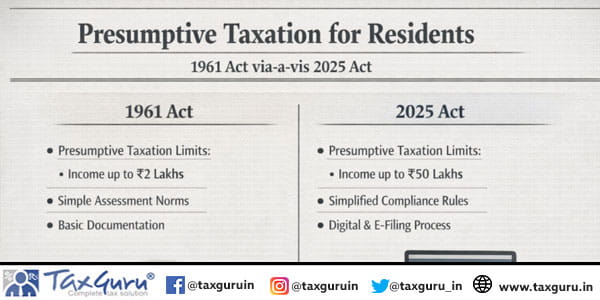
(d) Illustration:
If Mr. A carries on a trading business along with a small agency activity:
-
-
-
- Under section 44AD (1961 Act): Trading business could be covered under presumptive taxation while declaring income from agency business separately.
- Under section 58 (2025 Act): Mr. A becomes entirely ineligible for section 58.
-
-
This represents a material narrowing of the presumptive regime, disproportionately affecting small taxpayers with mixed streams of income.
3.2.2 Allowability of Deductions and Losses :
(a) Section 44AD(2) reads as under:
“(2) Any deduction allowable under the provisions of sections 30 to 38 shall, for the purposes of sub-section (1), be deemed to have been already given full effect to and no further deduction under those sections shall be allowed.”
(b) Section 44AD(2) of the Income-tax Act, 1961 specifically provides that deductions allowable under sections 30 to 38 shall be deemed to have been already given full effect to. These sections cover routine business expenditures such as rent, repairs, depreciation and other operational expenses. Given that section 44AD presumes a minimum profit of 6% or 8%, the balance amount is logically presumed to have been expended in the course of business. Accordingly, section 44AD(2) does not deprive the assessee of any substantive benefit but merely avoids double deduction.
(c) However, section 58(4) of the Income Tax Act, 2025 reads as under:
“(4) Any loss, allowance or deduction allowable under the provisions of this Act, shall not be allowed against the income computed in the manner specified in sub-section (2).”
(d) In contrast, section 58(4) of the Income-tax Act, 2025 provides that any loss, allowance or deduction under the Act shall not be allowed against income computed on a presumptive basis. The scope of this restriction is significantly wider. It bars set-off of intra-head and inter-head losses, adjustment of brought forward losses and even deductions otherwise available under the Act including deduction allowable under Chapter VIII of the Income Tax Act, 2025 (Chapter VIII of the Income Tax Act, 2025 corresponds to Chapter VI of Income Tax Act, 1961).
(e) Thus, if the assessee computes his income under section 58 of the Income Tax Act, 2025, he has to ensure that the profit so computed under the presumptive scheme shall form part of his Total Income at any case and no loss, allowance or deduction whatsoever under the Income Tax Act, 2025 shall be allowed against such income. These provisions are very harsh and makes the situation tough for the small taxpayers not willing to maintain books of account and get them audited.
(f) While the Income-tax Act, 2025 seeks to simplify drafting and streamline compliance, the expansion of restrictions on set-off of losses and deductions under section 58 marks a clear departure from the policy underlying section 44AD of the 1961 Act. Small taxpayers opting for presumptive taxation will need to carefully evaluate the impact of these provisions before exercising the option, particularly where losses or deductions are otherwise available.
3.2.3 Maintenance of Books of Account and Audit Requirement – A Shift in Compliance Philosophy
(a) One of the most significant yet nuanced deviations between section 44AD of the Income-tax Act, 1961 and section 58 of the Income-tax Act, 2025 relates to the circumstances under which an assessee is required to maintain books of account and get them audited upon declaring income lower than the presumptive rate.
(b) Position under the Income-tax Act, 1961
(i) Under the 1961 Act, the requirement to maintain books of account and undergo tax audit is not triggered merely because the assessee declares income lower than the presumptive rate under section 44AD(1). Instead, section 44AD(4) read with section 44AD(5) creates a two-tier conditional framework, wherein audit becomes mandatory only when all the following conditions are cumulatively satisfied:
-
-
-
-
- The assessee had declared income under section 44AD in any one of the preceding five assessment years;
- The assessee declares income below the presumptive rate during the relevant previous year; and
- The total income exceeds the basic exemption limit
-
-
-
(ii) In absence of the above cumulative conditions, merely declaring income lower than the presumptive rate does not, per se, attract the rigours of section 44AA and section 44AB. Thus, the compliance burden under the 1961 Act is continuity-centric.
(iii) Stated differently, where an assessee, in the first year of business or in a year in which section 44AD has not been opted for in any of the preceding five assessment years, declares income below the presumptive rates of 6% or 8%, such declaration, by itself, does not trigger the requirement of tax audit, even if the total income exceeds the basic exemption limit.
(c) Position under the Income-tax Act, 2025
(i) In contrast, section 58 of the Income-tax Act, 2025 reflects a marked shift in compliance philosophy. While the five-year continuity condition is broadly retained, the audit trigger mechanism has been materially realigned.
(ii) Under the new regime, the audit requirement is attracted in either of the following situations:
-
-
-
- Condition 1: Where the assessee continues to be governed by the five-year continuity rule (no material change from the 1961 Act); or
- Condition 2: Income is declared below the presumptive rate and total income exceeds the basic exemption limit, irrespective of continuity.
-
-
(iii) This represents a significant departure from the earlier law. Under the 2025 Act, the mere act of declaring lower income—coupled with crossing the basic exemption threshold—can independently trigger the obligation to maintain books and undergo audit, even if there is no violation of continuity.
(d) Critical Evaluation
(i) The shift from a continuity-based audit trigger to an income-based audit trigger substantially enhances the compliance burden on small taxpayers.
(ii) Moreover, when read in conjunction with section 58(4)—which completely bars set-off of losses and deductions—the revised audit trigger further narrows the practical utility of the presumptive scheme under the 2025 Act.
(e) Conclusion
It exemplifies how the Income-tax Act, 2025, though retaining the outer framework of presumptive taxation, has reoriented the compliance threshold from behavioural consistency to income outcomes. This change calls for careful tax planning, as declaring lower income may now automatically expose the assessee to audit and record-keeping obligations.
4. Section 44ADA of 1961 Act versus Section 58 of 2025 ActTop of FormBottom of Form
4.1 Comparative Summary :
Comparative summary of section 44ADA of the Income Tax Act, 1961 with section 58 of the Income Tax Act, 2025 is as under:
| SN | Particulars | Section 44ADA of 1961 Act | Section 58 of 2025 Act |
|---|---|---|---|
| 1. | Eligible assessee and Business | Resident Individual or Partnership Firm (other than LLP) and carrying out any specified profession | No change |
| 2. | Turnover / gross receipts limit | ₹50 lakhs (₹75 lakhs where cash receipts ≤ 5% of the gross receipts) | No Change |
| 3. | Presumptive income rate / amount | 50% of the gross receipts |
No Change |
| 4. | Option to declare higher income | Yes |
Yes |
| 5. | Allowability of deductions and losses | Any deduction allowable under the provisions of sections 30 to 38 shall be deemed to have been already allowed; no further deduction | Any loss, allowance or deduction allowable under the provisions of this Act, shall not be allowed against the income computed u/s.58 |
| 6. | Depreciation treatment | WDV deemed as if depreciation allowed | No Change |
| 7. | Maintenance of books & audit | Mandatory if –
· Income below presumptive; and · Total income exceeds basic exemption limit.
|
No Change
|
4.2 Critical Analysis of Key Deviations
There is only one material deviation between section 58 of the Income-tax Act, 2025 and section 44ADA of the Income-tax Act, 1961, namely with respect to the allowability of deductions and losses. This deviation and its consequential impact have already been analysed in detail in paragraph 3.2.2 above while discussing section 44AD of the 1961 Act, and the same analysis shall apply mutatis mutandis in the present context.
5. Section 44AE of 1961 Act versus Section 58 of 2025 Act
5.1 Comparative Summary :
Comparative summary of section 44AE of the Income Tax Act, 1961 with section 58 of the Income Tax Act, 2025 is as under:
| SN | Particulars | Section 44AE of 1961 Act | Section 58 of 2025 Act |
|---|---|---|---|
| 1. | Eligible assessee and Business | Any assessee owning not more than 10 goods carriages at any time during the previous year and engaged in the business of plying, hiring or leasing goods carriages | No Change |
| 2. | Turnover / gross receipts limit | Not turnover-based; ownership capped | No Change |
| 3. | Presumptive income rate / amount | · Heavy goods vehicle: ₹1,000 per ton per month or part of the month
· Other goods vehicle: ₹7,500 per month or part of the month |
No Change |
| 4. | Option to declare higher income | Yes |
Yes |
| 5. | Allowability of deductions and losses | Any deduction allowable under the provisions of sections 30 to 38 shall be deemed to have been already allowed; no further deduction | Any loss, allowance or deduction allowable under the provisions of this Act, shall not be allowed against the income computed u/s.58 |
| 6. | Depreciation treatment | WDV deemed as if depreciation allowed | No Change |
| 7. | Maintenance of books & audit | Mandatory if Income declared below presumptive rates
|
Mandatory if –
· Income declared below presumptive rates; and · Total income exceeds basic exemption limit.
|
| 8. | Additional Benefit for Partnership Firms | Salary and interest paid to partners subject to condition and limits specified u/s.40(b) is deductible from the income computed as above | No Change |
5.2 Critical Analysis of Key Deviations
There are two major changes in section 58 of the Income Tax Act, 2025 as compared to section 44AE of the Income Tax Act, 1961 analysed as under:
5.2.1 Allowability of Deductions and Losses :
This deviation and its consequential impact have already been analysed in detail in paragraph 3.2.2 above while discussing section 44AD of the 1961 Act, and the same analysis shall apply mutatis mutandis in the present context.
5.2.2 Greater Flexibility in Audit Requirement for Small Transporters
(a) A notable and beneficial shift under the Income-tax Act, 2025 is observed in the audit trigger mechanism.
(b) Position under the Income-tax Act, 1961 : Under Section 44AE(7) of the Income Tax Act, 1961, where an assessee claims income lower than the presumptive rate, he is required to maintain books of account; and get such accounts audited irrespective of whether the total income exceeds the basic exemption limit. Thus, even small transporters declaring lower income but remaining below the taxable threshold were exposed to audit compliance.
(d) Position under the Income-tax Act, 2025 : Section 58 introduces a threshold-based safeguard. Audit is now required only when both conditions are satisfied viz. Income is declared below the presumptive rate; and total income exceeds the basic exemption limit. Accordingly, where a transporter declares lower income but remains within the basic exemption limit, no requirement to maintain books or undergo audit arises.
This change clearly enhances compliance flexibility for genuinely small transport operators and aligns audit requirements with the ability-to-pay principle.
5.2.3 Conclusion
Contrary to an initial perception of rigidity, the Income-tax Act, 2025 introduces a more nuanced and taxpayer-friendly audit regime for transport operators. While the scope for adjusting losses and deductions against presumptive income has been curtailed, the removal of mandatory audit for assessees remaining within the basic exemption limit marks a progressive and pragmatic reform.
6. Similar Relaxation for payment of Advance Tax
Section 211(1)(b) of the Income Tax Act, 1961 relaxes the assessee opting presumptive taxation scheme of section 44AD or 44ADA and provides that such assessee can pay advance tax with 4th installment fully. Similar provisions have been incorporated under section 408(2) of the Income Tax Act, 2025 and first three installments of advance tax have been relaxed for the assessee opting presumptive taxation scheme of section 58 other than assessee engaged in plying, hiring or leasing goods carriages.
7. Conclusion
Section 58 of the Income-tax Act, 2025 consolidates the presumptive taxation provisions of the 1961 Act into a single framework, achieving structural simplicity but introducing substantive changes. For business assessees, the shift to assessee-wise ineligibility, complete denial of set-off of losses and deductions, and outcome-based audit triggers significantly narrow the utility of the presumptive scheme. Specified professionals and transporters, though structurally unaffected, face similar restrictions on deductions and losses, impacting tax efficiency. In contrast, transport operators benefit from a more rational audit threshold linked to the basic exemption limit. Thus, while the 2025 Act simplifies form, it selectively tightens substance. Presumptive taxation under section 58 now demands careful evaluation rather than automatic adoption by small taxpayers.







Good comparison. Three practical points small business owners often miss when reading about Section 58:
ELIGIBILITY BAR HAS CHANGED. Under old Section 44AD, even if you earned a small commission from one transaction, you could still opt for presumptive scheme for your main business. Under Section 58, if any commission or agency income exists during the year, you are entirely ineligible for presumptive scheme on ALL your business income. This catches many traders off guard.
AUDIT TRIGGER IS NOW INCOME-BASED, NOT HISTORY-BASED. Under 44AD, the 5-year exit rule meant if you declared less than 8% profit in any year, you were locked out of presumptive scheme for 5 years. Section 58 drops that continuity approach. Now, audit applies if you declare income below the prescribed percentage, regardless of your history. Cleaner rule, but no grandfathering protection.
SET-OFF OF LOSSES NOW BARRED. The 2025 Act imposes a complete bar on loss set-off against presumptive income. Under 44AD, this was a limited restriction. Under Section 58, it is absolute. Business owners who relied on setting off depreciation or other losses will need to rethink their structure.
For most small businesses with turnover below 2 crore and clean books, Section 58 is simpler than the old regime. The complexity only bites those with mixed income streams.