
United Teleservices Ltd. Vs ACIT (ITAT Kolkata)
Conclusion: Disallowance on account of interest on office loan was confirmed as assessee had taken loan from Bank for office and claimed deduction in respect of the interest expenditure incurred on this loan thus, the presumption based on mixed funds could not be applied.
Held: Assessee had claimed interest expenditure of Rs.4,02,837/- for its office. AO disallowed it since this office was not utilized/put to use. CIT(A) confirmed the action of the AO. Assessee contended that it had its own fund to the tune of Rs.8,28,88,111/-and the loan amount was only to the tune of Rs. 1.3 cr. and, therefore, assessee possessed mixed fund which included its own fund in sufficient quantity. Therefore, according to him, presumption need to be drawn that its own funds were utilized for the purchase of office. It was held that assessee had shown in its books that the loan of Rs. 1.3 cr. had been taken from the Axis Bank for office and claimed deduction in respect of the interest expenditure incurred on this loan thus, the presumption based on mixed funds could not be applied.
FULL TEXT OF THE ITAT JUDGEMENT
This appeal preferred by the assessee is against the order of Ld. CIT(A)-4, Kolkata dated 11.02.2020 for AY 2016-17.
2. The grounds of appeal raised by the assessee are as under:
1. (a) For that on the facts and in the circumstances of the case, the Ld. CIT(A) was not justified in holding that the addition made by the A.O. on account of business promotion expenses u/s. 40(a)(ia) is restricted to Rs. 20,65,713/- when the total addition made by the A.O. itself was Rs. 15,12,574/-.
(b) For that on the facts and in the circumstances of the case, the Ld. CIT(A) ought to have deleted the disallowance of Rs. 15,12,574/- being 30% of Rs. 50,41,915/- on account of business promotion expenses made by the A.G. by wrongly invoking the provision of section 40(a)(ia).
2. For that on the facts and in the circumstances of the case, the Ld. CIT(A) ought to have allowed Rs. 4,02,837/- on account of interest on office loan disallowed by the A.O.
3, (a) For that on the facts and in the circumstances of the case, the Ld. CIT(A) erred in making an enhancement of Rs. 20,35,95,402/- in the hands of the assessee on account of alleged inflated purchases.
(b) For that the Ld. CIT(A) was not justified in introducing in the assessment, a new source of income and failing to confine himself to those items of income which were the subject matter of the original assessment.
(c) For that the Ld. CIT(A) failed to afford full and proper opportunity before proceeding to make huge and unjustified enhancement of Rs. 20,35,94,402/-.
3. As far as ground no. 1(a) is concerned, the Ld. AR Shri Subhas Agarwal drew our attention to page no.2 of the assessment order, from which it is seen that AO has made a chart wherein he has noted that the assessee company failed to deduct tax at source in respect of sixteen (16) items of expenses to the tune of Rs.50,41,915/- and, therefore, he disallowed 30% of it u/s. 40(a)(ia) of the Income Tax Act, 1961 (hereinafter referred to as the “Act”) i.e. Rs.15,12,574/-. Aggrieved, the assessee preferred an appeal before the Ld. CIT(A) who has decided the issue at page 6 and 7 of the impugned order wherein the Ld. CIT(A) has given relief to the tune of Rs.29,76,202/- (expenditure) by excluding four (4) items of expenditure and one duplicate entry from TDS. However, while disposing off this ground of appeal, the Ld. CIT(A) directed the AO the following:
“In view of the above, the amount of Rs.29,76,202/- was not liable for deduction of taxes for the remarks given in the above table, therefore, the addition is restricted to Rs.20,65,713/-. Accordingly, this ground is partly allowed.”
4. This direction of the Ld. CIT(A) is being challenged by the Ld. AR stating that the total disallowance made by the AO was only at Rs.15,12,574/- (i.e. 30% of Rs.50,41,915/-) whereas the Ld. CIT(A) after giving partial relief erroneously enhanced the addition to Rs.20,65,713/- (Rs.50,41,915/- – 29,76,202/-) which was the expenditure on which the Ld. CIT(A) found that the assessee was liable to deduct taxes and, therefore, the Ld. CIT(A) ought to have directed 30% on the amount of Rs.20,65,713/- i.e. (@30% of Rs.20,65,713/-and not disallowance of Rs.20,65,713/-. However, by raising ground no. 1(b) the Ld. AR further contended that out of this relief granted for the expenditure in respect of Rs.29,76,202/- the assessee is challenging his action/omission in respect of payments made to M/s. Rakshit & Company amount of Rs.2,27,282/- and M/s. Choicest Enterprise Ltd. to the tune of Rs.9,53,105/-. According to the Ld. AR, these two payments were made to decorators/event managers. In order to substantiate these expenditures’ genuinity, he drew our attention to page 22 and 23 of the paper book which are the bill of M/s. Rakshit & Company; and thereafter he drew our attention to page no. 27 wherein the bill of M/s. Choicest Enterprise Ltd. has been found placed. According to the Ld. AR payments made to these two concerns must have been reflected in their respective turnovers and in their ROI, and they ought to have paid the taxes on it, so, he pleaded that no disallowance u/s. 40(a)(ia) of the Act is warranted for these two expenses. Per contra, the Ld. DR did not object to the correction raised in ground no. (1)(a), which is per-se evident. However, in respect to the relief claimed in respect of expenditures in respect of two concerns are concerned, according to Ld. DR, factual verification is necessary, therefore, he pleaded that these two expenses may be remanded for verification back to AO.
5. Having heard both the parties we are not repeating the facts narrated above for the sake of brevity. In respect of ground no. 1(a), we find that the Ld. CIT(A) erred while giving direction to restrict the addition to Rs.20,65,713/- because at the first place the AO had made the disallowance only to the tune of Rs.15,12,574/-. It is noted that the Ld. CIT(A) had given partial relief to the assessee by taking note of the fact that expenditure in respect of items amounting to Rs.29,76,202/- was not liable for deduction of taxes for various reasons stated in the chart prepared by him at pages 6 and 7 of the impugned order. However, when he gave the final direction, he erroneously directed that the addition may be restricted to Rs.20,65,713/- (Rs.50,41,915 – Rs.29,76,202). So, there is an error apparent on the face of the record. The Ld. CIT(A) after giving partial relief to the expenditure to the tune of Rs.29,76,202/- could have only directed that the disallowance could have been made only in respect of the expenditure regarding Rs.20,65,713/- i.e. 30% of Rs.20,65,713/- u/s. 40(a)(ia) of the Act. So, the Ld. CIT(A) per-se erred in directing so (supra). Be that as it may be, however, the Ld. AR has pleaded that out of the items on which the Ld. CIT(A) has not given relief in respect of expenditure of Rs.20,65,713/- the assessee seeks verification in respect of two items of expenditure i.e. in respect of M/s. Rakshit & Company and M/s. Choicest Enterprises Ltd. to whom the assessee had made payment of Rs.2,78,282/- and Rs.9,53,105/- respectively. The Ld. AR had drawn our attention to the bills as discussed supra and contends that the AO may verify as to whether these two concerns have shown this amount as receipts in their respective turnover and has paid taxes on it in accordance to law. In such an event it was contended that there should be no disallowance. We find force in the said contention of the Ld. AR and we direct the AO to verify from these two concerns as to whether they (M/s. Rakshit & Company and M/s. Choicest Enterprises Ltd.) have shown these amounts/receipts in their trading receipts in this assessment year and have paid due taxes thereon. The assessee to give all the details to the AO regarding their identity. And, the AO to verify from these concerns the veracity of the payment made by assessee and if the AO finds that both the concerns have shown these two payments made by the assessee as their receipts and have paid taxes thereon in this assessment year, then no deduction u/s. 40(a)(ia) of the Act is warranted, if not, the same may be confirmed. In respect of other items confirmed by the Ld. CIT(A), the Ld. AR does not want to press taking into account the smallness of the amount and, therefore, those expenses to be disallowed u/s. 40(a)(ia) of the Act. So, this ground is partly allowed for statistical purposes.
6. Ground no. 2 is against the action of Ld. CIT(A) in confirming the disallowance of Rs.4,02,837/- on account of interest on office loan.
7. Brief facts of the case as noted by the AO are that it has come to his notice that expenditure claimed on account of interest on borrowed fund utilized for purchase of office was to the tune of Rs.4,02,837/-. According to the AO, no depreciation was claimed in respect of this office since it does not appear as an item in the fixed asset. According to him, the office was not utilized/put to use in this year for the purpose of business. Thereafter, he applied section 43(1) and section 36(1)(iii) of the Act and held that since the office was not utilized or put to use in the year for the purpose of business interest paid on the capital borrowed for acquisition of the office cannot be allowed and therefore, the sum of Rs.4,02,837/- was disallowed u/s. 36(1)(iii) of the Act. Aggrieved, the assessee preferred an appeal before the Ld. CIT(A) who notes that the office was taken on the fixed asset of the company for the Financial year 2016-17 and office got registered in FY 201617 and according to Ld. CIT(A) this expenses of Rs.4,02,837/- cannot be allowed in this year (F.Y. 2015-16). However, according to Ld. CIT(A), the same can be capitalized in the year of acquisition. The Ld. AR assailing the action of the Ld. CIT(A) submitted that the assessee has borrowed an amount of Rs.1,36,65,535/- from the Axis Bank which is discernible from a perusal of page 5 of the paper book. According to Ld. AR, no disallowance could have been made when the assessee possessed mixed fund which includes its own fund in sufficient quantity. Then, according to him, the presumption is that its own funds were utilized for the advances need to be drawn and according to Ld. AR, the assessee’s share capital plus Reserve [Rs.1,48,12,000/- + Rs.6,80,76,111/-] totaling Rs. 8,28,88,111/-. Therefore, according to the Ld. AR, when the assessee had sufficient funds, then the presumption is that its own funds were utilized for the advance and relied on the ratio of the decision of Hon’ble Bombay High Court in the case of CIT Vs. Reliance Utilities & Power Ltd. 313 ITR 340 and CIT vs. HDFC Bank Ltd reported in 366 ITR 505 (Bom.). So, according to the Ld. AR no disallowance was warranted since the assessee has got its own funds of Rs.8,28,88,111/- and the loans taken by it is only to the tune of Rs. 1.3 cr. Per contra, the Ld. DR supports the order of the Ld. CIT(A) and does not want us to interfere.
8. Having heard both the sides and perused the record, we note that the assessee had claimed interest expenditure of Rs.4,02,837/- for its office. The AO disallowed it since this office was not utilized/put to use. The Ld. CIT(A) confirmed the action of the AO. Before us it has been demonstrated that assessee has its own fund to the tune of Rs.8,28,88,111/-and the loan amount is only to the tune of Rs. 1.3 cr. and, therefore, according to the Ld. AR, the assessee possessed mixed fund which includes its own fund in sufficient quantity. Therefore, according to him, presumption needs to be drawn that its own funds were utilized for the purchase of office and, therefore, no disallowance was warranted by applying the ratio of the decision of Hon’ble Bombay High Court in Reliance Utilities & Power (supra). However, we do not agree to the said contention of Ld. AR for the reason that assessee has shown in its books that the loan of Rs. 1.3 cr. has been taken from the Axis Bank for office and claimed deduction in respect of the interest expenditure incurred on this loan. And the AO/Ld. CIT(A) has disallowed the interest expenditure citing sec. 36(1)(iii) of the Act which reads as under:
“36(1) The deductions provided for in the following clauses shall be allowed in the matter dealt with therein, in computing the income referred to in section 28:
(i) ……..
(ii) ……..
(iii) the amount of the interest paid in respect of capital borrowed for the purposes of the business or profession;
[Provided that any amount of the interest paid, in respect of capital borrowed for acquisition of an asset t’**] (whether capitalised in the books of account or not); for any period beginning from tile date on which the capital was borrowed for acquisition of the asset till the date on which such asset was first put to use, shall not be allowed as deduction.]
Explanation.-Recurring subscriptions paid periodically by shareholders, or subscribers in Mutual Benefit Societies which fulfill such conditions as may be prescribed, shall be deemed to be capital borrowed within the meaning of this clause;”
9. It is noted that the AO has disallowed the interest applying the proviso to clause (iii) of sub-section (1) of section 36 of the Act. The AO has found that the office which has been acquired by loan of Rs.1.3 cr. from Axis Bank has not been utilized/put to use, so he disallowed the interest expenditure. The Ld. CIT(A) has found that the assessee has got the office in question registered next year i.e. F.Y 2016-17 i.e. AY 2017-18, which fact corroborates the finding of AO and therefore, the proviso to section 36(1)(iii) of the Act is attracted. And in this case, the presumption as per the ratio of the decision rendered by Hon’ble Bombay High Court in Reliance Utilities and HDFC (supra) cannot be applied because in those cases, there was mixed funds in the hands of assessee i.e. both own and borrowed funds and allocation of borrowed funds could not be specifically determined. In the case in hand, the loan amount was allocated for its office/capital which is a factual finding, which could not be disproved by the assessee, so the presumption based on mixed fund cannot be applied. So, we confirm the action of Ld. CIT(A). Therefore, this ground of appeal of assessee is dismissed.
10. Ground no. 3 is in respect of action of the Ld. CIT(A) in enhancing the addition by Rs.20,35,95,402/- on account of alleged inflated purchases.
11. At the outset, it is noted that this addition was not made by AO. The Ld. CIT(A) after giving notice to the assessee observed that the assessee has made certain sales at High sea and the same goods have been re-purchased by it again using a layer of companies. So, he issued a show cause notice dated 11.12.2019 to the assessee, which is reproduced as under:
“Please refer to the above.
The appellate proceedings are going on before the undersigned. Your kind attention is invited to explanation to Section 251 of the I. T. Act, 1961 which is as under:
“Any matter arising out of proceedings in which the order appealed against was passed.”
During the course of appellate proceeding and perusal of case records it is noted that you have made various purchases from your sister concerns. In this connection, you are hereby requested to furnish:
i) Sales made by you to your sister concerns,
(ii) Purchases made by you through your sister concerns,
(iii) Whether the same goods which were sold by you to your sister concerns have been purchased by you using another sister concern. If so please give these details along with the following :
a) Amount at which sales were made by you to your sister concerns,
b) Amount at which same goods were purchased by you from these sister concerns.
Your reply on the above must reach this office on or before 24.12.2019 positively.”
12. The Ld. CIT(A) has reproduced the Replies of the assessee at page 8 to 13 of his impugned order.
Thereafter, the Ld. CIT(A) has held as under:
“From the above, circular movement of goods between United Teleservices Limited and Zeniak Innovation India Limited & Infobitz India can be explained as under :
Circular Movement of Goods:
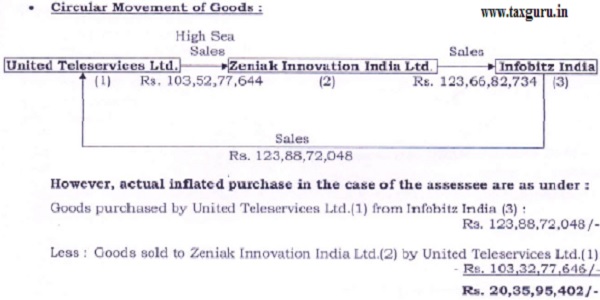
From the above, it is clear that the assessee has accepted that it purchased the same goods which were sold by it. The above discussion in the appellate order has already revealed that the circular transactions of purchase and sales have resulted into inflated purchases in the hands of the assessee company by an amount of Rs. 20,35,94,402/-. It is to be noted that at no point of time, the assessee is denying the same, however, it is taking frivolous explanations to justify its act. In no circumstances bona fides of the assessee company can be established as it was a pre-planned action undertaken by the assessee company. In these circumstances, I do hereby add an amount of Rs.20,35,94,402/- to the income of the assessee. In this case, notice of enhancement has already been given as per Section 251 (2) of the Income Tax Act, 1961 vide letter dated 24.12.2019. Therefore, a total addition of Rs.20,35,94,402/- is hereby made to the income of the assessee.”
13. Assailing the aforesaid action of the Ld. CIT(A) enhancing the addition, the Ld. AR brought to our notice the following facts which were brought to the notice of Ld. CIT(A).
1. United Teleservices Limited sold Gionee Mobile Phone through HSS to Zeniak Innovation India Limited of Rs. 103,52,77,646 (Only Materials Value).
Custom duty paid by Zeniak ‘Innovation India Limited of Rs.15,36,36,925.00
Purchase Price in the books of M/s. Zeniak Innovation India Limited Rs. 118,89,14,571.00
2. Zeniak Innovation India Limited sold to Infobitz India of Rs. 123,66,82,934.00 .
3. Infobitz India sold to United Teleservices Limited of Rs. 123,88,72,048.00.”
14. Our attention was drawn to the following facts which was noted by the Ld. CIT(A) while issuing show cause notice:








