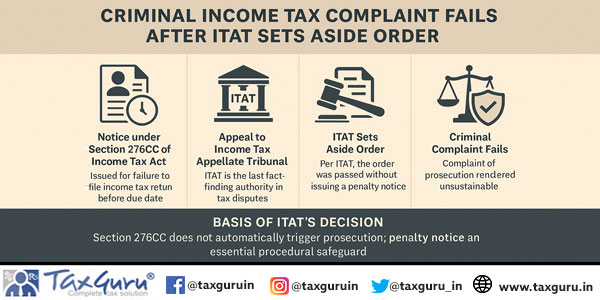
The Criminal Complaints under Sections 276(1), 276D, and 277(1) of the Income Tax Act cannot be sustained when the Assessment Order has been set aside by ITAT for want of incriminating material
Summary: A criminal complaint was filed against a petitioner on January 27, 2016, for alleged tax evasion related to foreign bank accounts at HSBC, Switzerland, for the years 2006-07 and 2008-09. The prosecution’s case was based on unauthenticated documents received from the French government under a Double Taxation Avoidance Agreement (DTAA). The petitioner argued that these documents were unreliable and possibly modified, a claim supported by news reports. The court noted that the documents did not come directly from the Swiss government, raising doubts about their authenticity, and that no prima facie evidence was presented to link the petitioner to the alleged accounts. A raid on the petitioner’s premises also failed to produce any incriminating documents. The court also highlighted that the income tax assessments for those years were initially finalized with a refund issued to the petitioner. The reopening of the cases and the subsequent prosecution relied heavily on the petitioner’s refusal to sign a “Consent Form,” which the court deemed insufficient as proof of undisclosed income. Ultimately, the court found a lack of credible evidence to support the charges of tax evasion, false verification, and non-compliance, leading to the quashing of the criminal complaints.
On 27.01.2016, the Criminal Complaint under Sections 276C(1)(i), 277(1)and 276 (D) IT Act, was instituted against the Petitioner in regard to Income Tax Returns for the years 2006-07 and 2008-09, for willful attempt to evade tax in relation to the alleged Foreign Bank Accounts in HSBC Bank, Switzerland; alleged false verification given while filing original Return of Income; and non-compliance of Notice dated 18.07.2013 wherein the Petitioner was required to sign “the Consent Form” and thereby committed offences punishable there under, respectively.
the source of information is the nonauthenticated documents received from French Government under DTAA. Petitioner has also relied on a photocopy of the News Report dated 01.02.2012, downloaded from the website ‘www.Swissinfo.ch‟and a News Report dated 03.05.2012, published in Nouvel Observateur which stated that the information as received, was stolen and modified and no reliance can be placed upon the said information.
The first significant aspect is that the information about unauthenticated documents was received from French Government and not from the original or primary source, namely the Swiss Government, which casts a doubt on its authenticity. Even no prima facie evidence whatsoever, has been placed on record to establish ownership or linkage of any funds in Foreign Bank Accounts, to the Petitioner. Mere presence of his name in unauthenticated document obtained indirectly through a Foreign Government about alleged Swiss Bank Accounts, does not shift the burden of proof onto the Petitioner to rebut the allegations as mentioned therein.
Moreover, it has been rightly asserted by the Petitioner that the Respondent had sought further information from the Swiss Authorities about the impugned document or the alleged Bank Account, though nothing has been received so far, as is averred in paragraph 9 of the impugned Assessment Order dated 23.03.2015. It cannot be said that it was the responsibility of the Petitioner to verify the correctness of the information received.
Another material aspect is that on the basis of these un-authenticated documents, a raid was conducted in the premises of the Petitioner, but no incriminating document even remotely suggesting existence of foreign Account, was discovered. In the absence of any evidence of there being a concealment of the income or non-disclosure of the complete income for the two Financial Years, it cannot be said that the income Assessment as submitted by the Petitioner, was fraudulent or there was any concealment of true income.
This is an interesting case, where Income Tax Assessment for the financial year 2006-2007 and 2007-2008 not only got finalised, but the excess amount was refunded to the Petitioner on 25.05.2007. The Income Tax Department sought to reopen these ITRs for these two years in January, 2012 on the pretext of having received some unauthenticated documents under DTAA. As already discussed, above in detail, these documents were unproved, unreliable documents, which have even been so held by ITAT in its Order dated 15.02.2018. Therefore, there was no evidence or reason whatsoever to even prima facie establish that there was any evasion of tax punishable under Section 276C(1) of the IT Act.
The entire prosecution rests on non-signing of the Consent Waiver Form. As discussed above in detail, the basis for compelling him to sign the Consent Waiver Form was the unauthenticated information of Swiss Bank Accounts, which has already been discussed to be not justiciable. He has already been penalized under S. 271 (b) for this act. Therefore, no offence is even prima facie disclosed under this S. 276 (D) IT Act.
Non-signing of Consent Waiver Form by no interpretation can be taken as proof of undisclosed income of the Petitioner or considered as evidence to prima facie establishing any case for criminal prosecution against the Petitioner.
The criminal prosecution in the present petition rests solely on these non-existent Bank Accounts. The findings of ITAT also confirms and corroborates that there exist no Facts, no Accounts, no False Statement and no Falsification of Record, which merit the prosecution under Sections 376C(1)(i), 276D and 277(1) of IT Act.
The Respondent has relied upon Sasi Enterprises Vs. Assistant Commissioner of Income Tax (Supra) to contend that the Assessment proceedings are not related to criminal prosecution and therefore, setting aside of the Assessment Order would not have any impact on the prosecution proceedings.
In the light of aforesaid discussion, considering the totality of the circumstances and the absence of any credible or corroborative evidence, the essential ingredients required to attract the provisions of Sections 276(1), 277(1), and 276D of the IT Act, cannot be said to have been established. The Petitions are therefore, allowed and the Two Complaints No536622/2016 and 517460/2016, are hereby quashed