Summary: GST valuation for post-supply discounts is governed strictly by Section 15(3)(b) of the CGST Act, which allows a reduction in taxable value only if the discount was established via a pre-existing agreement linked to specific invoices, and the recipient reverses the corresponding Input Tax Credit (ITC). Failure to meet these dual conditions treats the discount as a financial rebate, offering no GST relief. Historically, the strict pre-agreement clause and the requirement for the supplier to obtain a CA/CMA certificate from the buyer to confirm ITC reversal made compliance challenging and litigation-prone. However, recent reforms indicate a business-friendly shift. The 56th GST Council Meeting (Sep 2025) proposed removing the mandatory pre-agreement condition to simplify post-supply adjustments. Furthermore, Circular 253/10/2025 has withdrawn the cumbersome CA certificate requirement, easing the compliance burden. Businesses must now prioritize clear contract drafting, proper credit note issuance referencing original invoices, and diligent tracking of ITC reversals to maintain compliance and successfully reduce their final GST liability.
- 1. Introduction: Context of GST Valuation
- 2. Key Provisions of Section 15(3)(b)
- 3. Practical Implications for CAs & Businesses
- 4. Challenges in Implementation
- 5. Case Studies & Real-Life Examples
- Textiles
- Healthcare/Pharma
- Hospitality
- Metal Industry
- E-commerce
- 6. Best Practices & Way Forward
- 7. Conclusion: Balancing Flexibility and Compliance
- 8. Sources & References
- 9. Key Takeaways
1. Introduction: Context of GST Valuation
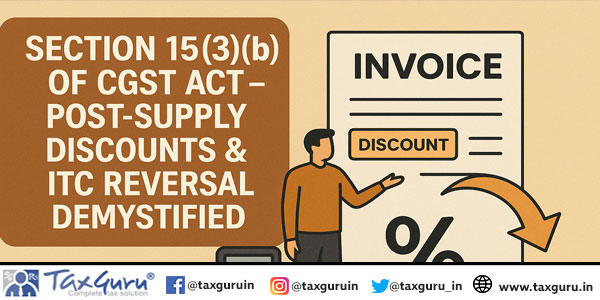
In my opinion, one of the most sensitive aspects under GST is valuation of supply. Section 15 of the CGST Act, 2017 prescribes how to determine taxable value. While certain incidental expenses are compulsorily included, discounts—particularly post-supply discounts—have always been tricky. Section 15(3)(b) specifically governs when such discounts can legally reduce the GST liability.
2. Key Provisions of Section 15(3)(b)
According to my knowledge, Section 15(3)(b) permits exclusion of post-supply discounts from taxable value only if:
1. The discount was established in terms of an agreement made before or at the time of supply and linked to invoices; and
2. The recipient reverses Input Tax Credit (ITC) on the discounted portion.
If both are satisfied, the supplier issues a credit note under Section 34, reducing GST liability, and the recipient reverses ITC proportionately. Otherwise, the discount is treated as a pure financial rebate, with no GST adjustment.
3. Practical Implications for CAs & Businesses
From my experience, Chartered Accountants and advisors should:
- Ensure that discount agreements are properly documented.
- Reconcile ITC reversals with clients’ GSTR-3B returns.
- Separate commercial rebates (non-GST relevant) from eligible Section 15(3)(b) discounts.
Failure to comply could result in GST demands, interest, and litigation.
4. Challenges in Implementation
Historically, businesses faced two major hurdles:
- Strict Pre-condition: The “agreement + invoice linkage” condition was often disputed in audits.
- Compliance Burden: Circular 212/6/2024 required suppliers to obtain a CA/CMA certificate from buyers to prove ITC reversal—an additional cost and hassle.
This made post-supply discount claims cumbersome and litigation-prone.
5. Case Studies & Real-Life Examples
Textiles
A wholesaler exceeding 10,000 units annually gets a 5% year-end rebate. Since pre-agreed, the supplier issues a credit note and both adjust GST.
Healthcare/Pharma
Distributors crossing sales targets receive a 10% rebate. Pre-declared → eligible under Section 15(3)(b).
Hospitality
A hotel chain offers corporates a 15% retroactive discount if room bookings exceed agreed volumes. Linked contract → qualifies for GST adjustment.
Metal Industry
A steel supplier includes a price-protection clause. If market prices drop, refunds via credit notes qualify as post-supply discounts.
E-commerce
Platforms pre-announce commission rebates on festive sale thresholds. Credit notes are issued; sellers reverse ITC proportionately.
6. Best Practices & Way Forward
- Draft clear clauses in supply contracts mentioning rebate schemes.
- Always issue credit notes referencing original invoices.
- Ensure ITC reversal is tracked via reconciliations.
- Latest development: The 56th GST Council (Sep 2025) proposed dropping the pre-agreement condition, making it easier for businesses to adjust post-supply rebates.
- Circular 253/10/2025 has withdrawn the CA certificate requirement, easing compliance further.
7. Conclusion: Balancing Flexibility and Compliance
Section 15(3)(b) continues to be vital for businesses offering incentives, trade discounts, or price protection. While earlier compliance was rigid, recent reforms show a business-friendly shift, aiming to reduce litigation. Still, documentation and ITC reversals remain the backbone of compliance.
8. Sources & References
- Circular No. 212/6/2024-GST (26-06-2024)
- Circular No. 253/10/2025-GST (01-10-2025)
- 56th GST Council meeting – Press Release (05-09-2025)
9. Key Takeaways
√ Discounts reduce taxable value only if ITC is reversed.
√ New GST Council proposal removes pre-agreement condition → simplification ahead.
√ CA certificate requirement withdrawn → lower compliance burden.
*****
Disclaimer: This article is prepared solely for educational purposes. It is based on official press releases, CBIC circulars, and GST Council updates. Readers are advised to cross-check with CBIC notifications before acting. This is not legal or professional advice.