
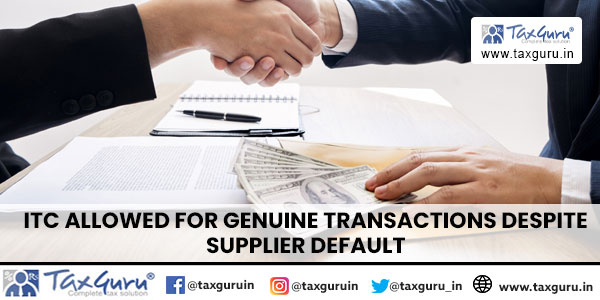
ITC Cannot Be Denied To Recipient In Genuine Transactions Where Supplier Has Defaulted In Payment Or Filing Returns.
Summary: Section 16 of the CGST Act, 2017, imposes restrictions on Input Tax Credit (ITC) claims, leading to challenges for recipients when suppliers default on their GST obligations. Key issues arise from conditions linking ITC to the supplier’s GSTR-1 filing and GST payment, which are often beyond the recipient’s control. While the CBIC has issued clarifications emphasizing that ITC denial should not be automatic, practical challenges persist. Judicial interpretations from the Allahabad, Calcutta, and Madras High Courts generally support buyers, asserting that ITC should not be denied to a genuine purchaser if they have valid invoices, have paid through banking channels, and have received goods or services, even if the supplier defaults. These courts suggest authorities should primarily pursue action against defaulting suppliers. However, the Patna High Court holds a differing view, stressing that ITC is only available when the tax collected by the supplier is remitted to the government, creating a conflicting legal landscape. Until the Supreme Court provides a definitive ruling, the enforcement approach remains varied. This article summarizes the key restrictions on Input Tax Credit (ITC) under Section 16 of the CGST Act, 2017.
Restrictions on ITC under Section 16 of CGST Act: Key Provisions and Legal Perspectives
Section 16(2) of the CGST Act outlines conditions under which a registered person is not entitled to claim ITC, including:
a) Absence of a valid tax invoice, debit note, or other payment documents
b) Supplier not filing GSTR-1 (Outward Supply Statement)
c) Non-receipt of goods or services
d) ITC restricted under Section 38 (as per GSTR-2B)
e) Supplier failing to pay GST
f) Recipient failing to file returns
Among these, conditions (b) and (e) are beyond the recipient’s control, leading to legal and practical issues where buyers are penalized due to supplier defaults. These conditions effectively link the buyer’s ITC entitlement to the compliance behavior of the supplier, which has led to significant legal debate and judicial interpretation.
Practical Challenges
Even if ITC appears in GSTR-2B, buyers often do not verify if suppliers have filed GSTR-3B or paid GST. However, compliance under Section 16(2)(aa) & (c) technically mandates such due diligence, raising the issue of whether ITC can be denied to a recipient who has duly paid tax to the supplier and fulfilled all conditions under Section 16(2)(a), (b), (d), (e), and (f), but is penalized due to default by the supplier in filing returns or paying tax to the government.
CBIC Clarifications
Press Release (18.10.2018): Clarification was issued stating that furnishing of outward details in Form GSTR-1 by the corresponding supplier(s) and the facility to view the same in Form GSTR-2A by the recipient is in the nature of taxpayer facilitation and does not impact the ability of the taxpayer to avail ITC on self-assessment basis in consonance with the provisions of Section 16 of the Act.
Press Release (04.05.2018): Clarification was issued stating that there shall not be any automatic reversal of input tax credit from buyer on non-payment of tax by the seller. In case of default in payment of tax by the seller, recovery shall be made from the seller however, reversal of credit from buyer shall also be an option available with the revenue authorities to address exceptional situations like missing dealer, closure of business by supplier or supplier not having adequate assets etc.
This press release clarification was considered by the Honorable Calcutta High Court in Assistant Commissioner of State Tax v. Suncraft Energy Pvt. Ltd., (2023) case.
Judicial Interpretations: Supportive of Buyers – helpful to Assessee & Practitioners
Issue Involved: – Difference of ITC claimed and credit appearing in GSTR-2A. Sec 16(2)(aa)
Held:
Record shows that the amount of GST charged over the said tax invoices, were paid by recipient through banking channel i.e. by R.T.G.S.
record further shows that for non-discharge of their duties by the selling dealer, the proceedings were initiated against the selling dealer as evident from the letter issued by the Joint Commissioner (Corporate Circle) – II, Commercial Tax, Lucknow.
It is a matter of common knowledge that under the provision of the GST Act, the purchaser cannot compel the selling dealer to deposit the amount of tax realized from the petitioner with the government treasury. (Here sec 16(2)(c) is quashed by the Honourable High court).
the purchasing dealer can also not compel the selling dealer to file the return within stipulated time and deposit the tax collected. The purchasing dealer cannot be left at the mercy of the selling dealer. (Here sec 16(2)(aa) is quashed by the Honourable High court).
When the petitioner has discharged his duties diligently, it is the onus upon the assessing authority to duly communicate about the said fact i.e. the purchase has been made through tax invoices and payments have been made through banking channel and therefore, the authority ought to have counterpart of the selling dealer have initiated action and action has been taken with the benefit ought to have given to the petitioner.
Accordingly, the impugned orders cannot be sustained in the eyes of law and the same are hereby quashed.
Issue Involved: Some of the invoices of the supplier was not reflected in the GSTR 2A of the appellant for the Financial Year 2017-18. Sec 16(2)(aa)
Held:
The ASSISTANT COMMISSIONER, STATE TAX without resorting to any action against the Seller has ignored the tax invoices produced by the buyer as well as the bank statement to substantiate that they have paid the price for the goods and services rendered as well as the tax payable there on. Therefore, before directing the buyer to reverse the input tax credit and remit the same to the government, the ASSISTANT COMMISSIONER, STATE TAX ought to have taken action against the selling dealer.
Order dated 20.02.2023 passed by the Assistant Commissioner, State Tax, Ballygaunge Charge, is set aside with a direction to the appropriate authorities to first proceed against the Seller and only under exceptional circumstance as clarified in the press release dated 4th May, 2018 issued by the Central Board of Indirect Taxes and Customs (CBIC) like missing dealer, closure of business by supplier or supplier not having adequate assets etc., then and then only proceedings can be initiated against the Buyer.
Update:
The State’s SLP before the Hon’ble Supreme Court (14.12.2023) was dismissed. The apex court declined to interfere under Article 136 of the Constitution.
Issue Involved: Supplier did not pay any tax to the Government. Sec 16(2)(c)
Held:
When it has come out that the seller has collected tax from the purchasing dealers, the omission on the part of the seller to remit the tax in question must have been viewed very seriously and strict action ought to have been initiated against him.
According to the State Tax Officer, there was no movement of the goods & buyer had availed input tax credits on the strength of generated invoices. Hence, examination of Seller has become all the more necessary and imperative. When the buyer has insisted on this, I do not understand as to why the respondent did not ensure the presence of Seller, in the enquiry. Thus, the impugned orders suffers from certain fundamental flaws. It has to be quashed for more reasons than one.
- a) Non-examination of Seller in the enquiry
- b) Non-initiation of recovery action against Seller in the first place
Therefore, the impugned orders are quashed and the matters are remitted back to the file of the State Tax Officer. The stage upto the reception of reply from the petitioners herein will hold good. Enquiry alone will have to be held afresh. In the said enquiry, Suppliers have to be examined as witnesses. Parallelly, the State Tax Officer will also initiate recovery action against Suppliers.
Contrary Judicial View
Aastha Enterprises v. State of Bihar [CWJC No. 10395 of 2023, Patna High Court – Dated 18.08.2023]
Held:
the word ‘Input Tax Credit’ itself postulates a situation where the purchasing dealer has a credit in the ledger account maintained by it with the Government. The said credit can only arise when the supplier pays up the tax collected from the purchaser. The mere production of a tax invoice, establishment of the movement of goods and receipt of the same and the consideration having been paid through bank accounts would not enable the Input Tax Credit; unless the credit is available in the ledger account of the purchasing dealer who is an assessee. When the supplier fails to comply with the statutory requirement, the purchasing dealer cannot, without credit in his account claim Input Tax Credit and the remedy available to the purchasing dealer is only to proceed for recovery against the seller.
Conclusion
The prevailing judicial sentiment — particularly from the Allahabad, Madras, and Calcutta High Courts — is clear: ITC should not be denied to a bona fide purchaser solely due to default by the supplier, provided that the buyer has:
- Valid tax invoices
- Paid consideration and tax via banking channels
- Received the goods or services
However, the Patna High Court has taken a divergent view, emphasizing statutory compliance and credit reflection as prerequisites.
In light of these decisions, until the Supreme Court conclusively settles the matter, revenue authorities should proceed against defaulting suppliers first, and consider reversal from the buyer only in exceptional cases, as clarified by CBIC.
R R TIWARI SHAH & Co LLP
CHARTERED ACCOUNTANTS
RAJESH R. TIWARI, FCA (Designated Partner)
DHWANI P. SHAH (Designated Partner)
Contact: – 9870356602 / 7738608848
Email: [email protected]




This is important information, not only favourable but unfavourable verdicts are also given, this helps decision making at the time of assessment. I am sure this will help a lot of taxpayers who have received such notices for ITC reversal.