Sh. Shivam Agarwal Vs Gaursons Realtech Pvt. Ltd. (NAA)
Keeping in view the self-admission of the Respondent in which he has stated that he is liable to pass on the benefit of additional ITC as per the provisions of Section 171 of the above Act, the above projects are required to be investigated as there are sufficient reasons to believe that the Respondent is required to pass on the benefit of additional ITC to the eligible house buyers in respect of the these projects. This Authority cannot refuse to examine and take suo moto cognizance of the benefit of ITC which the Respondent is apparently liable to pass on to the buyers of the above projects as per the provisions of Section 171 (2) of the CGST Act, 2017 once it has been brought to its notice. This is in consonance with the order dated 10.02.2020 passed by the Hon’ble High Court of Delhi in W.P.(C) 969/2020, in the case of M/s Nestle India Ltd. & another v. Union of India & others in which the Hon’ble Court has observed that:-
“We, however, make it clear that this interim order shall not come in the way of the National Anti Profiteering Authority in cases where if has suo moto taken action,” (Emphasis supplied)
Accordingly, the DG AF’ is directed to investigate the issue of passing on the benefit of additional ITC in respect of the above projects and submit his Report in terms of Rule 133 (5) of the CGST Rules, 2017 which reads as under:-
“(5)(a) Notwithstanding anything contained in sub-rule (4), where upon receipt of the report of the Director General of Anti-profiteering referred to in sub-rule (6) of rule 129, the Authority has reasons to befieve that there has been contravention of the provisions of section 171 in respect of goods or services or both other than those covered in the said report, it may, tar reasons to be recorded in writing, within the time limit specified in sub-rule (1), direct the Director General of Anti-profiteering to cause investigation or inquiry with regard to such other goods or services or both, in accordance with the provisions of the At and these rules.
(b) The investigation or enquiry under clause (a) shall be deemed to be a new investigation or enquiry and all the provisions of rule 129 shall mutatis mutandis apply to such investigation or enquiry.”
It has also been observed from the record that vide Report dated 23.10.2018 furnished under Rule 129 (6) it was submitted by the DGAP that the complaint filed by the Applicant No. 1 was not covered under the anti-profiteering measures. However, when this Authority had directed to reinvestigate the case vide its order dated 28.03.2019 the Respondent has been found liable for profiteering to the extent of Rs. 19,72,09,203/-. Therefore, it would he appropriate for the investigation team of the office of DGAP to be careful in future while carrying out investigation in all such cases.
This Authority (NAA) as per Rule 136 of the CGST Rules 2017 directs the Commissioners of CGST/SCST Uttar Pradesh to monitor this order under the supervision of the DGAP by ensuring that the amount profiteered by the Respondent as ordered by the Authority is passed on to all the eligible buyers, A report in compliance of this order shall be submitted to this Authority by the Commissioners CGST/SGST through the DGAP within a period of 4 months from the date of receipt of this order.
FULL TEXT OF ORDER OF NATIONAL ANTI-PROFITEERING APPELLATE AUTHORITY
1. The investigation Report dated 23.10.2018 was received from the Applicant No. 2, the Director General of Anti-Profiteering (DGAP) under Rule 129 (6) of the Central Goods & Service Tax (CGST) Rules, 2017. The brief facts of the case were that the Utter Pradesh State Screening Committee on Anti-profiteering had forwarded an application filed by the Applicant No. 1 to the Standing Committee on Anti-profiteering under Rule 128 (2) of the CGST Rules, 2017, as per the minutes of its meeting held on 25.04.2018. The above Applicant had alleged in his application that the Respondent had resorted to profiteering, While he had sold flat No. F-11.49 in his project “16th Park View”, situated in Sector-19A, Yamuna Express Way, Jaypee Green Sports City (East), Land Parcel, Mirzapur, Greater Noida to him. The above Applicant had also alleged that the Respondent had charged GST @ 12% from him on the consideration paid by him before the GST had come into force w e.f. 01.07.2017. He had further alleged that he had paid the full amount for the purchased flat or or before 30.06.2017 i.e. before the implementation of the GST and got the demand letter on 02.07,2017 in which no GST was charged on the consideration paid before 01.07,2017, but later on, in July 2017, the Respondent had raised demand for payment of GST @ 12% from him on the amount paid prior to the imposition of the GST. Along with the application, the Applicant had submitted the following documents:-
(i) Duly filled in Form APAF-1.
(ii) Clarification about applicability of GST on under construction and ready-to-move-in property issued by the CBEC
(iii) Applicant’s Ledger in the books of M/s Gaursons.
(iv) Correspondence of Applicant with M/s Gaursons through e-mail.
(v) Progress report of the project “16th Park View”.
2. The complaint lodged by the above Applicant was examined by the Standing Committee on Anti-profiteering in its meetings held on 07.08.2018 and 08.08.2018 and it was decided to forward the same to the DGAP to conduct a detailed investigation.
3. While submitting the above Report the DGAP in paras 4 to 6 of the Report had stated that:-
“4. On scrutiny of the documents received from the Standing Committee on Anti-profiteering, it is observed that the Uttar Pradesh State Screening Committee has stated that in the subject case, the benefit of input tax credit had not been passed on by the Respondent, however a perusal of the application revealed that the applicant had alleged that the Respondent had charged GST on the amount paid by him prior to GST, thus there was no allegation that the benefit of input tax credit was not passed on.
5. Further the applicant relied on a clarification about applicability of GST on under construction and ready-to-move-in property issued by CBEC which says that no GST is payable on such properly, if the entire consideration has been paid to the builder before 1st July, 2017 and such transaction would attract Service Tax as per the Point of Taxation Rules, 2011 applicable to Service Tax, which is further confirmed from an advertisement issued by Central Board of Indirect Taxes and Customs http ://wwvv.cbic.gov.in/resources//htdocscbec/gst/GST on commercial properties), where the invoice was raised or payment was made prior to the appointed date under GST, the point of taxation arose before the appointed day (01.07.2017) and, such transaction would attract Service Tax and not GST.
6. It is clear from the documents submitted that M/s Gaursons raised the cost of the flat from Rs, 2878,4251- (including taxes) to Rs. 30,62,7001- (including taxes) after implementation of GST by charging extra sum of Rs. 1,84,275/- and this increment is on account of a demand for GST on the payment received from the applicant prior to implementation of GST. Section 171 of the COST, 2017 in as much the provisions of Section 171 comes into play in the event, there is a reduction in the rate of tax or there is an increase in the benefrt of input tax credit. The charging of GST is by itself outside the framework of the said section 171. Therefore, the grievances of the Applicant could not be redressed through anti-profiteering provisions. However, this issue of charging of GST can be examined by the jurisdictional GST authorities:
4. The above Report was considered by this Authority in its sitting held on 30,10.20’8 and since the allegation of the above Applicant was not found to be maintainable by the DGAP it was decided to hear the Applicants on 29.11,2018, Sh, Shivam Agarwal the Applicant No 1 was present in person along with his Counsel Sh. Prabhat Kaushik and the DGAP was represented by Smt, Gayatri, Deputy Commissioner. The Applicant No 1 had stated during the hearing that the Respondent had not given the benefit of ITC to him which the Respondent had availed w.e.f. 01.07.2017. He had also submitted copy of the demand letter dated 17.07.2017 which showed that the Respondent had informed the above Applicant that his instalments were due on 21.07.2017 i.e. after coming in to force of the GST due to which it prima facia appeared that the above Applicant was entitled to the benefit of Mc He had also submitted a copy of the letter dated 23.04.2018 written by the Additional Commissioner, Commercial Taxes, Govt. of Uttar Pradesh, Lucknow to the Commissioner COST, Lucknow which showed that after thorough enquiry the Additional Commissioner had found that the Respondent had claimed benefit of ITC through the TRAN-1 statements as well as the regular GSTR-3B Returns however. 1-e had riot passed on the benefit of ITC to the recipients. Based an the above evidence it was decided to call the Respondent to explain whether the above Applicant was entitled to the benelit of ITC cr nat. Accordingly further hearings were held on 12.12.2018 and 19.12.2018. where the Respondent was represented by Sh. Ajay Sharma, Chartered Accountant, while the Applicant No, 1 was present in person along with Sh. Prabhat Kaushik, Advocate and the DAP eras represented by Smt. Gayatri, Deputy Commissioner.
5. The Respondent vide his submissions dated 19.12.2019 had stated that the flat had been booked on 06.06.2017 and the booking amount of Rs. 2,85.285/-, due on the same day was paid by the above Applicant are 2 instalments of Rs. 21,000/- and Rs. 2,64,285/‑ on 26th June & 30th June, 2017_ The Respondent had also stated that the cheque issued for payment of Rs. 21,000/- was dishonoured and hence it was realised in the month of July on which GST was collected as per the transitional provisions contained in section 139 to 142 of the CGST Act, 2017. The Respondent had also quoted the provisions 04 Section 142 (11) (C) of the CGST Act 2017. in his support_ Referring to the provisions of Section 171 of the CGST Act 2017, the Respondent had further stated that all his customers including the above Applicant were informed through e-mail dated 31.07_2017 that the benefit of ITC would be passed on and the quantum of the benefit the to the introduction of the GST was also mentioned in these communications The Respondent had also submitted copy of the e-mail dated 18.12,2017 addressed to the Applicant No. 1 in which he was informed that he would be paid ITC benefit of 4% and he would have to pay balance 8% GST.
6. The Applicant No. 1 vide his written submissions dated 22.1.2017 had submitted that the cheque was dishonoured due to mentioning of incorrect date and not on account of insufficient balance hence question of collecting GST did not arise. He had also submitted that the demand letter dated 02.07.2017 issued by the Respondent mentioned only the Service Tax and not the GST. The above Applicant had further submitted that since the GST 012% was collected on the last instalmeht the benefit of ITC should have been passea on to him He had also contended that only 8% GST was collected from him by the Respondent by adjusting 4% tax as the net ITC benefit, however, he questioned the justification for passing on only 4% as no calculations were provided to him.
7. This Authority vide its order dated 17.01.2019 had asked the DGAP to file reply to the submissions made by the Respondent however, no specific reply on each issue raised by the Applicant was filed by the DGAP on the ground that all the issues/documents enclosed therein hod been covered in his Report dated 23,10.2018. The DGAP was also asked to file his reply vide order dated 22.01 2019 on the submissions of the above Applicant dated 22.01,2019 and vide his Report dated 30.01.2019 the DOAP had stated that as per the Point of Taxation Rules, 2011, applicable to the Service Tax “where the invoice was raised or payment WM received prior to the appointed date under GST (01.07.2017), the point of taxation would afise before the appointed day and thus, such transaction would attract Service Tax and not GST”. The DGAP had also quoted the provisions of Sections 142 (11) (c), 13 (2) and 31 of the COST Act, 2017 in his support. The Report had also mentioned that based on the above provisions of the Act since the Respondent had issued the tax invoice on 21.07.2017 which was the due date of payment as per the contract and as per Section 13 (2) (a), the time of supply of service was the date of receipt of payment, i.e. 30,061017 in the present case.
8. During these hearings the Respondent vide his submissions dated 04,02.2019 also submitted that as per the recommendation of the CREDAI he had already passed on the benefit of ITC @ 4% in respect of the completed projects and 6% in respect of the on going projects. Vide his submissions dated 11.021019, 27.02.2019 & 14.03.2019 he had filed details of the projects being executed by him and admitted that he had already passed on the ITC benefit of Rs. 19,71,96,462/- in the case of the Project “16th Park View” by crediting it into the ledgers of all the buyers including the above Applicant. The Respondent had also admitted that he had already passed on the ITC benefit of Rs. 1,63,18,191/- in case of the project “2nd Park View” and Rs. 1,54,05,5321- in case of the project ‘GYC Galleria”. The Respondent had further admitted that in total he had passed on an amount of Rs. 22,89,20,185/- as benefit of ITC to the buyers of the flats. The Respondent had further admitted that he had passed on the benefit of ITC, as per the directions of the CREDAI, ranging from 4% to 6% of the installments pending after implementation of GST in respect of all his projects that were in progress.
9. This Authority had carefully considered the DGAP’s Reports, the Applicant’s submissions, the Respondent’s detailed submissions and the documents placed on record and found that the Uttar Pradesh Screening Committee had made the following recommendation to the DGAP in its meeting held on 25.04.2018:-
(i) The complainant had informed that he had booked the fiat under construction linked project in 16th Park View sector-19 A, J P Green Sport City (East), Yamuna Express way, Greater Noida, Gautambudh Nagar, UP, on 06.06.2017. The cost of flat (was) Rs. 28,52,850/- including ST @ 4.5% before implementation of GST. The builder after implementation of GST has increased price of the flat and is asking for Rs. 30,37,700/- (inclusive of GST 12% instead of earlier price of Rs. 28,52,850/- (inclusive of GST @ 12% instead of earlier price of Rs. 28,52,850/- (inclusive of ST @4.5%) but is not passing the benefit of input tax credit taken by him.
(ii) The report received from office of the Additional commissioner, HQ Lucknow in this regard along with the documentary evidences viz. GSTR- 3B and Tran-1 form filled by the builder was perused and it was found that the builder had taken ITC in all the GSTR-3B (From July’ 2017 to January’ 2018) returns (copy enclosed i and utilized it for payment of GST Therefore, the contention of the complainant that benefit of ITC was not passed on to him prima-facie appears to be correct.
(iii) it has also been noticed that the builder has made payments for his tax liabilities pertaining to reverse charge by cash as per the current legal provisions and has utilized it for payment of his liabilities of GST on his outward supplies. No other payment of taxes has been made through the cash ledger.”
10. It was absolutely clear from the perusal of pars (ii) above that the recommendation of the Uttar Pradesh Screening Committee made to the Standing Committee for investigation in to the complaint lodged by the Applicant No. 1 was based on the report of the Additional Commissioner SGST, HQ Lucknow in which the documentary evidence of GSTR-3B Returns and TRAN-1 Statements was duly relied upon, copies of which were also supplied to the DAP and it was specifically recorded by the above Committee that the Respondent had availed ITC but had not passed on the benefit of ITC to the above Applicant. However, in spite of the documentary evidence the ‘MAP had chosen not to examine the Applicant and had summarily rejected his claim against all cannons of natural justice by stating in pars 4 of his Report dated 23.10.2018 that “a perusal of the application revealed that the applicant had alleged that the Respondent had charged GST on the amount paid by him prior to GST, thus there was no allegation that the benefit of input tax credit was not passed on.” The DGAP had also not examined the Additional Commissioner, SGST, HQ Lucknow. Once the Screening as well as the Standing Committee had recommended investigation on the complaint filed by the above Applicant as per the provisions of Rule 128 of the CGST Rules, 2017 the DGAP was bound to initiate investigation to ascertain the truth of the allegation as per Rule 129 (2) of the above Rules.. Perusal of the summary of the complaint attached with the APAF-1 form enclosed as Annexure by the DGAP revealed that the above Applicant had made specific prayer stating that 1 kindly request Anti-Profiteering Committee to take strongest action against such company who are not passing the benefit of GST but taking advantage of the same.’ which showed that the contention of the DGAP that no complaint for passing on the benefit of ITC was made was not correct as passing of benefit of GST included passing on the benefit of ITC.
11. During the course of the hearings it was also revealed that the Respondent had himself admitted that the Applicant No. 1 was entitled to the benefit of ITC and he had already passed en the same to him @ 4%, He had also admitted that he had already passed on the ITC benefit of Rs. 19,71,96,462/- in case of the project “16th Park View” to all his customers in which the above Applicant had also purchased a flat. The Respondent had further admitted that he had also passed on the benefit of Rs. 1,63,18,191/- in case of the project “2nd Park View” and Rs. 1,54,05,532/- in respect of the project “GYC Galleria”. The Respondent had also acknowledged that in total he had passed on an amount of Rs. 22,89,20.185/- as benefit of ITC to the buyers of the flats. The Respondent had also submitted that he had 33 (Thirty Three) more projects in the brand name of “Gaur” Where h e has already passed on the commensurate ITC benefit to the tlat buyers. List of all these projects along with percentage of ITC benefit claimed to have been passed on by the Respondent was submitted as is given below:-
Table-‘A’
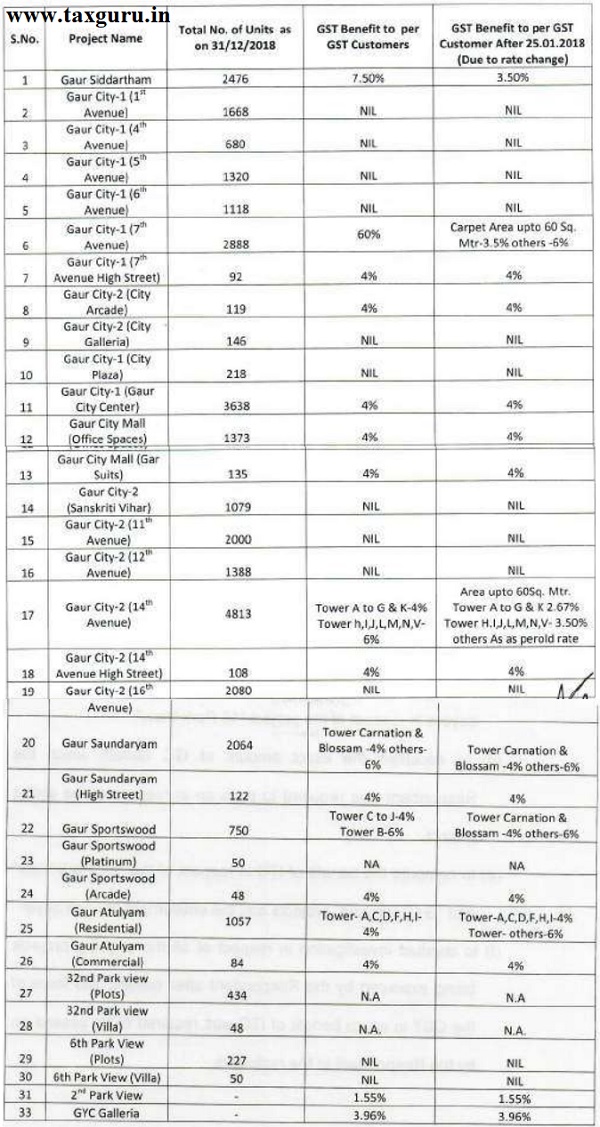
Therefore, there was sufficient evidence to conclude that the above Applicant as well other flat buyers were entitled to be given the benefit of ITC availed by the Respondent the exact quantum of which needed to be computed and passed on.
12. In view of the above tracts, this Authority vide its order dated 28.03,2019 had directed the DGAP under Rule 133 (4) of the CGST Rules, 2017:-
(a) to conduct thorough investigation on all the relevant aspects of the present complaint after affording opportunity to the Applicant No. 1.
(b) to compute the ITC benefit to be passed on by the Respondent to the above Applicant.
(c) to calculate the benefit of ITC to be passed on to the other flat buyers in respect of the project ”16 Park View”.
(d) to ascertain the exact amount of ITC benefit which the Respondent was required to pass on in respect of the above project.
(e) to compute the benefit of ITC in respect of the “2”d Park View’ and “GYC Galleria’ projects and the entitlement of each buyer.
(f) to conduct investigation in respect of all the ongoing projects being executed by the Respondent after coming into force of the GST in which benefit of ITC was required to be passed on by the Respondent to the recipients.
13. The DGAP has accordingly, re-investigated the case and submitted his Report dated 10.12.2019 to this Authority on 11.12.2019.
14. The DGAP has stated that this Authority vide Order No. 03/2019 dated 28.03.2019 has referred the matter back to him under Rule 133 (4) of the Rules, to conduct thorough investigation on all the relevant aspects of the present complaint and to compute ITC benefit to be passed on by the Respondent to the Applicant No. 1 as well as other buyers in respect of project “16 Park View” Further this Authority has also directed to compute the benefit of ITC in respect of the “2nd Park View’ and “GYC Galeria” projects and also to conduct investigation in respect of all the ongoing projects of the Respondent after corning in to force of the GST in which the benefit of ITC was required to be passed on by the Respondent.
15. The DGAP has also stated that on receipt of the matter from this Authority, it was decided to initiate investigation in respect of project “16th Park Viola” only and not in respect of the other projects in the absence of any allegation of profiteering in respect of the other Projects. In order to colrect evidence necessary to determine whether the benefit of ITC has been passed on by the Respondent to the above Applicant in respect of the construction service supplied by the Respondent in the project “16th Park View”, a Notice under Rule 129 (3) of the COST Rules, 2017 was issued by the DGAP on 24.04.2019, calling upon the Respondent to reply as to whether he admitted that the benefit of ITC has riot been passed on to the above Applicant by may of commensurate reduction in price and if so, to suo moto determine the quantum thereof and indicate the same in his reply to the Notice as well as to furnish all the supporting documents. Further, in the said Notice dated 24.042019, the Respondent was afforded an opportunity to inspect the non-confidential evidence/information submitted by the Applicant No. 1 during the period from 29.04.2019 to 01.05.2019. However, the Respondent did not avail of the said opportunity, The DGAP has also stated that vide e-mail dated 19.09.2019, the above Applicant was also given an opportunity to inspect the non-confidential documents/reply furnished by the Respondent on 25.09.2019 or 26,09,2019 which the Applicant did not avail of. The DGAP has further stated that the period covered by the current investigation was from 01.07 2017 to 31.03,2019.
16. The DGAP has also intimated that the Respondent has submitted his replies to the Notice dated 24.04.2019 and further reminders, vide letters/e-mails dated 06.05.2019, 20.05.2019, 10.06.2019, 19.09.2019, 20.09.2019, 25.10.2019 and 08.11.2019. The replies of the Respondent were summed up by the DAP as follows:-
(i) That the Respondent had passed on the benefit of ITC in the following manner:
(a) Units sold in pre-GST period: 4% for completed tower and 6% for incomplete tower by way of issue of credit notes at the time of the issuance of the demand notes.
(b) Units soul Post-GST introduction: % upfront on the total booking price (i.e. sale price) at the time of the booking of the unit, The same had also been communicated to the customer at the time of booking and accounted in the booking form by name of GST discount.
(C) That he had not applied any calculation for the allocation of the above benefit However, the benefit passed or committed to be passed on was in compliance of the guidelines issued by the CREDAI (Confederation of Real Estate Developers Association of India). Further these benefits have been passed irrespective of the increase in cost by whatsoever reason and any consideration to the incremental ITC. Even going by the various calculations made during the course of the proceedings before this Authority, the benefit of ITC actually passed on by the Respondent was more than the earned ITC benefit due to introduction of the GST.
(d) That the provisions of the Section 171 of the CGST Act, 2017 have ignored certain aspects which might arise till the completion of the project. There were various instances when the Respondent could lose the ITC in future due to various reasons or events, Therefore, any such contingencies and situations which led to the reduction/reversal/loss of credit in GST would resultantly cause an impact on the GST credit already passed/liable to be passed on. Sonic of the circumstances are mentioned below:-
(a) Reversal of ITC in future due to receipt of Completion Certificate.
(b) Overflow of ITC at the end of the Project etc.
Therefore, such critical factors needed to be given appropriate weightage and the Respondent should be allowed to make the final computation at the end of the project
17, The DGAP has also stated that apart from the above, during the personal hearing held before this Authority, the Respondent has also submitted the following:
(i) That he was incorporated under the Companies Act, 1956 and was working in the Real Estate Sector including construction of residential and commercial complexes.
(ii) That the real estate industry was a complex business in terms of the involvement of the goods & services. Therefore, it was also a complex job to identify the benefit out of anti-profiteering measures. In addition, there was no methodology (clear or unclear) provided under the GST law, how to proceed for the calculations of the benefits and their distribution. The problem gets aggravated clue to the complexities in real-estate and construction contracts where the prices were fixed prior to implementation of GST and where a portion of work was pending to be executed as on that date.
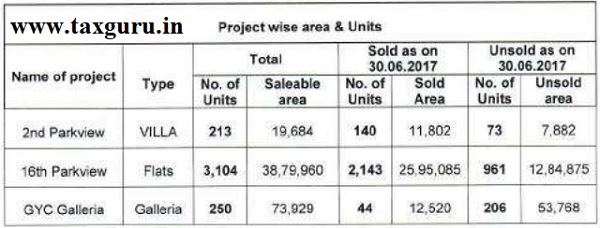
iii. That the details of various projects undertaken by the Respondent under this GST Registration No, were furnished as is given in Table- ‘B’ below:-
Table- ‘B’
(iv) That in the Pre-GST regime, works contracts were liable to pay VAT in respective states and most were also liable to payment of Service Tax. However due to legal restriction the VAT paid was not eligible for claiming ITC. In addition to it, the material used in the construction was liable to Excise Duty in the Pre-GST regime, the ITC of which was not allowed to the builders.
However, after introduction of the GST, all taxes on the goods & services have been subsumed in the GU and inputs have to be purchased by paying GST. Further credit has been Mowed by the CST law on the taxes charged on the purchases of goods & services, The credit r goods which was not allowed in the Pre GST regime has become eligible in the GST regime
(v) That the projected material cost as on date has been analysed by the Respondent for the remaining construction which would be Rs. 70.00 Crore approximately on which tax credit has been projected as Rs. 9.81 Crore (approximately). The same has been considered for the analysis of the benefit arising due to the GST even the same contingent and has riot actually accrued till date.
(vi) That during the course of the implementation of the GST, the demand has decreased and it was at all-time low, The same was due to various reasons including introduction of the GST as a key reason. To address this issue, various brokers have been appointed by the Respondent to revive his plunged sales. The appointment of the brokers has caused rise in the cost due to commission.
(vii) That the project has been delayed due to some unusual reasons i.e. agitation by the farmers. therefore: interest cost hats increased due to delay in demand. The implementation and compliance cost has also gone up due to implementation of the GST and the Real Estate (Regulation and Development) Act, 2016.
(viii) That the calculation of benefit of ITC post introduction of GST and its distribution was a critical and complex task for the Respondent and the industry Further, due to lack of availability of mechanism and regulation for identification of profiteering, industry as a whole was unable to calculate the effect of the benefit due to implementation of the GST, because it was a meticulous and difficult exercise to determine the quantum of benefit specifically in case of B2C supplies.
(ix) That in the real estate industry in which the Respondent was operating had no evidence of any rate reduction due to introduction of the In respect of the benefit of ITC, the Respondent has passed on the benefit on adhoc basis in line with the guidelines issued by the CREDAI and that benefit was more than the benefit actually accrued.
(x) That the transitional credit has been taken in respect of the stock of the inputs and the built in material for the unsold stock, as per section 140 (3) of the Act The unsold units were only in the stock ideally; therefore, the credit in respect of the unsold units had been taken as semi-finished goods or finished goods in the stock. Respondent has further contended that this transitional credit of the built in material had been questioned by the GST Audit Commissionerate, Ghaziabad vide letter dated 02.08.2018, which has been replied by the letter dated 04.09.2018 by the Respondent. Therefore, there was high risk on the apparent admissibility and eligibility of the transitional credit as it was under litigation as on date and even in the face of the litigation on the transitional credit, he has passed it on to the customers.
(xi) That after application of the above said mechanism the final result after allocation of the due benefit was lesser than what actually has been passed on by the respondent upon the advice of CREDAI, the calculation of working has been provided in Table-‘C’ below‑
Table-‘C’
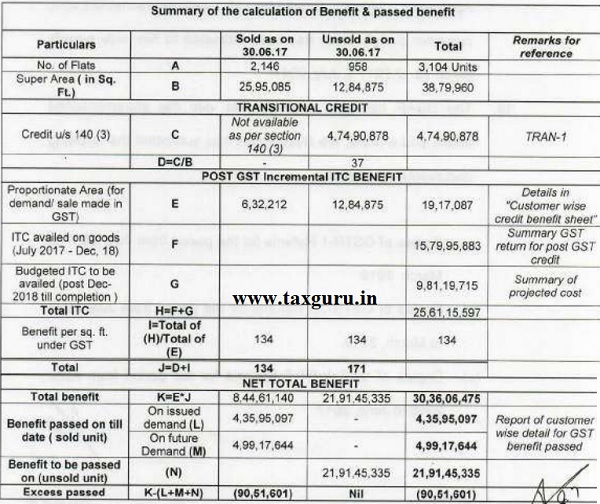
It was further submitted by the Respondent that distribution of the benefit in accordance with the advisory issued b the CREDAI had gone beyond the actual benefit which was earned proportionate to the demand raised in GST era, Therefore, there was no question of not complying with section 171 of the CGST Act i.e. the Anti-profiteering measures, However, the Respondent was obliged to reconsider these benefits at the completion of the project and would make adjustments accordingly.
(xii) That the benefit or 4% of basic amount of the demand with charging of tax on the instalments due post-GST has been passed on to the above Applicant which has been reflected in the Applicant’s ledger (available at www.gaursonsindia.com customer portal) which has been intimated to him vide e-mails dated 18.12.2017 & July, 2017.
18. The DGAP has also Informed that vide the aforementioned letters and e-mails, the Respondent has submitted the following docurnents/information:-
(a) Copies of GSTIR-1 Returns for the period from July, 2017 to March, 2019.
(b) Copies of GSTR-3B Returns for the period from July, 2017 to March, 2019,
(c) Copies of VAT & ST-3 Returns for the period from April 2016 to June, 2017,
(d) Copies of all demand letters and sale agreement/contract issued in the name of the Applicant.
(e) Details of applicable tax rates, pre-GST and post-GST.
(f) Copies of Balance Sheets (including all annexures and profit & loss account) for FY 2016-17 & FY 2017-18,
(g) Copy of Electronic Credit Ledger for the period from 01.07.2017 to 31.03.2019.
(h) CENVAT Credit/Input Tax Credit ledgers for the period from April, 2016 to March, 2019.
(i) List of home buyers in the project ‘”16th Park View” along with the customer wis details of benefit passed on.
19. The DGAP has also stated that the Respondent has claimed confidentiality of all the data/ information furnished by him, in terms of Rule 130 of the Rules except the detail (information related to the above Applicant like booking ledgers or demand/credit notes raised on him.
20. The DGAP has further stated that he has carefully examined the order received from this Authority, the various replies of the Respondent and the documents/evidence on record and found that the main issues for determination were whether there was benefit of reduction In the rate of tax or ITC on the supply of construction service by the Respondent, on introduction of GST w.e.f. 01.07.2017 and if so, whether such benefit was passed on by the Respondent to the recipients, in terms of Section 171 of the CGST Act, 2017.
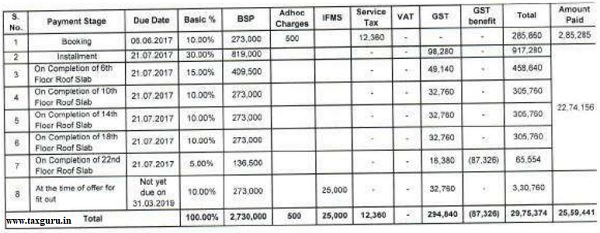
21. The DGAP has also submitted that the Respondent, vide his letter dated 20.05.2019, has submitted a copy of the allotment letter dated 19.06.2017, application form and demand letters for the sale of Flat No. F-1149 to the above Applicant, measuring 1,000 sq. ft, at total basic sale price of Rs. 27,55,500/- (Rs. 2.730/- basic sale price per sq. ft.) and Rs. 500/- for Adhoc Charges, and Rs. 25000/- for IFMS The details of the amounts and taxes paid by the above Applicant to the Respondent have been furnished by the DGAP as is given in Table-‘D’ below:-
Table-‘D’
(Amount in Rs.)
22. The DGAP has further submitted that before enquiring into the allegation of profiteering it was important to examine Section 171 of CGST Act, 2017 which governed the anti-profiteering provisions under GST. Section 171 (1) reads as “Any reduction in cafe of tax on any supply of goods or services or the benefit of ITC shall be passed on to the recipient by way of commensurate reduction in prices.” Thus, the legal requirement was abundantly clear that in the evening a benefit of IT or reduction in the rate of tax, there must be a commensurate reduction in the prices of the goods or services. Such reduction could obviously be in money terms only, so that the final price payable by a consumer got reduced. This was the legally prescribed mechanism for passing on the benefit of ITC or reduction in the rate of to to the consumers under the GST regime. Moreover, rt was also clear that the said Section 171 simply did not provide a supplier of goods or services, any other means of passing on the benefit of ITC or reduction in the rate of tax to the consumers. Thus, the legal position was unambiguous and could be summed up as follows:-
(a) That a supplier of goods or services must pass on the benefit of ITC or reduction in the rate of tax to the recipients by commensurate reduction in prices.
(b) That the law did not offer a supplier of goods and services any flexibility to suo moto decide on any other modality to pass on the benefit of ITC or reduction in rate of tax to the recipients.
Therefore. in terms of Section 171 of the CGST Act, 2017, the claim of increase in the cost on account of increase in commission. increase in interest cost (due to agitation by farmers) and the implementation and compliance cost of GST & RERA could not be considered,
23. The DGAP has also observed that the contention of the Respondent that he would compute the benefit on account of ITC of GST in respect of the project. at the end of the project after making necessary adjustments on account of various contingencies and situation which lead to the reduction/reversal/loss of credit in GST future. might have merit but the profiteering, if any, had to be determined at a given point of time. Therefore, the additional ITC available to the Respondent and the amounts received by him from the above Applicant and other recipients post implementation of GST, had to be taken into account to determine the benefit of ITC that was required to be passed on.
24. The DGAP has also claimed that pars 5 of Schedule-III of the CGST Act 2017 (Activities or Transactions which shall be treated neither as a supply of goods nor a supply of services) reads as “Sale of land and, subject to clause (b) of paragraph 5 of Schedule If, sale of building”. Further, clause (b) of Paragraph 5 of Schedule II of the CGST Act. 2017 reads as (b) construction of a complex, building, civil structure or a part thereof, including a complex or building intended for sale to a buyer, wholly or partly, except where the entire consideration had been received after issuance of completion certificate, where required, by the competent authority or after his first occupation, whichever was earlier.” Thus, the ITC pertaining to the residential units which were under construction but not sold was provisional ITC which might be required to be reversed by the Respondent, if such units remained unsold at the time of issue of the completion certificate, in terms of Section 17(2) & Section 17(3) of the CGST Act, 2017, which read as under:-
Section 17 (2) “Where the goods or services or both was used by the registered person partly for effecting taxable supplies including zero-rated supplies wider this Act or under the Integrated Goods and Services Tax Act and partly for effecting exempted supplies under the said Acts, the amount of credit shall be restricted to so much of the input tax as was attributable to the said taxable supplies including zero-rated supplies”,
Section 17 (3) ‘The value of exempted supply under sub-section (2) shall be such as might be prescribed and shall include supplies on which the recipient was liable to pay tax on reverse charge basis, transactions in securities, sale of land and subject to clause (b) of paragraph 5 of Schedule sale of building”,
Therefore, the DGAP has further claimed that the ITC pertaining to the unsold units might not fall within the ambit of his investigation and the Respondent was required to recalibrate the selling prices of such units to be sold to the prospective buyers by considering the net benefit of additional ITC available to him post-CST,
25. The DGAP has also contended that the Respondent had claimed in his letter submitted to this Authority during the hearing held on 27.02.2019 that he had passed cm the ITC benefit to his customers 4%-6% including benefit of 4% to the Applicant No. 1, The DGAP has also submitted that it was seen and verified from the Applicants Ledger furnished as a part of the Respondent’s letter dated 20.05.2019 that the Respondent has passed on the benefit of Rs. 87.326/- to the above Applicant vide credit note No. CN16/01254/17-18 dated 09.10.2017. However, the correctness of the amount of benefit so passed on by the Respondent had to be determined in terms of Section 171 of the CGST Act, 2017 and the Rules made thereunder. Therefore. the ITC aveilble to the Respondent and the taxable amount received by him From the above Applicant and other recipients, post implementation of GST, had to be taken irrto account for determining the benefit of ITC required to be passed on.
26. The DGAP has also stated that as regards the allegation of profiteering, it was observed that prior to 01.07.2017 i.e. before the GST was introduced, the Respondent eras eligible to avail credit of Service Tax paid on input services only (no credit was available in respect of Central Excise Duty paid on the inputs) and also ITC of VAT paid on inputs was not available to him. Further, Post-GST the Respondent could avail ITC of GST paid on all the inputs and the input services including the sub-contracts. From the information submitted by the Respondent for the period from April. 2 016 to March, 2019, the details of the ITC availed by him, his turnover from the impugned project “16 Park View”, the ratios of ITC to turnovers, during the pre-OST (April, 2016 to June: 2017) and post-CST (July, 2017 to March, 2019) periods, have been furnished by the DGAID as is given in the Table-‘E’ below:-
Table-“E”
(Amount in Rs.)
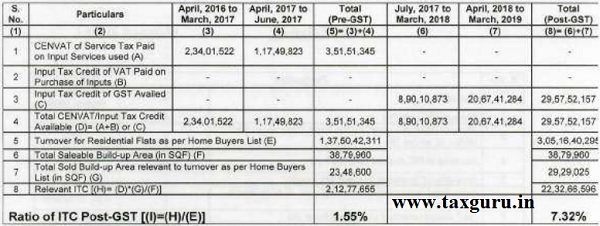
27. From the Table-‘E’, the DAP has submitted that the ITC as a percentage of the turnover that was available to the Respondent during the pre-GST period April, 2016 to June, 2017) was 1.55% and during the post-GST period (July, 2017 to March, 2019), it was 7.32%. This clearly confirmed that post- GST, the Respondent has benefited from additional ITC to the tune of 5.77% [7.32%(-)1.55%] of the turnover. Accordingly, the profiteering has been examined by comparing the applicable tax rate and ITC available in the pre-GST period (April, 2016 to June, 2017) when Service Tax @4.50% was payable with the post-GST period (July, 2017 to March, 2019) when the effective GST rate was 12% (GST @18% (along with 1/3rd abatement for land value) on construction service, vide Notification No. 11/2017-Central Tax (Rate), dated 28.06.2017. Accordingly, an the basis the figures contained in Table-E above, the comparative figures of the ratios of ITC availed/available to the turnover in the pre-GST and post-GST periods as well as the turnover, the recalibrated base price and the excess realization (profiteering) during the post-GST period, has been tabulated by the DGAP as has bean given in Table- P below:-
Table-‘F’
(Amount in Rs.)
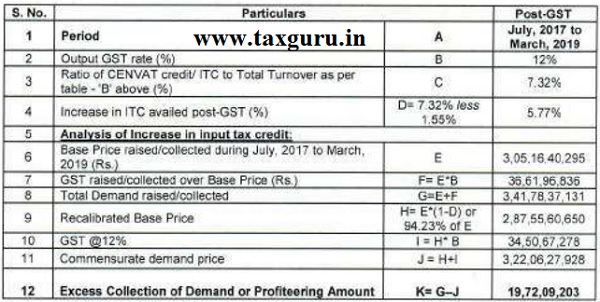
From Table-‘F’ above, the DGAP has submitted that the additional ITC of 5.77% of the turnover should have resulted in the commensurate reduction in the base prices as well as cum-tax prices of the flats Therefore, in terms of Section 171 of the CGST Act, 2017, the benefit of such additional ITC was required to be passed on by the Respondent to the respective recipients.
28. The CLAP has also averred that on the basis of the aforesaid CENVAT/input tax credit availability in the pre and the post-GST periods ar-d the details of the amount collected by the Respondent from the Applicant No. 1 and other home buyers during the period from 01.07.2017 to 31.03.2019, the amount of benefit of ITC that needed to be passed on by the Respondent to the recipients, came to Rs. 19,72,09,2031- which included 12% GST on the base profiteered amount of Rs, 17,60,79,645/-. The home buyer and unit no, wise break-up of this amount has been given in Annexure-14 of the DGAP’s Report dated 06.12,2019. This amount was inclusive of Rs. 1,41,139/- (including GST on the base profiteered amount of Rs, 1,26,017/-) which was the benefit of ITC required to be passed on to the above Applicant, who has been mentioned at serial no 219 of Annexure-14.
29. The DGAP has further averred that the above computation of profiteering was with respect to 2,349 home buyers, whereas the Respondent has booked 2,809 units till 31.03.2019. 460 customers who have booked the flats and also paid the booking amounts in the pre-GST period, have not paid any consideration during the post-GST period from 01.07.2017 to 31.03.2019 (period under investigation). Therefore if the ITC in respect of these 460 units was considered to calculate the profiteering in respect of 2,349 units where payments have been received after GST, the ITC as a percentage of turnover might be erroneous. Therefore, the benefit of ITC in respect of these 460 units might be calculated when the consideration would be received from such units by taking into account the proportionate ITC in respect of such units.
30. The DGAP has also stated that the Respondent has also submitted that he has passed on benefit of 28,22,65,749/- to the home buyers. He has also submitted sample copies of the credit notes vide his submission dated 08.11.2019 vide which he has passed on the benefit of ITC and the same has been verified by the DGAP and found to be correct, A summary of category-wise ITC benefit required to be passed on and the benefit actually passed on, has been furnished by the DA1- as is mentioned in Table-‘G’ below:-
Table-‘G’
(Amount in Rs.)
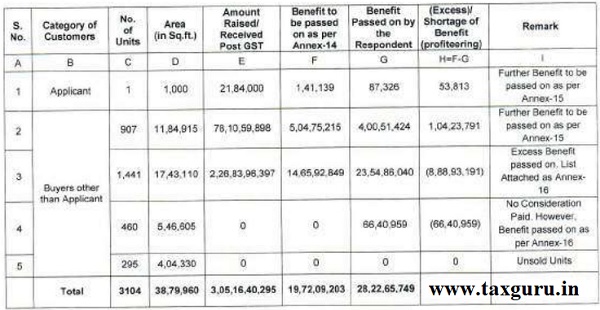
31. From the Table “G”, the DGAP has stated that the benefit passed on by the Respondent to the recipients eras less than what he ought to have passed on in case of 908 residential flats including the Applicant (Sr. 1 & 2 of Table above) by an amount of Rs. 1,04,17,604/-. The details of these amounts have been given in Annexure-15 of the DGAP’s Report dated 10.12.2019. Further, benefit passed on by the Respondent was higher than what he should have passed on. in respect of 1901 residential flats (Sr. 3 & 4 of Table alcove) by an amount of Rs. 9,55,34,150/-, The details of this excess benefit passed on by the Respondent have been given in Annexure-16 of the DGAP’s Report dated 06.12.2019. However, the excess benefit passed on to some recipients, could not be set off against the additional benefit required to be passed on to the other recipients and it could only be adjusted against any future benefit that might accrue to such recipients.
32. The DGAP has further stated that the benefit of additional ITC to the tune of 5.77% of the turnover has accrued to the Respondent post-GST and the same was required to be passed on by him to the above Applicant and the other recipients. The DGAP has further stated that Section 171 of the CGST Act, 2017 appeared to have been contravened by the Respondent. inasmuch as the additional benefit of ITC @ 5.77% of the base prices received by the Respondent during the period from 01.07.2017 to 31.03.2019, has not been passed on by him to the Applicant No. 1 and the other recipients. On this account, the Respondent has realized an additional amount to the tune of Rs. 53,813/. from the Applicant as has been mentioned at Sr, No. 1 of Table- ‘C’ Further, the investigation has revealed that the Respondent has also realized an additional amount of Rs. 1,04,23,791/- as has been mentioned at Sr. No. 2 of Table- ‘G’, from 907 other recipients who were not Applicants in the present proceedings. These recipients were identifiable as per the documents provided by the Respondent, giving the names and addresses along with Unit Nos, allotted to such recipients. Therefore, this additional amount of Rs. 1,04,23,791/- was required to be returned to such eligible recipients. Further, the benefit of ITC in respect of 450 units as mentioned at Sr. No 4 of Table- ‘G’. might be calculated when the consideration was received from such units by taking into account the proportionate ITC in respect of such units and would be adiuSted in future demands.
33. The DGAP has also stated that the present investigation has covered the period from 01.07.2017 to 31.03.2019. Profiteering, if any, for the period post March, 2019, has not been examined as the exact quantum of ITC that would be available to. the Respondent in future could not be determined at the stage, when the Respondent has been availing ITC in respect to the present project The DGAP has further stated that in view of the aforementioned findings, it appeared that provisions of Section 171(1) of the CGST Act: 2017 have been contravened by the Respondent.
34. The above Report was considered by this Authority in its meeting held on 12,12,2019 and it was decided that the Applicants and the Respondent be asked to appear before this Authority on 08.01.2020. Tile Respondent was issued notice on 16.12.2019 to explain why the above Report of the DGAP should not be accepted and his liability for violating the provisions of Section 171 of the CGST Act, 2017 should not be fixed. During the course of the hearings no one appeared for the Applicants and the Respondent was represented by Sh, Atul Gupta and Sh. Vishal Gill, Chartered Accountants. The Respondent has filed his written submissions dated 08.01.2o2o. and 22.01.2020. The issues raised by the Respondent in his above submissions have been mentioned in the subsequent paras.
35. The Respondent has submitted that the incremental tax paid on services should not form part of priori-leering, He has further elaborated that during the Pre-GST period, th.e rate of Service Tax charged on the input services was 15%, the credit of which was available, whereas during the GST regime, common GST rate for services has been increased from existing (pre- GST) 15% to 18%, the credit of which was also available in post T. Therefore, no additional benefit has accrued to the respondent on availment of IT related to input services in the GST regime as credit for the same was available in both the pre and post GST eras and the only difference was that the rate on services ha& been increased from 15% to 18%. The Respondent has submitted following illustration to strengthen his contention: