Impact of Moratorium on Arbitration: It it a Clash of Proceedings?
INTRODUCTION
Insolvency is a stage in which a business or person’s financial condition cannot meet their financial obligations or debts owed to a creditor, and they are unable to pay them back. They are also known as an insolvent person. Bankruptcy is a legal process that is initiated, i.e., court proceedings, to declare the debtor unable to pay and to recover the debt from the debtor. To regulate this particular process of insolvency and bankruptcy, the Government of India has introduced the Insolvency and Bankruptcy Code in the year 2016 (Hereinafter referred to as IBC) to regulate the process and to provide a time-bound process for the resolution, and loss minimisation with a Bankruptcy Law Reforms Committee, chaired by T.K. Vishwanathan in the year 2015. One of the most important features of IBC is the moratorium. A moratorium is a suspension of law or activity for a temporary period of time until the purpose is resolved. The Moratorium in the IBC is issued to prohibit the institution of suits or proceedings against the corporate debtor in the Corporate Insolvency Resolution Process and in the liquidation process. Arbitration is an alternative dispute resolution process that resolves disputes between the parties with a neutral person known as an arbitrator. The proceedings are generally held outside the traditional court. The disputes are generally from contracts. The claims are settled, and an award will be given. The same will be enforced by the parties in the court where the dispute should have been dealt with, instead of the arbitration tribunal.
In the IBC, the insolvency procedure will be started when the financial creditor, operational creditor or corporate debtor files an application to initiate the corporate insolvency resolution process. One of the stages in this process, moratorium, will be declared under Section 13 of the IBC, 2016, and Section 14 of the IBC, 2016, which will prohibit the creditor from initiating the proceedings in court or a tribunal. When the moratorium is declared, the creditors cannot initiate or continue any legal suit or proceedings against the debtor or corporate debtor. Also, suppose the resolution plan is not submitted or rejected. In that case, the liquidation process is started, and again, a moratorium is declared by the adjudicating authority under section 33(5) of the IBC,2016. There is a lot of ambiguity in the wording of the particular sections, like proceedings, which include all proceedings, even the arbitration proceedings. There is a lot of confusion under both sections because one section prohibits the initiation and continuation of the proceedings, and the other only prohibits the initiation of the legal proceedings. There is a lot of confusion about the enforcement of the arbitration proceeding during the moratorium period. There is an exception to this moratorium that is any petition which is filed under Article 32, 226, and 136 of the Constitution of India. As they are the constitutional courts, and they will decide the constitutionality of any provisions, or the provisions in corporate debtor company charter documents, and this article discusses the impact of the moratorium on the arbitration.
MORATORIUM VIS-À-VIS ARBITRATION
Section 14 of the IBC, 2016 says that “(1) Subject to provisions of sub-sections (2) and (3), on the insolvency commencement date, the Adjudicating Authority shall by order declare a moratorium for prohibiting all of the following, namely:— a) the institution of suits or continuation of pending suits or proceedings against the corporate debtor, including execution of any judgment, decree or order in any court of law, tribunal, arbitration panel or other authority.[1];”
Section 33(5) of the IBC, 2016 says that “(5) Subject to section 52, when a liquidation order has been passed, no suit or other legal proceeding shall be instituted by or against the corporate debtor: Provided that a suit or other legal proceeding may be instituted by the liquidator, on behalf of the corporate debtor, with the prior approval of the Adjudicating Authority.[2]”
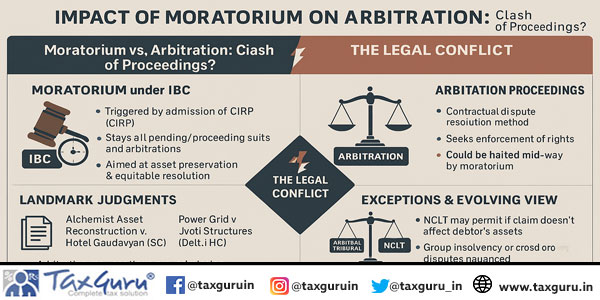
According to these two sections, the adjudicating authority will declare a moratorium, and it prohibits the financial creditor or operational creditor under section 14 and when the liquidation order is given under section 33(5) from initiating any legal proceedings or suit against the debtor. Also, it prohibits the continuation of the pending proceeding in the court or tribunal. In the case of “Power Grid Corpn. v. Jyoti Structures Ltd., (2019) 6 Comp Cas-OL 76[3]”, the court said that “moratorium under section 14 is to prohibit the debt recovery proceedings against the creditor”. The impact can be seen in two stages. They are:
- Arbitration proceedings after the initiation of CIRP/During the moratorium period.
Once the moratorium is declared by the adjudicating authority, according to section 14 IBC, 2016, it prohibits the legal proceedings. The arbitration proceedings, which are started after the moratorium is declared, will now be stopped or ignored altogether and cannot be continued further. The same cannot be initiated, and this was supported in several court cases.
In the case of “Alchemist Asset Reconstruction Co. Ltd. v. Hotel Gaudavan (P) Ltd., (2018) 1 Comp Cas-OL 405[4]” the supreme court held that “This being the case, we are surprised that an arbitration proceeding has been purported to be started after the imposition of the said moratorium and appeals under section 37 of the Arbitration Act are being entertained. Therefore, we set aside the order of the District Judge dated July 6, 2017 and further state that the effect of section 14(1)(a) is that the arbitration that has been instituted after the aforesaid moratorium is non-est in law.”
In the case of “” the supreme court held that “”
- Arbitration proceedings before the initiation of CIRP/Declaration of moratorium.
As per the bare reading of sections 14 and 33(5), one section says that both initiation and continuation are prohibited, and according to 33(5), continuation of the proceedings is allowed, but initiation is not allowed, and initiation should be backed by the leave of the NCLT. Arbitration proceedings can be initiated when the proceedings are unrelated to the debt or when the award is given in favour of the corporate debtor. There will be two stages in this particular stage. They are:
- Pre-award stage:
In the case of “Jharkhand Bijli Viltran Nigam Ltd. v. IVRCL Limited, 2018 SCC OnLine NCLT 18197,[5]” the NCLT held that “the claim from the creditor will be covered under moratorium and it will be non-est, but the claims and counter-claims filed by the corporate debtor will be continued and will not fall under the ambit of moratorium under section 14” Therefore, we can say that claims by the debtor are entertained during the moratorium period in Sections 14 and 33(5) of IBC, 2016.
- Post-award stage:
As already held in the Power Grid case, the moratorium for the debt recovery procedure will be prohibited. The post-award stage is either the enforcement or the set-aside of the award. The award, which is passed against the corporate debtor, will be the evidence for default and will amount to a default. As it amounts to a default, enforcement of the award will be prohibited by the moratorium. But when the award is in favour of the corporate debtor, then the proceedings are not stopped by the moratorium, as it will not affect the assets of the corporate debtor, and it will not increase the liability of the corporate debtor.
POSITION OF ARBITRATION PROCEEDINGS DURING MORATORIUM IN THE UK AND THE USA
1. United Kingdom:
In the United Kingdom, the insolvency process is governed by the Corporate Insolvency and Governance Act 2020 and the Insolvency Act of 1986. These Acts of 1986 and 2020 regulate the insolvency and liquidation process in the United Kingdom and give the timelines for the process. The act of 2020 is for new moratorium provisions. According to section 130(2) of the Act of 1986, the moratorium period will start as soon as the order is granted, and new cases cannot be initiated, and the pending proceeding before the court should be stopped/suspended. It is known as an automatic moratorium.
In the case of the arbitration proceeding in the United Kingdom, the automatic moratorium will prevent the arbitration proceeding from being commenced; if, however, the arbitration moratorium is to be continued, the court will grant leave to commence the arbitration after considering many criteria for the same. It even says that it does not permit to initiation of proceedings even though the company administration gives permission to initiate the proceedings. There is another case where the arbitration is commenced and a moratorium is declared. Then, the arbitration proceedings will be stayed/suspended as per the same provisions as discussed earlier for fresh proceedings.
2. United States of America:
In the United States of America, a moratorium is known as an automatic stay. The automatic stay is granted when the bankruptcy petition is filed. This period suspends/stops the judgments, collection, foreclosures, and repossession of property. The debtors cannot proceed with any claims or debts against the debtor that arose before the petition is filed before the bankruptcy court. The creditor can file a petition and ask the court to lift the stay to permit the proceedings.
Arbitration is also filed for claiming the losses from the contractual disputes, and they are known as claims. These claims are filed against the person who defaults on the terms of the agreement. Therefore, the arbitration between the parties is also stayed or suspended till the process is completed or when the court lifts the stay on its own or the application for lifting the stay is successful before the court. The claims under the arbitration may also be considered as bankruptcy claims and resolved through the bankruptcy plan.
The position regarding the arbitration proceeding during the moratorium period is almost similar to the Indian law position and regulations on the moratorium period and the arbitration proceedings.
CONCLUSION:
The insolvency process of corporate debtors and the liquidation process under the Insolvency and Bankruptcy Code, 2016, play a key role in the insolvency and financial regime in the country. Especially, the moratorium is an important part of it, where it stops or suspends someone from initiating the proceedings in the court/tribunal against the corporate debtor. Even the arbitration proceedings will also come under the purview of the moratorium, and those proceedings are also affected by the moratorium. The moratorium is a blessing and also a disguise for both the debtors and the creditors. Sometimes it restricts the rights of the creditor from claiming the claims from the debtor, and the creditor faces losses. But the debtors also have been facing difficulties. There are some lacunas still in the code, where the code is lacking in properly describing what the proceedings are and what type of proceedings are covered under the moratorium, which cannot be commenced or suspended when there is a moratorium. It is a recommendation that the Central Government should amend the act or provide separate rules for the same, saying what all the proceedings are covered under this moratorium under sections 14 and 33(5) of theInsolvency and Bankruptcy Code, 2016.
[1] Insolvency and Bankruptcy Code,2016 § 14, No. 31, Acts of Parliament, 2016 (India).
[2] Insolvency and Bankruptcy Code,2016 § 33, No. 31, Acts of Parliament, 2016 (India).
[3] Power Grid Corpn. v. Jyoti Structures Ltd., (2019) 6 Comp Cas-OL 76.
[4] Alchemist Asset Reconstruction Co. Ltd. v. Hotel Gaudavan (P) Ltd., (2018) 1 Comp Cas-OL 405.
[5] Jharkhand Bijli Viltran Nigam Ltd. v. IVRCL Limited, 2018 SCC OnLine NCLT 18197.