
What is Dormant Company:
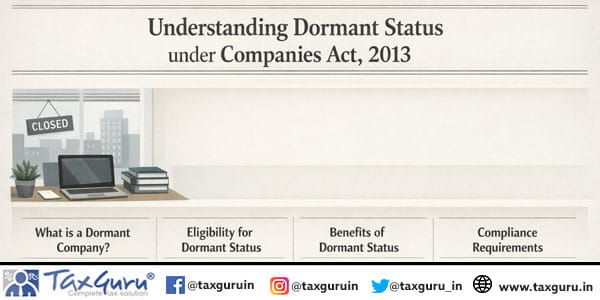
As per Section 455 of the Companies Act, 2013, Dormant Company means the Company which remains temporarily Inactive. In simple terms a company, which has not been carrying on any business or operation, or has not conducted any significant accounting transaction during the last two financial years , or has not filed financial statement and annual returns during the last two financial years.
Why to obtain the Status of Dormant Company
The company may seek dormant status for protection of their intellectual property rights (Patents, Trademark, Copyrights, Trade Secret etc.) or for future business plan and expansion or projects, for lowering the cost associated with running the company. Some companies apply for dormant status to avoid the regulatory compliance requirements applicable to Active Companies and if the company has not any significant business transactions.
Significant business accounting transaction any transaction other than:
- payment of fees by a company to the Registrar;
- payments made by it to fulfil the requirements of this Act or any other law;
- allotment of shares to fulfil the requirements of this Act; and
- payments for maintenance of its office and records.
Eligibility Criteria:
1. No significant accounting Transactions in the company in last two years
2. No business operation carried out in last two years.
3. No outstanding loan whether secured or unsecured
4. No unpaid taxes, duties payable to central or state government or any local authorities or any unpaid workmen’s dues.
5. The Company should not be listed company.
6. No ongoing inspection, inquiry or investigation has been ordered or taken up or carried out
7. No prosecution has been initiated or pending under any law against the company.
8. No outstanding public deposit
What are the benefits after obtaining dormant status
Reduced Compliance Burden Dormant Companies are exempt from compliance applicable to Active Company i.e . Not required to convene 4 Board meeting in a financial year, Holding the Annual General Meeting (AGM) and Filing of Form AOC-4 and Form MGT-7/MGT 7A.
Cost Saving: After getting dormant status there is no need to incur business expenses, Accounting fees, Auditing Fees, payroll obligations, taxes/duties obligations. It lowering cost to the company.
Legal protection of the name of company: useful if you reserve the name today and plan to start the operation with the same brand.
Maintained legal existence: Dormant status of company allows you to pause business operations without losing legal identity.
Comparison of Active vs Dormant company status:
| Feature/Aspect | Active Company | Dormant Company |
|---|---|---|
| Trading/Revenue | Can trade, earn revenue, and incur expenses | Cannot trade or earn revenue (except certain exempt payments, e.g., filing fees) |
| Taxes and duties | Must calculate the profits and pay tax there on | No profits during dormant status means no taxes |
| Accounts/Filing | Full annual accounts and tax returns required | Simplified dormant accounts, minimal filing requirements |
| Compliance Costs | Higher – accounting, audits, payroll, GST, ROC fees etc. | Lower – minimal accounting, no audits |
| Company Name Protection | Protected as long as company exists | Name remains reserved; cannot be registered by others |
| Legal Existence | Fully active legal entity | Maintains legal entity during Dormant status |
| Flexibility | Can expand, invest, or take on loans | Can be reactivated for trading anytime in future |
Process for obtaining the dormant status
1. Convene Board Meeting and pass the resolution for applying the Dormant status.
2. Issue notice for calling the General meeting of the members of the company
3. Hold General meeting and pass the special resolution for approving the application for obtaining the dormant status.
4. Filing of Form MSC-1 with the Registrar of companies pay prescribed fees with the following details
-
- Company details (CIN, registered office, etc.)
- Declaration that the company is not carrying on any business or operation
- Purpose of remaining dormant (future business or investment)
After reviewing the application, ROC shall grant the dormant status in by issuing dormant company certificate in Form MSC-2
Compliances during Dormancy status
1. File annual return in Form MSC-3 within 30 days from the end of financial year.
2. Maintain statutory registers (members, directors, etc.).
3. Do not carry out business activities which are not permitted.
Reactivation from the dormant status to active status
A dormant company shall have to file Form MSC-4 with the registrar of companies after paying the prescribed fees to resume business operations when It is ready to start commercial activities and the company wants to raise funds, trade, or carry out contracts.
Conclusion
Obtaining dormant company status provides a framework for businesses that are not in operation but wish to maintain their legal existence. This status enables companies to minimize compliance obligations, reduce operational costs, and protect their intellectual property right, while maintaining the flexibility to reactivate operations in the future.
By opting for dormant status, companies can effectively balance regulatory compliance with strategic business planning, ensuring that they remain well-positioned for future growth and investment opportunities without the burden of maintaining an active operational structure.





Nice it is very useful.