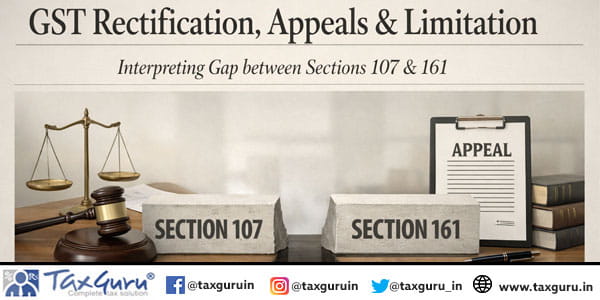
The interplay between Section 107 (appeals) and Section 161 (rectification) of the GST Act raises an important limitation issue: whether the time spent pursuing rectification should be counted while computing the limitation period for filing an appeal. The GST Act prescribes a three-month appeal period with an additional one-month condonable delay but does not clarify the effect of rectification proceedings on this timeline. Courts have addressed this legislative gap through interpretation. One High Court held that when a rectification application is filed and later disposed of, the limitation for filing an appeal should be counted from the date of disposal of the rectification application, since the authority has effectively reconsidered the matter. Another High Court applied the principle similar to Section 14 of the Limitation Act, ruling that the time spent in bona fide rectification proceedings should be excluded when calculating limitation. Both approaches aim to prevent taxpayers from losing their right to appeal merely because they first pursued the statutory remedy of rectification.
An adjudication order is issued.
An error comes to light.
A request for rectification is made.
Time moves forward—quietly, almost imperceptibly.
What begins as days stretches into weeks, and weeks fade into months.
For the taxpayer, this is not delay—it is the use of a statutory remedy expressly provided by law.
For the legal framework, however, a deeper question emerges:
While the authority re‑examines its own order, does limitation continue to tick, or does it stand still?
The GST Act offers no direct answer.
Between the appellate provision in Section 107 and the rectification power under Section 161 lies a legislative pause—an unspoken space.
It is within this silence that judicial interpretation has begun to evolve.
The statutory scheme and the unanswered question
Section 107 of the GST Act confers a right of appeal against “any decision or order passed under this Act,” prescribing a limitation period of three months from the date of communication, with a further condonable delay of one month.
The language is intentionally broad. On its face, it does not restrict the appeal only to original adjudication orders; it potentially encompasses all orders passed under the statutory framework.
Section 161, on the other hand, empowers the very authority that passed the order to correct errors apparent on the face of the record within the prescribed time. This is not an appellate exercise. Rectification is narrow in scope—confined to obvious and patent mistakes—and functions as an internal corrective mechanism.
What the statute does not explain is how these two provisions interact when it comes to limitation.
Section 107 fixes the clock for appeals.
Section 161 enables correction.
But nowhere does the Act clarify whether time spent pursuing rectification should be ignored, excluded, or reckoned while computing the limitation for appeal.
This statutory omission has resulted in inconsistent administrative responses—and has now drawn the attention of constitutional courts.
Madras High Court: A contextual reading of the GST framework
The Madras High Court addressed this issue in M/s SPK and Co. v. State Tax Officer.
The petitioner had challenged both the assessment order and the subsequent rejection of a rectification application. The Court observed that the assessee had already filed a detailed reply to the show cause notice and that the assessment order had been passed after considering those submissions. Since the dispute went to the merits of the assessment, the appropriate forum was the appellate authority under Section 107.
However, the Court also took note of a legitimate procedural concern. The petitioner feared that the appellate authority might calculate limitation from the date of the original assessment order, rendering the appeal time‑barred solely because a rectification application had been pursued first.
The Court dispelled this apprehension. It clarified that where a rectification application is filed and subsequently decided, the limitation for filing an appeal against the original order must be reckoned from the date on which the rectification application is disposed of.
The logic underlying this conclusion is rooted in statutory coherence. If rectification is allowed, the corrected order effectively replaces the original. Even where rectification is rejected, the authority has nonetheless applied its mind one final time to the request for correction.
Viewed this way, rectification proceedings are not alien to adjudication; they are an extension of it. Treating the rectification order as the relevant starting point for limitation preserves the internal consistency of the GST scheme.
Allahabad High Court: Borrowing from limitation principles
A comparable issue arose before the Allahabad High Court in Prakash Medical Stores v. Union of India.
In that case, the assessee faced an ex parte adjudication order and chose to file a rectification application under Section 161. After the rectification was rejected, an appeal under Section 107 was filed. The appellate authority dismissed the appeal as time‑barred, calculating limitation from the date of the original order.
The High Court intervened and set aside this approach.
While acknowledging that the Limitation Act does not strictly govern GST proceedings, the Court invoked the principle embodied in Section 14 of the Limitation Act—namely, exclusion of time spent in pursuing a remedy bona fide before a forum lacking jurisdiction or in an alternative statutory process.
The Court held that when a rectification application is filed within time and pursued in good faith, the limitation for filing an appeal effectively remains suspended during the pendency of the rectification proceedings. Consequently, the period consumed by rectification must be excluded while computing the limitation under Section 107.
Two judicial routes through the same silence
Both High Courts respond to the same legislative gap, yet their reasoning travels along different paths.
The Madras High Court resolves the issue within the GST Act itself, treating the rectification order as the operative point from which limitation begins to run.
The Allahabad High Court steps outside the four corners of Section 107 and imports a broader procedural principle derived from the Limitation Act, excluding the time spent in bona fide rectification proceedings.
Each approach seeks to prevent injustice. Yet the second raises an important jurisprudential question. Section 107 already provides a tightly calibrated limitation regime, including a narrowly defined power of condonation. Whether principles from general limitation law can consistently coexist with this self‑contained framework is an issue that remains open for further judicial refinement.
A statutory pause still being interpreted
The interplay between Sections 107 and 161 highlights a familiar phenomenon in tax legislation: clarity in rights, precision in timelines, and silence at their intersection.
One judicial approach harmonises the statute by treating rectification as part of the adjudicatory continuum.
Another leans on equitable doctrines to ensure that bona fide remedies do not become procedural traps.
Between these approaches lies a careful balance—between certainty and fairness, between rigid timelines and lived litigation realities.
Limitation law counts days with mathematical exactness.
But tax disputes unfold in intervals—
between orders and corrections,
between mistakes and remedies.
It is within those intervals that courts continue to give meaning to what the statute has left unsaid.