Capital Subsidy, Taxation, Interest Concession and Other Incentives for Future Industries of the Indian Economy — A Professional Analysis
Executive Summary
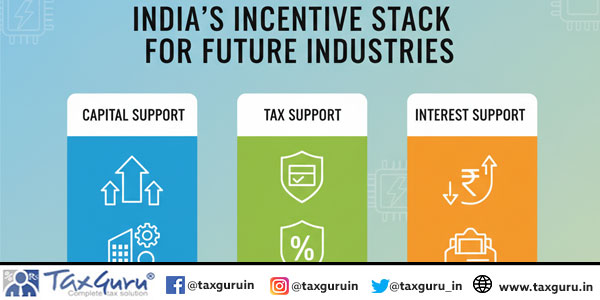
India’s industrial policy architecture has pivoted decisively towards outcome-linked incentives, technology localization, and climate-aligned growth. Production Linked Incentive (PLI) schemes across 14 sectors; the National Green Hydrogen Mission’s SIGHT incentives; semiconductor design and fabrication support under the India Semiconductor Mission (ISM); and state-level packages such as Rajasthan’s RIPS‑2022, Tamil Nadu’s Structured Package, and Gujarat’s Semiconductor Policy 2022‑27 are creating a multi-layered incentive stack. Concurrently, the direct tax regime offers elective concessional corporate rates (22% u/s 115BAA; 15% for new manufacturing u/s 115BAB subject to deadlines), export enablers like SEZ/IFSC regimes, and startup tax holidays u/s 80‑IAC. For debt affordability, exporters benefit from the Interest Equalisation Scheme, while MSMEs access capital subsidy and green-interest subvention under CLCS‑TUS and SIDBI’s green finance programs. This paper synthesizes these frameworks and translates them into numerical models, case studies, and compliance checklists for bankers, CFOs, and corporate strategists.
1) Policy Landscape and the Incentive Stack
The Centre’s policy mix emphasises: (i) output-tied incentives (PLI), (ii) technology-deepening subsidies (semiconductor DLI/ATMP/Foundry support), (iii) sunrise-sector acceleration (green hydrogen SIGHT, ACC batteries, EV ecosystem), and (iv) export platforms (SEZ, IFSC). States add location-linked sweeteners—capital subsidy, SGST reimbursement, electricity duty and tariff support, employment subsidies, stamp duty waivers, and bespoke packages for mega projects.
2) Capital Subsidies — Central and State
Central: MSME Credit Linked Capital Subsidy & Technology Up‑gradation (CLCS‑TUS/CLCSS) allows upfront capital subsidy (typically 15% within caps) on institutional finance for eligible machinery/technology upgradation. Semiconductor investments receive capital assistance under ISM and state policies (e.g., Gujarat offering power tariff subsidies, electricity duty exemptions, and land support for semiconductor clusters). State: Rajasthan’s RIPS‑2022 provides options including capital subsidy and turnover-linked incentives; Tamil Nadu offers fixed capital subsidy tiers and structured packages; Gujarat’s Semiconductor Policy 2022‑27 layers capital assistance with utilities support. These subsidies reduce initial capex burden, improve DSCR and shorten payback.
Numerical Illustration A: Capital Subsidy Impact on DSCR
Assume a greenfield component plant with eligible machinery worth ₹100 crore financed with a 30:70 debt-equity mix. If a 15% capital subsidy (₹15 crore) is credited upfront against the machinery, effective project cost for funding is ₹85 crore. At 10% blended interest with 7‑year amortisation, the annual debt service reduces by ~₹2.0–₹2.5 crore, lifting DSCR from ~1.25× to ~1.35–1.40× in base cases. Over the debt tenor, this widens the headroom for working capital and covenant buffers.
3) Interest Concessions and Export Credit
Exporters of specified categories access Interest Equalisation Scheme (IES) on pre/post-shipment rupee credit. MSMEs can additionally secure interest subvention under green programs like SIDBI’s MSE‑GIFT (2% p.a. for 5 years up to ₹2 crore) and state schemes (e.g., RIPS‑2022 sunrise sectors 5% subvention subject to caps). Lower all‑in rates improve viability in low-margin, scale-oriented sectors like electronics assembly, components, and clean-tech BOS manufacturing.
Numerical Illustration B: Interest Subvention on Export Credit
Consider a mid‑cap exporter (eligible category) availing ₹50 crore packing credit at 9.50% for 180 days. With 3% IES equalisation, the effective rate becomes 6.50%. Six‑month interest saves ~₹0.75 crore per cycle. For four cycles per year, annual interest saved is ~₹3.0 crore, directly enhancing EBITDA and pricing flexibility.
4) Taxation: Corporate Rate Options, Startup Holiday, SEZ/IFSC
Corporate Rate Choices: Section 115BAA (22% base) remains a widely used elective regime for established companies willing to forego most profit-linked deductions; MAT does not apply. Section 115BAB provides a 15% rate for new manufacturing companies that met the statutory commencement deadline; MAT also does not apply, but profit‑linked deductions (including 10AA) are foregone. Startups recognised by DPIIT can seek a 3‑year profit holiday u/s 80‑IAC within a 10‑year window, subject to conditions. Export Platforms: SEZ units (10AA) enjoy phased profit deductions (subject to the sunset for new units) and indirect tax benefits; IFSC GIFT City units receive 100% tax exemption for 10 out of 15 years under 80LA for specified income, alongside specific withholding and capital gains relaxations.
Numerical Illustration C: Choosing Between 115BAA and 115BAB/10AA
A manufacturing group evaluates a new line with projected PBT margin of 9% ramping to 12% by Year 5. Under 115BAA (effective ~25.17%), Year‑1 tax outgo on ₹50 crore PBT is ~₹12.6 crore. If eligible and within the deadline, 115BAB (effective ~17.16%) would cut Year‑1 tax to ~₹8.6 crore—an ~₹4.0 crore delta. However, if the unit’s export mix and embedded services qualify for 10AA‑type deductions (where applicable) or IFSC participation, the combined direct/indirect tax economics may offset the 115BAB advantage. A discounted cash‑tax NPV model over 10 years is essential before locking into an option.
5) Production Linked Incentive (PLI) — Design and Outcomes
PLI is output‑based: beneficiaries receive incentives as a percentage of incremental sales over the base year, conditional on investment and localisation thresholds, job creation, and compliance. Sectors span electronics and IT hardware, pharmaceuticals, telecom, textiles, white goods, auto/ACC batteries, solar PV, drones, and more. As of mid‑2025, over 800 applications have been approved across 14 sectors, with disbursements crossing ₹21,000 crore and incremental production exceeding ₹16.5 lakh crore, alongside significant employment creation. For corporate planners, PLI’s stair‑stepped rate cards and localisation matrices require granular ramp‑up plans.
Numerical Illustration D: PLI Computation for Electronics
Suppose a beneficiary faces a PLI rate of 4% in Year‑1, tapering down thereafter. If incremental eligible sales over base are ₹5,000 crore in Year‑1, gross PLI accrual is ₹200 crore. After quality/traceability holdbacks and compliance verification, a 95% net realisation yields ₹190 crore. Given a 6% EBITDA margin business, PLI can triple net earnings in early years and finance capex without equity dilution.
6) National Green Hydrogen Mission — SIGHT Incentives
SIGHT provides production incentives for green hydrogen and capital incentives for electrolyser manufacturing through competitive bidding (tranches under Modes 2A/2B) with technology‑neutral pathways. Bankers should underwrite offtake contracts, curtailment risk, and RE wheeling costs; corporates must model LCOS and LCOD trajectories under policy‑linked tariff pass‑throughs and ancillary services markets.
7) Semiconductors — Design to Fab
Under ISM, India extends design‑linked incentives and fiscal support for fabs/ATMP. High‑profile projects like Micron’s ATMP in Gujarat illustrate a blended model: 50% central fiscal support and additional state incentives (e.g., ~20% of project cost), plus utilities concessions. States compete via land, power, and infra readiness in clustered hubs (e.g., Dholera).
Case Studies
Case Study 1: Apple Supply Chain Deepening Under PLI
Indian iPhone production ramped sharply as contract manufacturers scaled under the PLI framework. Foxconn and Tata Electronics expanded exports, with domestic value addition crossing ~20% and shipments to the U.S. surging in 2025 amid tariff headwinds in other geographies. PLI payouts and state‑level support underwrote local ecosystem development in components, logistics, and testing services.
Case Study 2: Micron ATMP — Blended Subsidy Stack
Micron’s Gujarat ATMP facility demonstrates layered incentives: 50% central support under the modified ATMP scheme and ~20% state support, plus local infra facilitation. The structure de‑risks initial opex/capex and accelerates ecosystem formation (substrates, packaging materials, testing, and technical talent).
Case Study 3: Green Hydrogen — Electrolyser Line with SIGHT
A domestic OEM winning electrolyser capacity under SIGHT Tranche‑II receives per‑kW incentives subject to performance and localisation. With RE PPAs at ₹2.6–₹3.0/kWh and improving stack efficiency, the LCOD narrows sufficiently to support ammonia/fertiliser offtake contracts under Mode‑2A/2B allocations.
8) Compliance Trajectories, Covenants, and Risks
Incentives are contingent on timely filings (e.g., Form 10‑ID/10‑IC for tax options), investment proofs, incremental sales audits, localisation certificates, and environmental clearances. Risks include timeline slippage versus scheme sunsets, forex/commodity volatility eroding incremental value, and clawbacks for non‑compliance. Boards should institute an Incentives Steering Committee with legal, tax, ESG, treasury, and operations inputs.
9) State Incentive Snapshots (Illustrative)
Rajasthan (RIPS‑2022): options of capital subsidy/turnover‑linked incentives; SGST reimbursement; employment subsidy; interest subvention for sunrise sectors; exemptions on electricity duty and stamp/land conversion charges. Tamil Nadu: fixed capital subsidy up to defined ceilings based on location and size; electricity tax exemption; structured packages for mega/ultra‑mega projects; targeted MSME add‑ons. Gujarat (Semiconductor Policy 2022‑27): power tariff subsidy (₹2/unit for 10 years), electricity duty exemption, land support and cluster readiness; additional water/desalination capital assistance for fabs.
10) Banker’s Checklist for Sanction Notes
- Validate scheme eligibility and timelines (PLI tranche windows; 115BAB commencement; 80‑IAC recognition window).
- Map subsidy/incentive cashflows to debt service and build covenant buffers for audit/verification delays.
- Stress‑test LCOD/LCOS paths for green projects under variability in RE tariffs and utilisation.
- Factor state‑wise power/water logistics and incentives when choosing sites.
- Ensure robust compliance calendars and secure legal opinions on clawback language.
Conclusion
India’s incentive architecture is increasingly sophisticated, performance‑linked, and climate‑aligned. For future industries—semiconductors, electronics, green hydrogen, EVs/ACC, AI hardware, advanced materials—the optimal path blends central PLI/SIGHT/ISM with state subsidies, and a tax platform choice (115BAA/IFSC/SEZ) that maximises the after‑tax, after‑subsidy IRR while retaining operational flexibility. Execution discipline around eligibility, documentation, and verification is the differentiator between headline policy promises and realised cash benefits.
Capital Subsidy, Taxation, Interest Concession and Other Incentives for Future Industries — Rajasthan-Focused Comparative Analysis
Prepared for location committee notes at UCO Bank, Jaipur — September 2025
Executive Summary
This expanded note contextualises central and state incentive frameworks with a focus on Rajasthan. It juxtaposes the Rajasthan Investment Promotion Scheme (RIPS‑2022) against Tamil Nadu’s and Gujarat’s packages to guide location and credit committee decisions at UCO Bank, Jaipur. It also highlights compliance, financial modelling, and risk mitigation aspects.
Rajasthan Investment Promotion Scheme (RIPS‑2022) — Key Provisions
RIPS‑2022 covers manufacturing and service enterprises across identified sectors, including electronics, renewables, EV components, data centres, and agro-processing. Key features:
- Choice between Capital Subsidy and Turnover-Based Incentive.
- SGST reimbursement (up to 100% for defined periods) or capital subsidy (typically 25–30% of investment up to caps).
- Employment subsidy linked to local hiring (per employee per month for a defined period).
- Interest subvention for sunrise sectors (5% p.a. up to ceiling amounts) on term loans.
- Exemptions: electricity duty for 7 years; stamp duty; land conversion charges; priority allotment in industrial areas.
Comparative Table — Rajasthan vs Tamil Nadu vs Gujarat
While Tamil Nadu emphasises structured packages and skill-linked employment support, and Gujarat emphasises semiconductor ecosystem readiness with high fixed capital assistance and power tariff subsidies, Rajasthan provides flexibility between capital and turnover incentives and enhanced interest subvention for sunrise sectors.
Illustrative Comparison:
- Capital Subsidy: Rajasthan up to 30% (caps); Tamil Nadu fixed tiers (e.g., ₹2–₹5 crore for MSMEs); Gujarat 40–50% for semiconductors.
- SGST/Tax Reimbursement: Rajasthan 100% up to 10 years; Tamil Nadu SGST refund on incremental turnover; Gujarat 75% reimbursement plus utilities.
- Interest Subvention: Rajasthan 5% up to ceiling; Tamil Nadu limited to MSMEs (3%); Gujarat typically no interest subvention but power tariff subsidy.
- Utilities: Rajasthan electricity duty exemption; Tamil Nadu electricity tax exemption; Gujarat power tariff subsidy ₹2/unit for 10 years.
- Land/Stamp Duty: Rajasthan exemption; Tamil Nadu concessional stamp duty; Gujarat land at concessional rates plus cluster infra.
Numerical Illustration — DSCR Impact with RIPS‑2022 vs Tamil Nadu vs Gujarat
Assume a ₹200 crore EV components plant. Under Rajasthan, a 25% capital subsidy (₹50 crore) plus 5% interest subvention can reduce annual debt service by ₹6–₹7 crore. DSCR improves from 1.20× to ~1.40×. Under Tamil Nadu, the package may yield ₹10 crore capital subsidy plus SGST refunds; DSCR rises more modestly to ~1.25×. Under Gujarat (semiconductors focus), central+state support could reach 60–70% of project cost, dramatically changing viability, but eligibility limited to designated sectors.
Strategic Takeaways for UCO Bank Jaipur Credit/Location Committees
1. Map client project profiles to state policy eligibility — Rajasthan offers competitive incentives for a broad array of sectors with simpler compliance than some other states.
2. Build financial models incorporating capital subsidy timing (disbursement schedules) and interest subvention to correctly compute DSCR and covenants.
3. Evaluate SGST reimbursement reliability and working capital implications — delays can affect cash flow.
4. Consider cluster ecosystem maturity — Tamil Nadu offers deep supply chains for automotive/electronics; Gujarat offers semiconductor infra; Rajasthan’s advantage lies in cost, land, and power duty waivers for emerging sectors.
Taxation&Central Incentives in the Rajasthan Context
Companies setting up in Rajasthan can still elect for s.115BAA or 115BAB corporate tax regimes, claim Startup India u/s 80‑IAC, and avail PLI benefits. Integration of state and central incentives requires modelling of cumulative effective subsidy vs. tax liability. For example, PLI receipts are taxable income; companies may need to ring‑fence cash for tax outgo unless offset by accelerated depreciation.
Compliance Calendar
For RIPS‑2022, beneficiaries must register projects, submit investment proofs, employment records, and periodic returns to claim benefits. Similarly, central schemes require forms (e.g., 10‑IC for 115BAA, quarterly PLI filings). A combined calendar reduces the risk of clawbacks.
Conclusion — Rajasthan’s Competitive Position
Rajasthan’s RIPS‑2022 offers a flexible and generous incentive structure, particularly for sunrise sectors, with a relatively straightforward compliance regime. Compared to Tamil Nadu and Gujarat, it trades some ecosystem maturity for lower costs and simpler procedures. For UCO Bank Jaipur’s credit and location committees, this means more projects with bankable subsidy/interest support may arise locally, but due diligence on scheme eligibility, timing, and cash flow is critical.