Sh. Gajender Singh Vs Haamid Real Estate Pvt. Ltd. (NAA)
It has been revealed from the DGAP’s Report that the ITC as a percentage of the turnover that was available to the Respondent during the pre-GST period (April 2016 to June 2017) was 3.31% and during the post-GST period (July 2017 to April-2020), it was 5.42% for the Project ‘ The Peaceful Homes’. This confirms that post-GST, the Respondent has benefited from additional ITC to the tune of 2.11% (5.42% – 3.31%) of his turnover, and the same was required to be passed on to the customers/flat buyers/recipients. The DGAP has calculated the amount of ITC benefit availed by the Respondent which needs to be passed on to all the recipients of supply including the Applicant No. 1 as Rs. 3,52,59,318/-. The details of such calculations are mentioned in Table- B supra. The above amount is Inclusive of profiteered amount of Rs. 48,952/- In respect of the Applicant No. 1.
In view of the above discussions, the Authority finds that the Respondent has profiteered by an amount of Rs. 3,52,59,318/- during the period of investigation i.e. July 2017 to April 2020. The above amount that has been profiteered by the Respondent from his home buyers shall be refunded by him, along with interest @18% thereon, from the date when the above amount was profiteered by him till the date of such payment, in line with the provisions of Rule 133 (3) (b) of the GCST Rules 2017.
This Authority under Rule 133 (3) (a) of the CGST Rules, 2017 orders that the Respondent shall reduce the prices to be realized from the buyers of the fiats commensurate with the benefit of ITC received by him as has been detailed above.
The Respondent is also liable to pay interest as applicable on the entire amount profiteered, I.e. Rs. 3,52,59,318/-. Hence the Respondent is directed to also pass on interest @18% to the customers/ flat buyers/ recipients on the entire amount profiteered, starting from the date from which the above amount was profiteered till the date of passing on/ payment, as per provisions of Rule 133 (3) (b) of the CGST Rules 2017.
We also order that the profiteering amount of Rs. 3,52,59,318/- along with the interest @ 18% from the date of receiving of advance from the homebuyer till the date of passing the benefit of ITC shall be paid/passed on by the Respondent within a period of 3 months from the date receipt of this order failing which it shall be recovered as per the provisions of the CGST Act, 2017.
FULL TEXT OF ORDER OF NATIONAL ANTI-PROFITEERING AUTHORITY
1. The Present Report dated 26.02.2021 had been received from the Applicant No. 2 i.e. the Director-General of Anti-Profiteering (DGAP) after a detailed investigation under Rule 129 (6) of the Central Goods & Service Tax (CGST) Rules, 2017 (Rules). The brief facts of the present are that the Applicant No. 1 has alleged that the Respondent had not passed on the benefit of Input Tax Credit (ITC) to him by way of commensurate reduction in the price of the Unit No. B-173 purchased by him from the Respondent in the project “The Peaceful Homes” being executed in Gurgaon, on introduction of Goods & Service Tax (GST) w.e.f. 01.07.2017, in terms of Section 171 of the CGST Act, 2017.
2. Vide the above mentioned Report dated 26.02.2021, the DGAP had stated that:-
a. The aforesaid application was examined by the Standing Committee on Anti-profiteering and upon being prima fade satisfied that the Respondent has not passed on the benefit of ITC, the same was forwarded to the DGAP to conduct a detailed investigation in the matter. Upon receipt of the above reference on 06.05.2020, investigation was initiated against the Respondent to collect evidence necessary to determine whether the benefit of ITC had been passed on by the Respondent to the Applicant No. 1 in respect of construction service supplied by the Respondent or not.
b. A Notice under Rule 129 of the CGST Rules was issued by the DGAP on 02.06.2020, calling upon the Respondent to reply as to whether he admitted that the benefit of ITC had not been passed on to the Applicant No. 1 by way of commensurate reduction in price and if so, to suo-moto determine the quantum thereof and Indicate the same in his reply to the Notice as well as furnish all supporting documents. Vide the said Notice, opportunity to inspect the non-confidential evidences/information furnished by the Applicant was also provided to the Respondent on 25.06.2020 to 26.06.2020. However, the Respondent did not avail of this opportunity.
c. The Respondent did not submit all the requisite documents on the due date. Hence, two Summons under Section 70 of the CGST Act, 2017 read with Rule 132 of the Rules, were issued to Sh. Jasbir Singh (Director) to submit all the relevant documents. in compliance to said summons, the Respondent submitted the relevant documents.
d. The period covered by the current investigation was from 01.07.2017 to 30.04.2020.
e. The time limit to complete the investigation was 05.11.2020, however, vide Notification No.65/2020- Central Tax dated 01.09.2020 and Notification No.91/2020-Central Tax dated 14.12.2020 the time limit for compliance was extended up to 31.03.2021.
f. In response to the Notice dated 02.06.2020, the Respondent submitted his reply vide letters/e-mails dated 18.01.2020, 01.02.2020, 12.02.2020, 26.06.2020, 27.072020, 20.08.2020, 16.09.2020, 12.10.2020, 17.11.2020, and 18.02.2021 vide which he has submitted that:-
i. The Occupancy Certificate for the project ” The Peace& Homes’ was received on 29.10.2019 and on account of receipt of Occupancy Certificate the Respondent had reversed ITC amounting to Rs. 4,35,46,174/- in the month of September, 2020 and Rs. 2,15,34,662/- in cash in December, 2020.
ii. He had passed on the ITC benefit of Rs 5,15,80,785/- to all the buyers and the same was indicated in the home-buyers list.
g. That the aforementioned letters, the Respondent submitted the following documents/ information:
i. Copies of GSTR-1 Returns for the period July, 2017 to April, 2020.
ii. Copies of GSTR-38 Returns for the period July, 2017 to April, 2020.
iii. Electronic Credit Ledger for the period July, 2017 to April, 2020.
iv, Copies of VAT Returns (including all annexures) & ST-3 Returns for the period April, 2016 to June, 2017.
v. Copies of all demand letters issued to the Applicant No. 1.
vi. Details of VAT, Service Tax, ITC of VAT, Cenvat credit for the period April, 2016 to June, 2017 and output GST and ITC of GST for the period July, 2017 to April, 2020 for the project “The Peaceful Homes”.
vii. Cenvat/Input Tax Credit Register for the FY 2016-17, 2017-18, 2018-19 and for the period April, 2019 to April, 2020.
viii. List of home buyers in the project “The Peaceful Homes” along with details of benefit passed on.
ix. Brief profile of the Respondent.
x. Details of applicable tax rates, Pre-GST and Post-GST.
xi. Status of Project as on 30.04.2020.
xii. Copy of Occupancy Certificate.
h. The Respondent informed that all the documents except related to Applicant No. 1 like ledger, demand note, agreement might be treated as confidential, in terms of Rule 130 of the Rules.
i. Vide e-mall dated 19.02.2021 an opportunity was given to the Applicant No. 1, to inspect the non-confidential documents/reply furnished by the Respondent on 22.02.2021 and 23.02.2021. The Applicant availed of the opportunity and visited the DGAP on 22.02.2021 and inspected the non-confidential documents.
j. Para 5 of Schedule-III of the CGST Act, 2017 (Activities or Transactions which shall be treated neither as a supply of goods nor a supply of services) which read as “Sale of land and, subject to clause (b) of paragraph 5 of Schedule II, sale of building”. Further, clause (b) of Paragraph 5 of Schedule II of the CGST Act, 2017 reads as “(b) construction of a complex, building, civil structure or a part thereof, including a complex or building Intended for sale to a buyer, wholly or partly, except where the entire consideration had been received after issuance of completion certificate, where required, by the competent authority or after his first occupation, whichever was earlier”. Thus, the ITC pertaining to the residential units which was under construction but not sold was provisional ITC which might be required to be reversed by the Respondent, if such units remained unsold at the time of issue of the completion certificate, in terms of Section 17(2) & Section 17(3) of the CGST Act, 2017, which read as under:
Section 17 (2) “Where the goods or services or both was used by the registered person partly for effecting taxable supplies including zero-rated supplies under this Act or under the Integrated Goods and Services Tax Act and partly for effecting exempted supplies under the said Acts, the amount of credit shall be restricted to so much of the input tax as was attributable to the said taxable supplies including zero-rated supplies’:
Section 17 (3) “The value of exempted supply under sub-section (2) shall be such as might be prescribed and shall include supplies on which the recipient was liable to pay tax on reverse charge basis, transactions in securities, sale of land and, subject to clause (b) of paragraph 5 of Schedule II, sale of building’:
Therefore, the ITC pertaining to the unsold units might not fall within the ambit of this investigation and the Respondent was required to recalibrate the selling price of such units to be sold to the prospective buyers by considering the proportionate benefit of additional ITC available to him post-GST.
k. Prior to 01.07.2017, i.e., before the GST was introduced, the Respondent was eligible to avail credit of VAT purchases and Service Tax paid on the input services (CENVAT credit of Central Excise Duty was not available) in respect of the flats for the project “The Peaceful Homes” sold by him. Further, post-GST, the Respondent could avail ITC of GST paid on all the inputs and input services. As per the data submitted by the Respondent covering the period April, 2016 to April, 2020, the details of the ITC availed by him, his turnover from the project “The Peaceful Homes” and the ratio of ITC to turnover, during the pre-GST (April, 2016 to June, 2017) and post-GST (July, 2017 to April,2020) periods, has been furnished by the DGAP in Table-A below:-
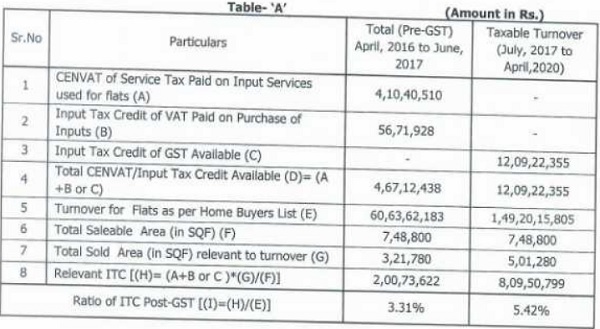
l. It was clear from the above Table-A that the ITC as a percentage of the turnover that was available to the Respondent during the pre-GST period (April, 2016 to June, 2017) was 3.31% and during the post-GST period (July, 2017 to April, 2020), it was 5.42% for the project “The Peaceful Homes”. Hence, It could be concluded that, in post-GST, the Respondent had been benefited from additional ITC to the tune of 2.11% [5.42% (-) 3.31%] of the turnover.
m. As per the figures contained in Table- ‘A’ above, the comparative figures of the ratio of ITC availed/available to the turnover in the pre-GST and post-GST periods as well as the turnover, the recalibrated base price and the excess realization (profiteering) during the post-GST period, has been furnished by the DGAP In Table-B below:-

n. Based on the calculation explained by the DGAP in the Table-B above, it is clear that the benefit of ITC which needed to be passed on by the Respondent to the buyers of flats came to Rs. 3,52,59,318/- which included 12% GST on the base amount of Rs. 3,14,81,533/- during the period 01.07.2017 to 30.04.2020. The homebuyer and unit no. wise break-up of this amount has been furnished by the DGAP in Annex-15 of his Report. This amount was inclusive of profiteered amount of Rs. 48,952/-(including GST) in respect of the Applicant No. 1.
o. For the purpose of the verification of ITC benefit claimed to has been passed on by the Respondent to his homebuyers, the Respondent had provided the details of benefit of ITC passed on to individual homebuyers separately for all the buyers and claimed that he had passed on ITC benefit of Rs 5,15,80,785/- as indicated in the list of home buyers. The DGAP had cross checked the details given in the home buyers’ list with the soft copies of documentary evidences (issued to homebuyers) submitted by the Respondent and it was noted that, 250 units were booked by the Respondent before getting the Occupancy Certificate and the Respondent had passed on the ITC benefit of Rs 5,15,80,785/-.
p. In order to cross check the claim of the Respondent, the DGAP had sent e-malls to the 150 buyers picked up randomly. Out of which, 15 buyers including the Applicant No. 1 gave confirmations that he had received benefit of ITC as claimed by the Respondent, which was about 6% of the total number of buyers to whom the ITC benefit had been claimed to be passed on by the Respondent. 01 buyer had responded in the negative and no reply had been received from remaining buyers. Since the percentage of confirmation received through e-mail was less than 10 0/0 (just 6 0k), the claim of the Respondent that he had passed on the ITC benefit to 237 buyers as indicated in home buyers list was not acceptable. However, since 15 buyers had confirmed over email so far that benefit of ITC was received by them, the claim of the Respondent regarding passing of ITC benefit in his cases was accepted. A summary of benefit of ITC required to be passed on and the ITC benefit passed on to the Applicants and other home buyers, was furnished in table-‘C’ below:-
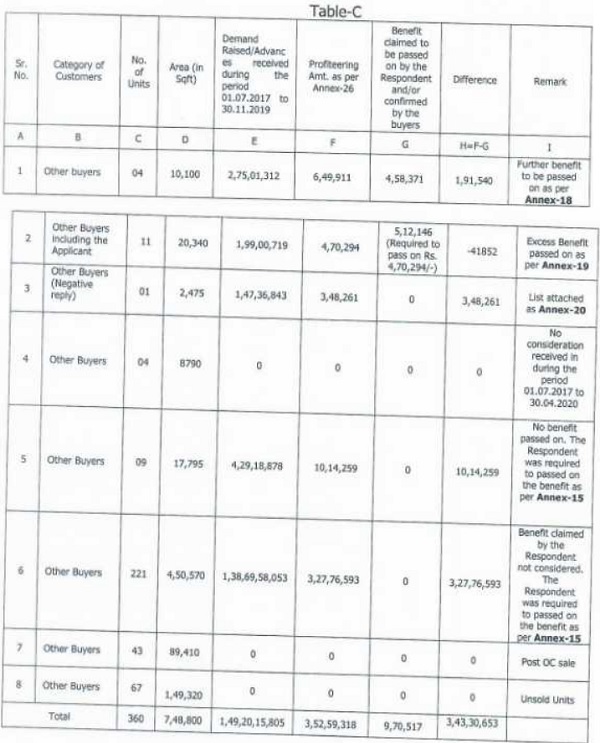
q. Out of 360 units, 67 units were unsold as on 30.04.2020 and 43 units were sold after getting Occupancy Certificate. Therefore, profiteering had been calculated in respect of 250 {360-(67+43)} buyers. Out of 250 buyers, no consideration was received during the period 01.07.2017 to 30.04.2020 in respect of 04 buyers. Thus, the profiteered amount was to be passed on to 246 (250-4) buyers including the Applicant No. 1. In respect of 11 buyers who confirmed passing on benefit of ITC over e-mail, the Respondent had actually passed on excess benefit (Row No. 2 of Table-C). Hence the Respondent was still required to pass on benefit to 235(24611) buyers amounting to Rs. 3,43,30,653/- (35259318-(458371-1-470294)) including GST.
r. On the basis of the details of outward supplies of the construction Services submitted by the Respondent, it was observed that the Respondent is providing his services in the State of Haryana only.
s. In the post-GST period, the benefit of additional ITC to the tune of 2.11% of the turnover was accrued to the Respondent and the same was required to be passed on by the Respondent to his recipients. Hence, the provisions of Section 171 of the CGST Act, 2017 appeared to has been contravened by the Respondent, in as much as the additional benefit of ITC @2.11% of the base price received by the Respondent during the period 01.07.2017 to 30.04.2020, had not been passed on by the Respondent to all the recipients . On this account, the Respondent had realized an additional amount to the tune of Rs, 3,52,59,3181- (including GST).
t. The Respondent had claimed that he had passed on the ITC benefit to all buyers. However, since only 15 buyers confirmed through e-mails, the ITC benefit claimed to had been passed on to other buyers had not been accepted. As per table-C above, the Respondent was still required to pass on ITC benefit of Rs. 3,43,30,653/-including GST to 235 buyers.
u. That the present investigation covers the period from 01.07.2017 to 30.04.2020. Profiteering, if any, for the period post April, 2020, had not been examined as the exact quantum of ITC that would be available to the Respondent in future could not be determined at this stage.
3. The above Report was considered by this Authority and a Notice dated 08.03.2021 was issued to the Respondent to explain why the Report dated 26.02.2021 furnished by the DGAP should not be accepted and his liability for profiteering in violation of the provisions of Section 171 should not be fixed. The Respondent was directed to file written submissions, which he had filed on 08.04.2021, wherein the Respondent, inter alia, in addition to submissions already mentioned in the Report , had submitted that:-
a. Benefit of profiteering should be limited to excise portion i.e. CGST on purchase of goods:
The credit of taxes paid on inward supply of services and SGST paid on purchase of goods had been considered in calculation of profiteering amount. Prior to introduction of GST the Respondent had availed the benefit of credit of VAT on purchases of goods and service tax paid on input services.
On similar ground, credit of taxes paid on inward supply of Services and SGST paid on purchase of goods should had been allowed to him in the post GST period as well and should not be taken while calculating profiteering amount. Therefore, for the period before and after 01.07.2017, profiteering amount should be limited to Excise Duty part viz. CGST paid on purchase of goods only for which input credit was not available in pre GST regime and the same should be recalculated.
A detailed breakup of ITC availed in GST regime categorized as Goods, works contract service and other input services had been furnished by the Respondent.
b. Difference in tax rate:-
In the pre-GST period, Service Tax rate was leviable ©15% whereas GST ©18% was charged on services. Hence, there was excess 20% increase in tax paid on procurement of services and the same should be excluded from profiteering amount.
c. Benefit of WCT paid in ore-GST regime should be considered:-
While calculating the profiteered amount, the DGAP had not considered the benefit of WCT (viz. works contract tax) paid In pre-GST period. However, he was eligible to avail the credit of WCT and the same should have been taken into consideration for calculation of profiteering amount for the period FY 201617 & 2017-17 (April-June-17). The Respondent has submitted documents/details for deposit of WCT for the period FY 2016-17 & 2017-17 (April-June-17) with proof of payment after deduction of WCT.
d. Buyer’s confirmation:-
The DGAP has provided only 7-10 days to the home buyers for confirmation of the receipt of the benefit of ITC resulting in that some buyers could not send confirmation in short span of time. Due to very short period, it was possible that most of the buyers had even not seen the mails and could not revert. Now, post submission of report by DGAP some more customers had responded to the mail and had confirmed that he had received GST Benefit. Mere non receipt of confirmation did not tantamount that the home buyers had not been given the FTC benefit that was clearly shown in his Account statement.
The DGAP had received denial from only one customer that he had not received ITC benefit. The Respondent informed that said customer had not made payment of dues but in his Account statement the ITC benefit had been clearly shown. Moreover, the Respondent had received cancellation request for that unit and not making the payment.
Further, in respect of sales made during GST Regime, the Respondent had already considered and allowed ITC benefit while finalizing Sale Prices and had issued letters showing the bifurcation of rates charged wherein Rebate/Discount in prices had been shown. Also, post submission of report by DGAP, the Respondent had received direct confirmation from some customers in respect of sale made during GST Regime that he had received GST and the same had been mentioned in the confirmation letters. Therefore, the Respondent has requested to direct DGAP to consider confirmations received after finalisation of DGAP report and profiteering amount should be recalculated accordingly.
4. The above submissions of the Respondent were supplied to the DGAP and Supplementary Report under Rule 133(2A) of the CGST Rules, 2017 was sought on the above submissions of the Respondent. In response, the DGAP vide his Report dated 11.06.2021 had inter-alia furnished the following clarification:-
a. While calculating profiteering CENVAT of Service Tax paid on Input Services and ITC of VAT paid on purchase of inputs had been considered for the pre-GST periods. This had been correctly done on the basis of information supplied by the Respondent.
b. In the instant case, the allegation was that commensurate benefit of ITC was not passed on to the recipients of the service. In terms of Section 171 of the CGST Act, 2017, the Respondent was required to pass on the benefit of additional ITC to the tune of Rs. 3,52.59,318/- commensurately to the buyers as calculated in Report dated 26.02.2021. SGST was also part of GST and had to be included in calculation of profiteered amount.
c. It had been deliberated within the Directorate and it was decided that rebate of VAT(WCT) given to a registered person in the State of Haryana was not admissible as credit for the purposes of computing the profiteering. The HVAT Act and Rules, did not provide for WCT as any Tax, nor did it fall within the definition of Input Tax as per Section 2(w) of the HVAT Act. Further even if WCT was qualified as credit within the definition of ITC and was provided for, the same was not reflected as credit in any VAT return of the Respondent. Further, the DGAP was not authorized to check the conditions regarding availability of VAT credit under Section 42(2) of the HVAT Act, which was specifically upon the satisfaction of Assessing Authonty, as defined under section 2(e) of the HVAT Act. Accordingly, any credit which was not reflected in VAT Returns could not be considered. As per practice, investigation was based on the documents submitted by the Respondent and the data reflected in the Returns was analyzed in accordance with the relevant provisions.
d. The investigation Report was required to be submitted by DGAP in a time bound manner and therefore a reasonable time was given for furnishing the requisite Information. In order to ascertain the claim of the Respondent that the ITC benefit had been passed to the buyers, emails were sent on 18.02.2021 to 150 buyers selected on random basis. On the date of submission of Report i.e. 26.02.2021, only 6% confirmations were received. Therefore, that entire claim of passing on of ITC benefit by the Respondent was not accepted as less than 10% confirmations had been received through e-mails However, claim in respect of 15 buyers who had confirmed over email that ITC benefit was received by him was accepted.
e. Any confirmation received by the Respondent after issuance of Report by DGAP might be considered by this Authority. The DGAP could consider any such claim of benefit only if so directed by the NM.
5. Copy of the above clarifications dated 11.06.2021 under Rule 133(2A) of the CGST Rules, 2017 filed by the DGAP were supplied to the Respondent for filing his rejoinder/submissions. The Respondent had filed his rejoinder/submissions dated 30.06.2021 vide which he had reiterated his earlier submissions and had inter-alia stated:-
a. That Benefit of WCT Paid in pre-GST regime should be considered:-
It had been observed from the calculation of profiteering amount as calculated by DGAP that benefit of WCT (viz. works contract tax) paid In pre-GST period had not be considered. It was to be noted here that in pre-GST regime, benefit of WCT (VAT) credit was eligible to the Respondent either in form of deduction of taxable turnover to the extent of amount paid to contractor (amount on which WCT had been deducted) or in for deduction from tax payable to the extent of amount of WCT deducted.
b. The Respondent has relied upon the judgment of Honble Supreme Court in the case of M/s Larsen and Toubro [2013 (9) TMI 853 — SUPREME COURT] vide which it was held that the constitutional validity of Rule 58 of the MVAT Rules 2005, which provided that amount paid by way of price for sub-contract, if any, to subcontractors was deductible while computing the taxable turnover for the builder work contractor.
c. Similar view had been taken in the case of Larsen & Toubro Limited and another Vs. State of Andhra Pradesh and others (2006) 146 STC 616.
d. The Respondent has also relied upon the Order of this Authority in the case of Rahul Kumar vs. Emaar MGF Land Ltd. cited in 2020-TIOL-26 NAA-GST (Order Date: 11.12.2020) vide which claim of ITC of WCT (VAT) credit had not be allowed as the DGAP had alleged that the respondent did not submit any evidence. However, in instant case, in order to substantiate the claim, the Respondent had submitted all document details for deposit of WCT for the period FY 2016-17 & 2017-18 (April-June 17) as proof of payment of WCT.
e. Further, in the case of Deepak Kumar Khurana vs. Sattva Developers Pvt. Ltd. cited In 2019 (29) G.S.T.L. 374 (N.A.P.A.) (Order Date: 14.06.2019), the DGAP in his report submitted that the Respondent prior to 01.07.2017 was eligible to avail CENVAT credit of Service Tax paid on input services and deduction of the payment made to the registered contractors and sub-contractors on which VAT @ 4% was being levied. Accordingly, the. DGAP had considered WCT paid as ITC in pre-GST period. Therefore, the Respondent should be allowed benefit of WCT paid in pre-GST regime while calculating profiteering amount.
f. Buyer’s confirmation:- Post submission of report by DGAP some more customers had responded to the e-mail sent by the DGAP and had confirmed that they had received benefit of ITC and these additional confirmations from buyers must have been received by the DGAP after the report. Few customers had shared copy of email with Respondent. List of Name of the buyers along with his confirmation mail was attached by the Respondent.
g. In following list of cases, on the basis of credit notes/ledger statement/demand letter the Authority had considered that the builder had passed on the benefit to buyers:-