GST At 9 Years: System Is Running, Now Make It Simple For Common Taxpayer
GST was introduced in India from 1 July 2017. At that time, many big hopes and promises were made. It was said that India would now have one tax system, business would become easier, tax evasion would reduce, the number of taxpayers would increase, government revenue would rise, and the tax system would become simple.
It was also said that GST would reduce the web of taxes, give relief to traders, bring transparency for consumers, reduce complicated procedures, and create an automatic tax system.
Now GST has completed 9 years. Nine years is not a small period. Therefore, GST should now be honestly reviewed. We should not only clap for it, and we should not only criticize it. Whatever good has happened should be accepted, and wherever improvement is required, it should be clearly stated so that policymakers may get the right direction.
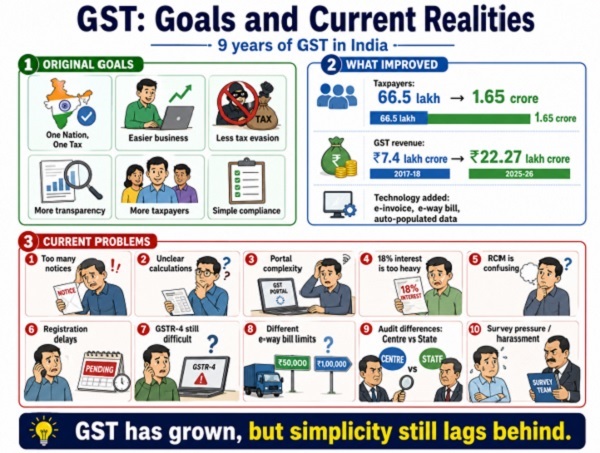
The biggest achievement of GST is that the number of taxpayers has increased and government revenue has also increased. At the time of GST, the number of taxpayers was around 66.5 lakh. Now it has reached around 1.65 crore. This is a big achievement. Revenue has also increased. In 2017-18, GST collection was around ₹7.4 lakh crore. In 2021-22, it became around ₹13.76 lakh crore, and in 2025-26 it reached around ₹22.27 lakh crore.
This means GST has surely increased government revenue. The number of taxpayers has also increased. A large part of business has now come on record. But the real question is this: Has GST made life easier for the common taxpayer or trader? The answer is — to some extent yes, but not fully.
In simple words, GST collection has increased, taxpayers have increased, and the system has become bigger. But the taxpayer still feels that the journey towards simplicity has been left behind. Let us see how this journey has been and what we can expect in the future.
In the beginning, the GST portal troubled everyone
No tax professional or trader can easily forget the early years of GST. The portal used to hang. While filing returns, the system often stopped working. GSTR-1, GSTR-3B, ITC matching, invoice upload — everything was new and everything was difficult. Many times it felt that the GST portal was a bigger law than the GST law itself.
Now the situation is better than before. The portal does not trouble taxpayers as much as it did earlier. Facilities like e-invoice, e-way bill and auto-populated data have come. NIL return filing through SMS was also introduced. These are good steps.
But only because the portal is working, we cannot say that GST has become simple. Real simplicity will come when taxpayers receive fewer notices, mismatches reduce, small traders do not lose sleep every month matching data, and departmental notices clearly mention where the mistake is.
Even today, many notices mention the demand amount, but the calculation is not clear. Invoice-wise details are not given. Party-wise working is not provided. This system should now change.
Taxpayers have got used to GST, but GST has not become easy
Today taxpayers are not as afraid of GST as they were in the beginning. They have become used to filing returns, preparing e-way bills, checking ITC, looking at GSTR-2B, filing annual returns, and replying to notices if they come.
But getting used to a difficult thing does not mean that the thing has become easy.
Even today, a small trader cannot understand GST on his own. He needs an accountant. He needs a consultant. This shows that GST has still not become a law in the language of the common taxpayer.
The next target of GST should be that even a small trader should be able to understand his basic compliance. The law should not be so difficult that an expert is required for every small matter.
18% interest rate is very heavy
Under GST, if tax is paid late, interest is charged at 18%. In today’s time, this rate appears very high, especially in cases where the government has not suffered any real loss.
For example, in many RCM cases, the taxpayer first pays tax and then takes ITC of the same tax. In the end, the government suffers no real revenue loss. Still, if there is a delay, 18% interest is charged. This is a harsh system for honest taxpayers.
The purpose of interest should not be to punish the taxpayer. The purpose of interest should only be to compensate the government for the time value of money. If someone commits fraud or intentionally does not pay tax, strict rules should apply. But there should be a difference between a genuine mistake and fraud.
The GST interest rate should be reconsidered. Relief should be given in revenue-neutral cases.
Registration process should be simple, not like an examination
GST registration is the first step to start a business. If the first step itself becomes difficult, how will a businessman move forward?
In the last few years, some improvements have been made in registration. Threshold limits for small traders were increased. The limit for the composition scheme was increased. In some cases, faster registration was discussed. Provisions like Rule 14A were also introduced in this direction.
But in the language of the common trader, the process is still not simple. A genuine businessman should not be trapped again and again in documents, physical verification and portal objections.
The principle of registration should be clear: honest businessmen should get quick registration, and suspicious cases should be checked on a risk-based basis. Looking at everyone with suspicion is not Ease of Doing Business.
Composition scheme was called simple, but GSTR-4 is difficult
The composition scheme was made for small traders. The idea was that small traders would pay tax at a fixed percentage on their turnover and stay away from the complications of ITC.
But the annual return of a composition dealer is still not easy. In GSTR-4, details of purchases are asked. This is difficult to understand. A composition dealer does not take ITC on purchases. His tax is payable on sales. Then what is the purpose of asking for complete details of normal purchases?
It is correct to ask for details of RCM purchases because tax liability arises on them. But asking for details of every purchase is against the basic idea of the composition scheme.
The annual return of a composition dealer should be very short and simple. It should contain only total turnover, tax payable, tax paid, RCM liability and declaration. Small traders should be treated like small traders.
RCM: The most confusing part of GST
Reverse Charge Mechanism, or RCM, is one part of GST which many taxpayers still do not understand properly.
In simple language, RCM means that the tax will not be paid by the seller, but by the buyer. It sounds simple, but in practice it is very confusing.
On which service will RCM apply? On which date will liability arise? Is self-invoice required or not? When should payment voucher be prepared? When will ITC be available? These complicated questions and procedures trouble common taxpayers.
If RCM was really simple, then how did even those taxpayers make mistakes who would have received ITC immediately if they had paid RCM on time? Now they have to pay interest and penalty.
The biggest problem is in cases where RCM has no real financial impact. The taxpayer pays tax and then takes credit of the same tax. In the end, the government has no loss. Still, if there is a mistake, interest, penalty and notice follow.
RCM should now be made very limited and simple. In revenue-neutral RCM cases, heavy interest and penalty should not be imposed.
E-way bill: One country, but different limits?
GST was called “One Nation, One Tax”. But different e-way bill limits in different states weaken this idea.
In one state, e-way bill may not be required for a certain value, but in another state, e-way bill may be required for the same value. This creates difficulty for both traders and transporters. It is not easy to remember different limits of every state.
If GST is a national tax system, the basic e-way bill limit should also be the same at the national level. Allowing each state to keep different limits does not give convenience to traders; it creates confusion.
Different audit style of Centre and State
Audit is necessary in GST, but the method of audit should also be proper.
Many times, it is seen that State GST issues audit notice for one year, while Central GST issues audit notice for five years. The taxpayer is the same, the law is the same, the records are also similar, but departments follow different styles and often conduct audit for a long period.
This creates a heavy burden on the taxpayer. He has to again prepare old records, reconciliations, returns, invoices and ledgers.
There should be a national SOP for GST audit. There should be coordination between Centre and State. Audit should be for checking compliance, not for creating pressure and collecting payment.
Commodity-wise survey should not become harassment
GST law gives inspection and survey powers to the department. These powers are necessary to stop tax evasion. But they must be used very carefully.
Commodity-wise surveys sometimes start looking like harassment. In the name of one commodity, pressure is created on many traders. Documents are demanded. Sometimes payment pressure is created on the spot.
There should be a clear SOP for this. Survey should be risk-based. There should be written authorization. Taxpayers should be informed about their rights. There should be no forced recovery on the spot. Survey observations should be given in writing.
Enforcement is necessary, but harassment is not.
GST Tribunal came late, but now there is hope
GST law was introduced, but the GST Appellate Tribunal was not formed for a long time. This was a major weakness of the GST system.
When there was no Tribunal, where could the taxpayer go? In many cases, taxpayers had to approach High Courts. Many appeals remained pending. Money remained blocked in pre-deposit. The burden of disputed demand continued.
Now the Tribunal has been formed. It has come late, but it is a welcome step. Now there is hope that a special forum will be available for GST disputes.
But the Tribunal should not be only for name. Hearings should take place on time. Orders should be in simple language. Appeals should not be rejected for small technical mistakes. Similar matters should get similar decisions.
In GST, justice is as important as collection. The success of GSTAT will depend on whether it gives timely justice to taxpayers.
Number of GST notices should reduce
Data matching in GST is a good thing. But sending notice for every mismatch is not a good system.
Today notices have increased on the basis of GSTR-1, GSTR-3B, GSTR-2B, e-way bill, e-invoice and annual return. Many notices may catch real tax evasion, but many notices are issued only due to timing difference or clerical mistakes.
Every mismatch is not tax evasion. Sometimes the supplier uploads the invoice in the next month. Sometimes credit note is adjusted later. Sometimes amendment is made later. Sometimes tax has already been paid.
In such cases, first a soft intimation should be given. The taxpayer should get an opportunity to correct or explain the matter. Directly issuing show cause notice is not proper.
The principle in GST should be: notices should be fewer, but clear. Every notice should clearly mention invoice-wise details, calculation and legal basis.
Human interference should reduce, but the machine should also be intelligent
GST is a digital system. Therefore, use of technology is necessary. But technology should not mean that the system keeps issuing notices without understanding the facts.
Human interference should reduce so that discretion and pressure reduce. But the automatic system should also be intelligent.
If tax is already paid, if the supplier has reported the invoice later, if adjustment has been made through credit note, or if the matter is revenue-neutral, then harsh notices should not be issued.
GST must move from being merely digital to being intelligently digital.
The position of the buyer is still very weak
The biggest practical weakness of GST is the position of the buyer.
The buyer purchases goods. He takes the bill. He makes payment including tax. He receives the goods also. Still, if the seller does not pay tax, files return late, or does not upload the invoice, the buyer’s ITC is blocked.
What kind of justice is this?
An honest buyer cannot control the seller’s return. The buyer can only check whether the supplier is registered, whether the invoice is correct, whether goods have been received, and whether payment has been made through bank. But how can he ensure that the seller has paid tax to the government?
If the seller does not pay tax, action should be taken against the seller. Blocking the buyer’s ITC means punishing an honest buyer.
Buyer protection is necessary in GST. If the buyer has a valid invoice, goods or services have been received, and payment including tax has been made, then his ITC should remain protected. ITC should be denied only in cases of fake invoice, collusion or fraud.
GST will have to move from a seller-based system to a balanced system. An honest buyer should get confidence that he will not be punished for the seller’s mistake.
What is the future of GST?
The future of GST can be good, but for that the next target should not be revenue. The next target should be simplicity.
Now the government should not only say how much GST collection has increased. Now the government should say how much GST compliance has become simpler.
In the future GST system, these things are necessary:
1. Rate structure should be simple.
2. Small taxpayers should have separate and easy compliance.
3. RCM should be simplified.
4. Relief should be given in revenue-neutral cases.
5. Buyer’s ITC should be protected.
6. Notices should be fewer and clearer.
7. Audit and survey should be done as per SOP.
8. Tribunal should give timely justice.
9. Registration should be fast and simple.
10. GST portal should not be only digital; it should also be intelligent.
The real question
GST has strengthened the government. Now GST should also strengthen the taxpayer.
GST has increased revenue. Now GST should increase trust.
GST has increased the tax base. Now GST should increase simplicity.
GST has increased data. Now GST should increase justice.
GST has built the system. Now GST should make the system humane.
Conclusion
Nine years of GST are a story of both achievements and difficulties. It would be wrong to say that GST has failed. GST has increased the tax base, increased revenue, made technology a part of the tax system, and changed the indirect tax system of the country.
But it would also be wrong to say that GST has now become fully successful and simple.
GST is still difficult for the common taxpayer. Composition dealers are facing difficulties. RCM is confusing. Different e-way bill limits of different states create confusion. There is uncertainty in audit. There is lack of SOP in survey. Notices are increasing. Buyer’s ITC is at risk due to the seller’s mistake. Interest rate is harsh. Registration is still not fully easy.
Now GST should start its second journey.
The first journey was to implement GST. The second journey should be to simplify GST.
The success of GST should no longer be measured only by how much tax the government has collected. Now success should be measured by how easily a small trader understands GST, how confidently he does compliance, and how fairly he is treated by the department.
From 2017 to 2026, GST has shown its strength. Now GST must show its simplicity, sensitivity and justice.
This is the biggest need of the next phase of GST.
– Sudhir Halakhandi