“Law loses meaning when wielded as a weapon.”
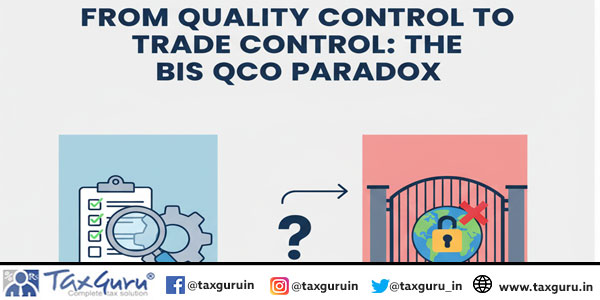
When the Times of India reported on November 04, 2025, that India is easing its Quality Control Orders (QCOs) — once used to restrict Chinese imports — it looked like a long-awaited policy correction. Yet beneath this headline lies a deeper malaise: the unpredictability of India’s economic regulation. Laws meant for quality assurance are being repurposed as instruments of political leverage and then hastily relaxed when convenient. This flip-flop is not just poor trade management; it’s an assault on the principle of legal certainty that underpins both commerce and governance.
The Flip-Flop of Trade Law
In early November 2025, Business Standard revealed that the government had begun fast-tracking import approvals for Chinese goods, including electronics, footwear, steel, and household items. These were products previously blocked or slowed under the QCO regime — ostensibly for quality reasons, but in practice functioning as technical barriers to trade.
The Times of India added that China’s exporters are “set to re-enter Indian markets after nearly four years of stalled clearances,” as officials rush to process long-pending Bureau of Indian Standards (BIS) certifications. The turnaround is startling. After 2020’s border tensions, India informally tightened trade with China by stalling BIS certifications for Chinese factories while domestic plants continued to get approvals.
Now, faced with consumer shortages and festive-season pressure, the same machinery that froze imports is suddenly melting the ice. The law that once justified restraint is being re-engineered to justify relaxation — without public debate or transparent rationale.
When Quality Controls Become Political Instruments
QCOs were introduced under the BIS Act to protect Indian consumers by enforcing standards of safety and quality. Their intent was noble. But intent without integrity degenerates into convenience.
After 2020, QCOs evolved from consumer-protection mechanisms into policy weapons. Instead of articulating a clear trade position against China, India used technical compliance hurdles — certification delays, inspection bottlenecks, and opaque processes — to achieve the same outcome without declaring it.
That approach might have seemed clever in the short term, but it violated the very spirit of the law. The BIS certification framework is meant to be predictable, scientific, and non-discriminatory. Once it becomes a proxy for trade diplomacy, it stops being law and turns into administrative theatre.
As reported by industry groups and even NITI Aayog’s internal review, many of these QCOs targeted raw materials and intermediate components not manufactured in India, crippling downstream industries. The government is now walking back some of those orders — a quiet admission that the overreach hurt Indian manufacturers more than it hurt Chinese exporters.
The Erosion of Trust
It takes years — even decades — to build a supply chain, but only a few policy swings to destroy one. When a manufacturer or importer invests in regulatory compliance, logistics, and supplier relationships, they are investing in trust: trust that the legal regime will remain stable, that tomorrow’s rule will resemble today’s, that the cost of compliance is not a political gamble.
When that trust collapses, rebuilding it is exponentially harder. As the saying goes, it is easy to destroy kingdoms, but rebuilding them takes far greater effort. Supply chains function like kingdoms of interdependence — delicate, layered, and slow-growing. Once disrupted by arbitrary law, they do not simply “restart” when a clearance is re-issued. They fracture, relocate, and, most dangerously, lose confidence in the jurisdiction itself.
The consequence is visible: industries hesitate to scale production; foreign partners tread cautiously; domestic investors seek predictability elsewhere. Policy volatility is the silent killer of economic resilience.
Unpredictability: The Real Threat to the Economy
The recurring tightening-and-loosening of QCOs exposes the real threat to India’s economy — not cheap imports or trade deficits, but policy unpredictability.
Laws gain legitimacy when they are applied consistently and transparently. The frequent invocation of executive power — sometimes in the name of consumer safety, sometimes to fix supply shortages — creates a perception that law in India is not principle, but preference. That perception damages not just trade but also the rule of law itself.
Arbitrariness is denunciation to legal order. The Supreme Court has repeatedly affirmed that any state action lacking reasoned justification offends Article 14’s guarantee of equality. Yet India’s import-control regime often operates through silence instead of reason — applications not denied but indefinitely delayed, standards imposed without capacity analysis, relaxations issued without explanation.
In 2024, WTO members such as Indonesia and Thailand explicitly accused India of violating the Technical Barriers to Trade (TBT) Agreement by enforcing QCOs unpredictably and with no clear timeline. When allies begin calling your quality law a trade barrier, the credibility deficit is no longer theoretical.
Sovereignty or Vulnerability?
Defenders of the QCO strategy argue that India has a sovereign right to safeguard its market. True — but sovereignty demands courage, not camouflage. If India intends to restrict trade with a country on strategic grounds, it should say so openly, through explicit policy instruments like import prohibitions or tariff adjustments.
Guile-based governance — invoking safety standards to hide geopolitical intent — is not sovereignty; it is vulnerability disguised as control. It shows that we are unwilling to speak our mind in the international arena and prefer bureaucratic maneuvering to principled policy.
When, after years of “protective” QCOs, the government suddenly opens the same gates under pressure of shortages or diplomatic recalibration, it sends a single message: India’s regulatory stance can be swayed, not trusted.
A rule-of-law nation cannot afford that image.
Reclaiming the Essence of Law
Every law is born from a principle. For QCOs, that principle is quality assurance — to ensure that Indian consumers receive safe, reliable products. The moment the enforcement deviates from that objective, the law loses its essence.
The purpose of regulation is not to make trade unpredictable but to make it dependably safe. The proper use of QCOs should focus on building testing capacity, harmonizing standards, and strengthening domestic quality culture — not on selectively squeezing foreign suppliers.
What we have instead is a cycle of instrumentalism — using the law when it suits the narrative and discarding it when the consequences bite. This not only undermines the legal framework but also signals to industry that compliance is conditional, not constitutional.
A Call for Policy Accountability
If India aspires to global leadership in manufacturing and trade, it must hold itself to the same standard it demands from others: clarity, consistency, and accountability.
Transparency should replace discretion. Every QCO or relaxation should be accompanied by a clear statement of rationale, economic impact, and expected duration. Public consultation must precede implementation, and data-based reviews should determine continuation or repeal.
Real sovereignty lies not in arbitrary control but in principled predictability. The ability to craft a transparent, stable trade policy — and to stand by it — is what distinguishes a confident state from an insecure one.
India’s policymakers must remember: laws are not tools of convenience. They are commitments — to fairness, to reason, to continuity. And when those commitments waver, economies tremble, investments pause, and trust dissolves.
In the end, rebuilding that trust will demand more than administrative correction. It will require moral courage — the courage to make the law serve its principle, not the politics of the day.
References:
- Times of India, 10 Nov 2025 — “Chinese goods set to re-enter Indian markets after nearly four years.”
- Business Standard, 4 Nov 2025 — “Government to expedite import approvals for Chinese goods.”
- Observer Voice, 10 Nov 2025 — “Government aims to alleviate QCO challenges for companies.”
- WTO TBT Committee records, 2024 — member statements on India’s unpredictable QCO enforcement.
Note from the Author
The views expressed in this article are based on an independent understanding of law, policy, and governance. They are not intended to criticise or undermine any policy decision or institutional effort. Rather, the purpose is to strengthen dialogue around transparency, predictability, and accountability in policymaking — values that ultimately reinforce the intent and spirit of the law itself.
For better reach this article discusses about
- India Quality Control Orders
- QCO policy India
- BIS certification delays
- India China trade restrictions
- Import policy unpredictability India
- Technical Barriers to Trade India
- WTO TBT India QCO
- India easing QCOs 2025
- BIS fast-tracking Chinese imports
- Regulatory uncertainty India