Income Tax : Budget 2015-16 -Rationalisation of provisions relating to Tax Deduction at Source (TDS) and Tax Collection at Source (TCS) Under C...
Income Tax : Interest payable by the assessee under section 220 Interest under section 220 is proposed to be increased or decreased as conseque...
Income Tax : The dispute concerned enforcement of long-pending tax demands without timely action. The Court held that prolonged inaction by aut...
Income Tax : The High Court held that once a resolution plan under IBC extinguishes prior tax liabilities, reassessment cannot be initiated. Th...
Income Tax : ITAT held that interest under Section 220(2) must be recomputed based on reduced assessed income after rectification under Section...
Income Tax : The Tribunal ruled that section 220(2) interest cannot be charged where the original demand notice showed nil demand, holding that...
Income Tax : Madras HC: Delayed self-assessment tax payment is not 'wilful evasion' under IT Act S. 276C(2) if the tax is paid before prosecuti...
The dispute concerned enforcement of long-pending tax demands without timely action. The Court held that prolonged inaction by authorities and absence of proof of service violated fairness. It quashed the notice while allowing fresh remedies.
The High Court held that once a resolution plan under IBC extinguishes prior tax liabilities, reassessment cannot be initiated. The notice under Section 148 was set aside. The ruling confirms that extinguished claims cannot be revived through reassessment.
ITAT held that interest under Section 220(2) must be recomputed based on reduced assessed income after rectification under Section 154. However, it clarified that interest will still run from the original demand date.
The Tribunal ruled that section 220(2) interest cannot be charged where the original demand notice showed nil demand, holding that interest arises only after a valid section 156 notice.
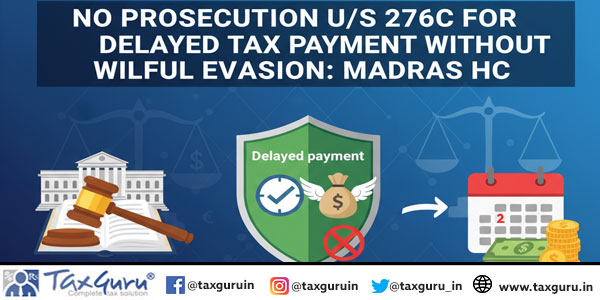
Madras HC: Delayed self-assessment tax payment is not ‘wilful evasion’ under IT Act S. 276C(2) if the tax is paid before prosecution. Mens rea is mandatory.
Read the Kerala High Court’s judgment on Section 220(2) of the Income Tax Act and its non-retrospective effect on tax interest in Catherine Thomas vs. Principal Chief Commissioner of Income Tax.
The legal principle is that the person who hears must decide. Therefore, by applying the said principle to the case on hand, the only conclusion that can be arrived at is to send back the matter for fresh consideration before the first respondent, on the plea for waiver of interest under section 220(2) and rule 5 of the Second Schedule to the Income Tax Act, 1961
Budget 2015-16 -Rationalisation of provisions relating to Tax Deduction at Source (TDS) and Tax Collection at Source (TCS) Under Chapter XVII-B of the Act, a person is required to deduct tax on certain specified payment at the specified rate if the payment exceeds the specified threshold. The person deducting tax (‘the deductor’) is required to […]
we feel that it would be appropriate if the ACIT reconsiders the application of the petitioner for stay in the light of the observations contained in the said decision [Soul v. DCIT (supra)]. This is so because according to the petitioner the assessment is a high pitched one inasmuch as it is approximately 17 times of the returned income.
Interest payable by the assessee under section 220 Interest under section 220 is proposed to be increased or decreased as consequent to any appeal, rectification or revision from the date of expiry of period stated in the notice of demand under section 156 of the Income Tax Act, 1961.