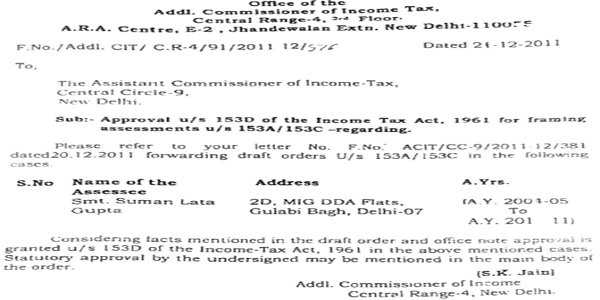
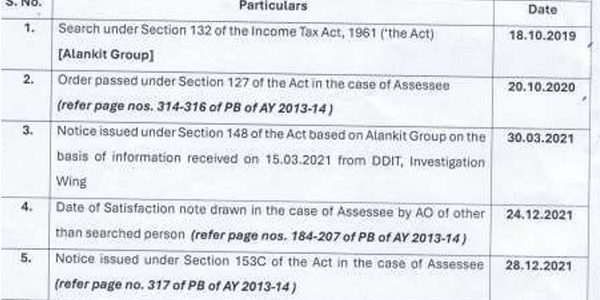
Income Tax : Judicial rulings clarify that satisfaction for initiating action against other persons in search cases must be recorded promptly. ...
Income Tax : CBDT issues new compounding guidelines simplifying process, eligibility, charges, and procedures under the Income-tax Act from Oct...
Income Tax : CBDT's new Compounding of Offence Guidelines (2024) simplify the process but maintain strict compliance rules. Learn about eligibi...
Income Tax : AY 2015-16 assessment under Section 153C held time-barred. Judicial rulings confirm six-year limit runs from handing over of seize...
Income Tax : Learn why a consolidated satisfaction note for multiple assessment years is legally invalid under Section 153C of the Income Tax A...
Income Tax : Learn about the new block assessment provisions for cases involving searches under section 132 and requisitions under section 132A...
Income Tax : The Tribunal held that an unsigned agreement without corroboration cannot be treated as incriminating material. Proceedings under ...
Income Tax : The Tribunal deleted additions where the Revenue failed to prove actual cash transactions. It emphasized that suspicion and assump...
Income Tax : The Tribunal held that reopening under Section 147 was invalid where it was based on third-party search material. It ruled that Se...
Income Tax : The issue was whether a notice granting less than the statutory minimum time is valid. The tribunal held that giving less than 7 d...
Income Tax : The Court held that a 21-month delay in recording the satisfaction note violates the requirement of immediacy. It ruled that such ...
Income Tax : Central Government has decided to extend the time limits to 30th June, 2021 in the following cases where the time limit was earlie...
Income Tax : Availability of Miscellaneous Functionalities related to ‘Selection of Case of Search Year’ and ‘Relevant Search...
ITAT held that reassessment without issuing notice under Section 143(2) is invalid, even if return was filed late. The ruling emphasizes that issuance of notice is mandatory and absence of it makes the assessment void.
The issue involved additions for alleged cash payments based on third-party data and statements. ITAT deleted the additions, holding that no independent evidence or cross-examination opportunity was provided.
The issue was whether a single satisfaction note can cover multiple assessment years under Section 153C. The Tribunal held that absence of year-wise satisfaction renders the proceedings invalid. The key takeaway is that jurisdiction requires specific satisfaction for each year.
The issue was whether reassessment under Section 147 is valid after a search. The ITAT held it invalid, ruling that only Section 153A applies post-search, making the reassessment void.
The Tribunal ruled that additions under Section 69 cannot be sustained when based solely on third-party statements and unverified electronic data. It emphasized the absence of independent evidence and upheld the taxpayers denial of cash payments.
The issue was whether proceedings under Section 153C were time-barred. The Tribunal held that the assessment fell outside the limitation period and was therefore invalid.
The issue was whether a single satisfaction note for multiple years is valid under Section 153C. ITAT Pune held it invalid, ruling that separate satisfaction per year is mandatory, thereby quashing the entire assessment.
The issue was whether protective additions can survive when substantive additions are deleted. The ITAT held that once the substantive addition fails on merits, the protective addition based on the same material cannot be sustained.
The Tribunal held that a notice issued under section 148 beyond the six-year limitation under the old law is invalid. It clarified that the first proviso to section 149 bars such reopening even under the amended regime.
The case involved addition for alleged on-money payment based on search findings of a builder. The ITAT ruled that absence of corroborative evidence and denial of cross-examination makes the addition unsustainable.