Ramdas Chabaji Dhankude Vs ACIT (ITAT Pune)
Core Issue:– The central issue involved is whether the assumption of jurisdiction under section 153C of the Income Tax Act is valid where the Assessing Officer records a single consolidated satisfaction note for multiple assessment years, or whether the law mandates separate and year-specific satisfaction for each assessment year, failing which the entire proceedings become void ab initio.
Facts:- The assessee, an individual, originally filed return declaring income from partnership firm and other sources. A search under section 132 was conducted at the premises of a third party, during which certain documents allegedly belonging to the assessee were seized. Based on such material, proceedings under section 153C were initiated. The Assessing Officer of the searched person as well as the Assessing Officer of the assessee recorded satisfaction notes; however, both satisfaction notes were common and consolidated covering multiple assessment years (2012-13 to 2018-19) instead of being recorded separately for each year. Notices were issued and assessments were completed accordingly. The assessee challenged the validity of such proceedings on the ground that consolidated satisfaction vitiates jurisdiction.
ITAT Finding:- The Tribunal held that recording of satisfaction under section 153C is a jurisdictional condition precedent and must be strictly complied with. It was observed that satisfaction must be recorded separately for each assessment year with specific reference to incriminating material relatable to that year. A consolidated satisfaction note covering multiple years is not in accordance with law and reflects non-compliance with statutory requirements. Relying on binding and persuasive judicial precedents, the Tribunal held that such defect is not procedural but goes to the root of jurisdiction. Accordingly, since both the Assessing Officers recorded consolidated satisfaction notes, the Tribunal held that the entire proceedings under section 153C were invalid and liable to be quashed, and the assessments were set aside.
Summary of Cases Relied Upon (Validity of Consolidated Satisfaction u/s 153C)
1. In CIT vs Sunil Kumar Sharma (2024) 165 taxmann.com 846 (SC) the Supreme Court dismissed the SLP filed by the Revenue against the Karnataka High Court ruling, thereby giving finality to the principle that recording a consolidated satisfaction note for multiple assessment years is not valid in law and vitiates the entire proceedings under section 153C.
2. In DCIT vs Sunil Kumar Sharma (2024) 159 taxmann.com 179 (Karnataka High Court) it was categorically held that satisfaction under section 153C is required to be recorded separately for each assessment year, and a combined satisfaction note for multiple years renders the assumption of jurisdiction invalid.
3. In Saksham Commodities Ltd vs ITO (2024) 464 ITR 1 (Delhi High Court) the Court reiterated that jurisdiction under section 153C is conditional upon strict compliance, and the satisfaction note must clearly demonstrate year-wise nexus of incriminating material, failing which the proceedings are liable to be quashed.
4. In Shri Rajendra Rameshlal Gugale vs PCIT (ITAT Pune, 30.12.2024) the Tribunal quashed the assessment holding that a consolidated satisfaction note covering multiple years is contrary to law and invalidates the entire 153C proceedings.
5. In Rameshbhai Harlilal Patel vs ACIT (ITAT Pune, 12.09.2025) it was held that recording a combined satisfaction note for different assessment years is a jurisdictional defect, and such defect cannot be cured, leading to quashing of assessment.
6. In Chitra Narendra Parmar vs ACIT (ITAT Pune, 14.07.2025) the Tribunal, following High Court precedents, held that satisfaction must be recorded separately for each year, and a consolidated note vitiates the proceedings ab initio.
7. In ACIT vs Subhash Jivraj Jain (ITAT Pune, 21.07.2025) it was reiterated that non-recording of year-specific satisfaction under section 153C strikes at the root of jurisdiction, making the assessment invalid.
8. In M/s Aashrya Developers (P.) Ltd. vs ACIT (ITAT Delhi, 31.12.2024) the Tribunal held that a common satisfaction note for multiple years fails to meet statutory requirements, and therefore, proceedings initiated on such basis are unsustainable in law.
9. In SRS Panchratan Diamonds Pvt. Ltd. vs DCIT (ITAT Delhi, 14.11.2025), following Saksham Commodities Ltd. and Sunil Kumar Sharma, it was held that recording a consolidated satisfaction note is fatal to the assumption of jurisdiction under section 153C, resulting in quashing of the assessments.
Summary :-Overall Legal Position Emerging
Across all the above decisions, a consistent and settled legal principle emerges that recording of satisfaction under section 153C is a jurisdictional precondition which must be exercised with strict compliance on a year-wise basis. Any deviation in the form of a consolidated or common satisfaction note for multiple assessment years is fatal and renders the entire assessment proceedings void ab initio.
FULL TEXT OF THE ORDER OF ITAT PUNE
ITA No.823/PUN/2024 filed by the assessee is directed against the order dated 20.03.2024 of the Ld. CIT(A), Pune -12 relating to assessment year 2016-17. ITA No.824/PUN/2024 filed by the assessee is directed against the order dated 16.03.2024 of the Ld. CIT(A), Pune -12 relating to assessment year 2018-19. Since identical grounds have been raised by the respective assessees in these appeals, therefore, for the sake of convenience, these were heard together and are being disposed of by this common order.
2. First we take up ITA No.823/PUN/2024 as the lead case. Facts of the case, in brief, are that the assessee is an individual and has filed his original return of income on 14.01.2017 disclosing total income of Rs.7,05,770/- being the share income from partnership firm and income from other sources. A search and seizure action u/s 132 of the Income Tax Act, 1961 (hereinafter referred to as ‘the Act’) was carried out on 19.12.2017 at the residential premises of Mr. Baburao Dattareya Chandere at 1053, Gokhale Cross Road, Matruda Building, Shivajinagar, Pune during which incriminating material belonging to the assessee was seized. The satisfaction as required u/s 153C of the Act by the Assessing Officer of the searched person was recorded on 09.12.2020. Thereafter, another satisfaction was recorded on 16.10.2020 by the Assessing Officer of the assessee and accordingly a notice u/s 153C of the Act dated 19.10.2020 for the assessment year 2016-17 was issued and duly served on the assessee calling for the return of income within 30 days from the service of the said notice. The assessee in response to the same filed his return of income on 11.11.2020 disclosing total income of Rs.9,79,410/- being the share income from partnership firm and income from other sources. The assessee also requested the Assessing Officer to give the details of the searched person in this case, the certified true copy of the satisfaction note and the documents referred to as incriminating in the satisfaction note. The Assessing Officer thereafter issued statutory notice u/s 143(2) of the Act requiring the assessee to produce any documents, accounts or any other evidence on which the assessee may rely in support of the return filed. Thereafter, a notice u/s 142(1) of the Act along with a detailed questionnaire was issued to the assessee. The assessee made partial submission which was examined by the Assessing Officer. The Assessing Officer noted that the assessee has disclosed short term capital gain on sale of flat at Pride Platinum amounting to Rs.2,73,638/-. The return was filed only after the issue of notice u/s 153C of the Act and therefore, penal provisions are attracted on this capital gain disclosed on this transaction. He accordingly initiated penalty proceedings u/s 271(1)(c) of the Act after accepting the income returned by the assessee in response to the notice u/s 153C of the Act.
3. Before the Ld. CIT(A) the assessee apart from challenging the initiation of penalty proceedings by the Assessing Officer, challenged the validity of issue of notice u/s 153C on various issues. However, the Ld. CIT(A) was not satisfied with the arguments advanced by the assessee and dismissed the appeal.
4. Aggrieved with such order of the Ld. CIT(A) the assessee is in appeal before the Tribunal by raising the following grounds:
1. The learned CIT(A) has erred in not appreciating the contention of the appellant that assessment order passed U/Sec. 153C of the Act is bad in law and void ab intio on account of following:
a. The approval granted by Additional CIT U/Sec. 153D of the Act does not contain Document Identification Number (DIN) which is in contravention to CBDT Circular No.19/2019 dated 14.08 2019.
b. The Additional CIT has granted approval U/Sec.153D of the Act mechanically without application of mind.
2. The learned CIT(A) while holding that assessment order passed by the learned AO is not bad in law has erred in not appreciating the fact:
a. That there are Jurisdictional High Court and ITAT Orders wherein the said issue is decided in the favour of the appellant.
b. That while holding that additional ground raised does not require adjudication only on the ground that while deciding the issue of mandatory allocation of DIN, the Hon’ble Apex Court vide their order dated 03.01.2024 has stayed the Hon’ble Delhi High Court’s observation on Mandatory Allocation of “DIN” while Communicating Notice, Order, and Summons, without appreciating that the issue involved in the case of the appellant relates to DIN on approval granted by Additional CIT and not to DIN on the assessment order.
3. The learned CIT(A) has erred in dismissing appellant’s appeal and confirming the action of the AO without appreciating that notice U/Sec. 153C of the Act and the assessment order passed U/Sec.153C of the Act is bad in law as no incriminating evidence has been found relating to this year in the course of search and nowhere in the satisfaction note it is remarked that the documents found are incriminating in nature.
4. The learned CIT(A) has erred in ignoring the fact that the appellant has not filed the return of income in this year only after the issue of notice U/Sec.153C of the Act and has instead rectified the short-term capital loss shown in original return of income.
5. The learned CIT(A) has further erred in dismissing appellant’s appeal on merits in a summary manner only on the basis of observations of the AO given in the assessment order and disregarding the submissions made by the appellant without assigning any valid reason.
6. The appellant craves leave to add, alter, amend, or delete any of the above grounds of appeal.
5. The assessee has raised the following additional ground:
“The assessment order passed by the Ld.AO is bad in law and void ab initio as consolidated satisfaction has been recorded u/s 153C of the Act for different assessment years by the Ld. AO which vitiates the entire assessment proceedings as the same is not in accordance with the law.”
6. The Ld. Counsel for the assessee referring to the above additional ground submitted that the additional ground raised is purely legal in nature which goes to the root of the matter and all necessary facts are already available on record. Referring to the decision of Hon’ble Supreme Court in the case of the National Thermal Power Co. Ltd. v. CIT [1998] 229 ITR 383 (SC) and in the case of Jute Corporation of India Ltd vs Commissioner Of Income Tax And Anr (1991) 187 ITR 688 (SC) he submitted that the additional ground raised by the assessee should be admitted.
7. The Ld. DR on the other hand strongly objected to the admission of the additional ground raised by the assessee.
8. After hearing both the sides and considering the fact that the additional ground raised by the assessee is purely legal in nature and all the material facts required for adjudication of the issue are already available on record and no new facts are required to be investigated, therefore, in view of the decisions of Hon’ble Supreme Court in the case of National Thermal Power Co. Ltd. v. CIT (supra) and in the case of Jute Corporation of India Ltd vs Commissioner Of Income Tax And Anr (supra), the additional ground raised by the assessee is admitted for adjudication.
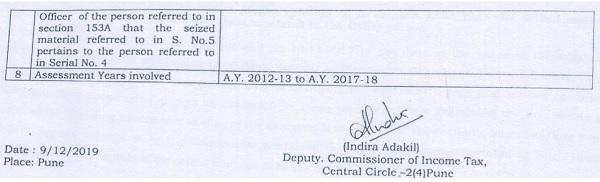
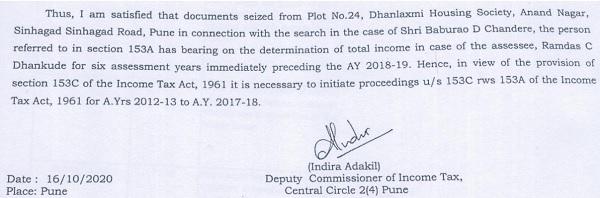
9. The Ld. Counsel for the assessee at the outset referring to the copy of satisfaction note recorded u/s 153C of the Act by the Assessing Officer in the case of the searched person on 09.12.2019, copy of which is placed at pages 20 to 23 of the paper book, drew the attention of the Bench to the same and submitted that the Assessing Officer has issued a common satisfaction note for assessment years 2012-13 to 2017-18. Referring to the copy of the satisfaction note by the Assessing Officer of the assessee for assessment years 2012-13 to 2018-19 dated 16.10.2020, copy of which is placed at pages 24 to 27 of the paper book, he submitted that here also the Assessing Officer has recorded a common satisfaction note for assessment years 2012-13 to 2017-18. Referring to the following decisions, he submitted that the assessment order is bad in law if a consolidated satisfaction note is recorded u/s 153C of the Act for all the assessment years:
i) CIT vs. Sunil Kumar Sharma (2024) 165 com846 (SC)
ii) DCIT vs. Sunil Kumar Sharma (2024) 159 com179 (Kar)
iii) Saksham Commodities Ltd vs. ITO (2024) 464 ITR 1 (Del)
v) Rameshbhai Harlilal Patel vs. ACIT vide IT(SS)A Nos.6 & 7/PUN/2025 order dated 12.09.2025 for assessment years 2017-18 and 2018-19
10. Referring to the decision of the Delhi Bench of the Tribunal in the case of SRS Panchratan Diamonds Pvt. Ltd. vs. DCIT vide ITA Nos.218 & 219/Del/2023 order dated 14.11.2025 for assessment years 2015-16 & 2016-17, he submitted that the Tribunal, following the decision of Hon’ble Delhi High Court in the case of Saksham Commodities Ltd. vs. ITO reported in 464 ITR 1 (Del) and the decision of Hon’ble Karnataka High Court in the case of Sunil Kumar Sharma (supra) has held that recording of consolidated satisfaction note for various assessment years by the Assessing Officer would become fatal to the very assumption of jurisdiction and consequential framing of assessment u/s 153C of the Act. He accordingly submitted that since in the instant case the Assessing Officer of the searched person as well as the Assessing Officer of the assessee have prepared a common satisfaction note for various assessment years, therefore, in view of these decisions, the notice issued u/s 153C of the Act by recording a common satisfaction note for different assessment years, vitiates the entire assessment proceedings.
11. The Ld. DR on the other hand submitted that even though a common satisfaction note has been written for all the years it does not show non-application of mind by the Assessing Officer. The satisfaction note is not a perfunctory satisfactory note. It gives proper reference to all the seized material and the amounts involved therein. Therefore, it shows due application of mind by the Assessing Officer. Relying on various decisions, he submitted that no prejudice has been caused to the assessee since the addition has been made only in those years for which the transaction pertains and there is no double addition.
12. We have heard the rival arguments made by both the sides, perused the orders of the Assessing Officer and Ld. CIT(A) and the paper book filed on behalf of the assessee. We have also considered the various decisions cited before us. We find the assessee in response to the notice u/s 153C of the Act filed his return of income on 11.11.2020 declaring total income of Rs.9,79,410/- as against the income declared in the original return at Rs.7,05,770/-. The assessee in the return filed in response to the notice u/s 153C of the Act has disclosed short term capital gain on sale of flat at Pride Platinum amounting to Rs.2,73,638/-. Although the Assessing Officer has accepted the income declared in the return filed in response to the notice u/s 153C of the Act, however, he initiated penalty proceedings u/s 271(1)(c) of the Act on the ground that the assessee has concealed the particulars of income. We find before the Ld. CIT(A), the assessee apart from challenging the initiation of penalty proceedings u/s 271(1)(c) of the Act, challenged the validity of the assessment u/s 153C of the Act which was rejected by the Ld. CIT(A). It is the submission of the Ld. Counsel for the assessee that since the Assessing Officer of the searched person as well as the Assessing Officer of the assessee have recorded a combined satisfaction note for assessment years 2012-13 to 2018-19, therefore, such satisfaction note being not in accordance with law, the entire 153C proceedings are vitiated.
13. We find some force in the above arguments of the Ld. Counsel for the assessee. A perusal of the copy of the satisfaction note recorded u/s 153C of the Act by the Assessing Officer of the searched person dated 09.12.2019, copy of which is placed at pages 22 to 23 of the paper book shows that the Assessing Officer at clause 8 has recorded the combined satisfaction note for assessment years 2012-13 to 2017-18 which reads as under:
14. We find the Assessing Officer of the assessee has also recorded a combined satisfaction note for assessment years 2012-13 to 2017-18, copy of which is placed at page 27 of the paper book and which reads as under:
15. We find the Co-ordinate Bench of the Tribunal in the case of Chitra Narendra Parmar vs. ACIT (supra) while quashing the assessment on account of combined satisfaction recorded for various assessment years has observed as under:
“59. Thus, it is seen that the Assessing Officer has passed a combined satisfaction note for various assessment years. We find the Hon’ble Karnataka High Court in the case of DCIT v. Sunil Kumar Sharma (supra) has held that satisfaction note is required to be recorded u/s 153C of the IT Act, 1961 for each assessment year and hence, a consolidated satisfaction note recorded for different assessment years would vitiate the entire assessment proceedings. The relevant observations of Hon’ble High Court read as under:
“53. Further, satisfaction note is required to be recorded under section 153C of the IT Act for each Assessment Year and in the impugned proceedings, a consolidated satisfaction note has been recorded for different Assessment Years, which also vitiates the entire assessment proceedings. In view of all these findings, it is said that the appeals do not have any substance for seeking intervention as sought for by the appellant/ Revenue.”
60. We find when the Revenue challenged the above order of the Hon’ble Karnataka High Court in the case of DCIT vs. Sunil Kumar Sharma (supra), the Hon’ble Supreme Court in SLP (Civil) Diary No.21526 of 2024 vide order dated 20th August, 2024 dismissed the SLP filed by the Revenue.
61. We find following the above decision, the Co-ordinate Bench of the Tribunal in the case of Shri Rajendra Rameshlal Gugale vs. PCIT vide ITA No.1676/PUN/2024 for assessment year 2017-18, order dated 30.12.2024 has quashed the assessment proceedings by observing as under:
“8.7. Since in the instant case a consolidated satisfaction note has been prepared for assessment years 2012-2013 to 2018-2019, therefore, the consolidation satisfaction note being not in accordance with law, therefore, the entire assessment proceedings is liable to be quashed. We hold accordingly and quash the assessment.”
62. So far as the decision of the Hon’ble Delhi High Court in the case of Indian National Congress vs. DCIT (supra) relied on by Ld. DR is concerned, we find no doubt there is a favourable decision in favour of the Revenue on the issue of combined satisfaction. However, it has been held in various decisions that when there are two views possible on an issue and there is no decision of the jurisdictional High Court on that issue, then the view which is favourable to the assessee has to be adopted. Even the Ld. DR in his written submissions has cited the decision of the Hon’ble Supreme Court in the case of CIT vs. Naga Hills Tea Co. Ltd. (1973) 89 ITR 236 (SC) where the Hon’ble Supreme Court at page 240 has observed as under:
“If a provision of a taxing statute can be reasonably interpreted in two ways, that interpretation which is favourable to the assessee, has got to be accepted. This is a well-accepted view of law.”
63. Further, the Hon’ble Supreme Court recently in the case of M/s. A.P. Electrical Equipment Corporation vs. The Tahsildar & Ors. (supra) has held that if two decisions of this Court appear inconsistent with each other, the High Courts are not to follow one and overlook the other, but should try to reconcile and follow that decision whose facts appear more in accord with those of the case at hand. Following the above principle and considering the fact that the Hon’ble Supreme Court has dismissed the SLP filed by the Revenue in the case of DCIT vs. Sunil Kumar Sharma (supra), therefore, we follow the decision of the Hon’ble Karnataka High Court in the case of DCIT vs. Sunil Kumar Sharma (supra) and hold that the satisfaction note is required to be recorded u/s 153C for each assessment year and a consolidated satisfaction note recorded for different assessment years would vitiate the entire assessment proceedings. Since in the instant case a consolidated satisfaction note has been prepared for assessment years 2012-13 to 2018-19, therefore, such consolidated satisfaction note being not in accordance with law, the entire assessment proceedings are liable to be quashed. We hold and direct accordingly.”
16. We find the Delhi Bench of the Tribunal in the case of SRS Panchratan Diamonds Pvt. Ltd. vs. DCIT (supra), following the decision of Hon’ble Delhi High Court in the case of Saksham Commodities Ltd. vs. ITO (supra) and the decision of Hon’ble Karnataka High Court in the case of Sunil Kumar Sharma (supra) has held that recording of consolidated satisfaction note for various assessment years by the Assessing Officer would become fatal to the very assumption of jurisdiction and consequential framing of assessment u/s 153C of the Act. The various other decisions relied on by the Ld. Counsel for the assessee also supports his case to the proposition that a combined satisfaction note for various assessment years recorded by the Assessing Officer would vitiates the entire assessment proceedings. Since in the instant case also a consolidated satisfaction note has been prepared for assessment years 2012-13 to 2018-19, therefore, such a consolidated satisfaction for issue of notice u/s 153C of the Act being not in accordance with law, the entire assessment proceedings are liable to be quashed. We hold and direct accordingly. The additional ground raised by the assessee is accordingly allowed.
17. Since the assessee succeeds on this legal ground, therefore, the grounds challenging the initiation of penalty proceedings become academic in nature and therefore, the same are not being adjudicated. The grounds raised by the assessee are accordingly allowed.
18. After hearing both sides, we find identical grounds have been raised by the assessee in ITA No.824/PUN/2024 including the additional ground. We have already decided the issue of combined satisfaction note and allowed the additional ground raised by the assessee. Following similar reasonings, we allow the additional ground raised in ITA No.824/PUN/2024.
19. In the result, both the appeals filed by the assessee are allowed.
Order pronounced in the open Court on 23rdMarch, 2026.