Income Tax : The ruling clarifies that unauthenticated digital chats and screenshots cannot form the sole basis of tax additions without proper...
Income Tax : Judicial rulings clarify that satisfaction for initiating action against other persons in search cases must be recorded promptly. ...
Income Tax : Section 270A penalties must specify the exact misreporting clause. Vague notices invalidate penalties and can restore immunity und...
Income Tax : Understand the three core processes of Indian Income Tax: Rectification of mistakes (Sec 154), the four types of Assessment (Summa...
Income Tax : Understand your legal rights and procedural protections during Income Tax and PMLA raids in India. Learn what to do and what to a...
CA, CS, CMA : Legal opinion sought by NFRA on auditing standards, penalties, and regulatory roles in India. Analysis of NFRA’s powers under th...
Income Tax : Learn about the new block assessment provisions for cases involving searches under section 132 and requisitions under section 132A...
Goods and Services Tax : The Ministry of Finance reports the arrest of a firm's finance head for GST evasion worth Rs 88 crore. Learn about the case and it...
Income Tax : The Central Board of Direct Taxes ( CBDT) has directed re-opening of all cases under the search and seizure label, income-escapin...
Income Tax : The ITAT Ahmedabad held that isolated WhatsApp messages and electronic communications cannot, by themselves, support additions in ...
Income Tax : ITAT Ahmedabad held that penalty under Section 43 of the Black Money Act could not be imposed when foreign assets were subsequentl...
Income Tax : The Hyderabad Bench emphasized that penalty under Section 271(1)(c) cannot be imposed solely because an addition survives appellat...
Income Tax : The Tribunal held that Section 263 cannot be invoked where the assessee never claimed the alleged expenditure as a deduction. With...
Income Tax : The Tribunal ruled that proportionate interest disallowance under Section 36(1)(iii) cannot be sustained when the assessee has ade...
Income Tax : Read the order issued by the Central Board of Direct Taxes (CBDT), Ministry of Finance, specifying the scope of the e-Appeals Sche...
Income Tax : Dispute arose between the Department and the assessees with regard to adjustment of such seized/requisitioned cash against advance...
In the absence of proper compliance with Section 65B and failure to establish a clear chain of custody, the digital evidence relied upon by the Revenue lacked legal admissibility and evidentiary value.
Investments made by a foreign company could not be attributed to a non-resident individual shareholder without lifting the corporate veil. AO could not tax these investments in the assessee’s hands without proving the funds were routed personally by him.
The issue was whether share capital addition could be sustained without seized evidence. The Tribunal held that in absence of incriminating material, the addition under Section 68 is invalid.
The issue was whether additions could be made in unabated assessments without incriminating material. The Tribunal held that such additions are invalid, relying on Supreme Court precedent.
The issue was whether protective additions can survive when substantive additions are deleted. The ITAT held that once the substantive addition fails on merits, the protective addition based on the same material cannot be sustained.
Retrospective cancellation of registration was held to be invalid as the scheme of Act did not permit cancellation of registration under Section 12AA(3) with retrospective effect in absence of explicit statutory authority.
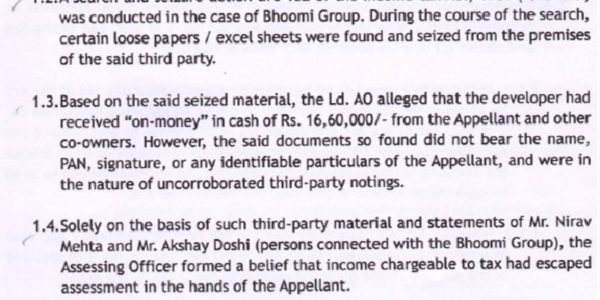
The case involved addition for alleged on-money payment based on search findings of a builder. The ITAT ruled that absence of corroborative evidence and denial of cross-examination makes the addition unsustainable.
The Court held that administrative delay in releasing seized jewellery violated CBDT-prescribed timelines. It ruled that increased bank guarantee due to rising gold prices cannot be imposed on the taxpayer.
The Court held that an assessment order passed in the name of an amalgamating, non-existent entity is void. It ruled that system glitches cannot cure a fundamental jurisdictional defect.
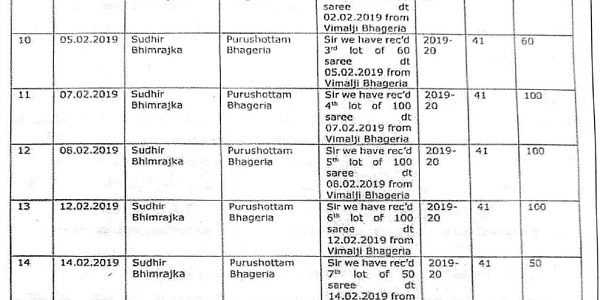
The Tribunal upheld deletion of addition as seized loose sheets lacked key details and no supporting evidence proved unaccounted sales. Reliance solely on such documents was held insufficient.