Income Tax : The law now proposes a single consolidated assessment-cum-penalty order for under-reporting of income, reducing multiple proceedin...
Income Tax : A summary of key penalties under the Income Tax Act for AY 2026-27, covering defaults from late filing and non-payment to misrepor...
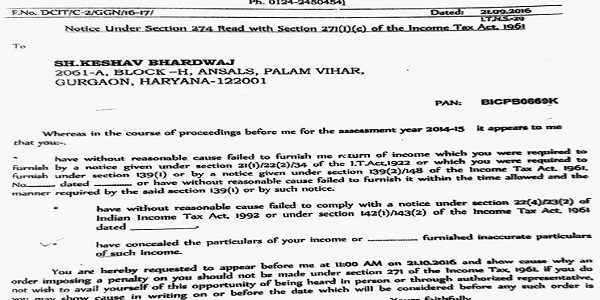
Income Tax : Understand why an income-tax penalty under Section 271(1)(c) is invalid if the charge isn't specified as concealment or inaccurate...
Income Tax : Learn how taxpayers can defer income tax penalty proceedings when quantum additions are under appeal. Understand legal grounds and...
Income Tax : Understand penalties for under-reporting or misreporting income under Section 270A of the Income Tax Act. Fines range from 50% to ...
Income Tax : The case addressed ambiguity in penalty proceedings where the specific charge was not identified. The Court upheld deletion of pen...
Income Tax : The case involved an ambiguous penalty notice that did not clarify whether the charge was concealment or inaccurate particulars. T...
Income Tax : The case involved penalty on disallowance of purchases treated as non-genuine and estimated at 12.5%. Tribunal ruled that estimate...
Income Tax : The ITAT held that penalty proceedings are invalid where the Assessing Officer does not specify whether the charge is concealment ...
Income Tax : The Tribunal held that omission of taxable foreign exchange gain in the return attracts penalty. It noted that disclosure during a...
The Tribunal held that the incorrect carry-forward loss claim arose from an inadvertent mistake and was not deliberate. The penalty was deleted after noting absence of concealment or inaccurate particulars.
The Tribunal ruled that Section 271(1)(c) penalty cannot be imposed on estimated income. While the penalty on actual taxable additions remains, the portion related to estimated income was deleted. Key takeaway: penalties require confirmed income, not mere estimates.
ITAT condoned a significant seven-year delay in filing an appeal, recognizing assessee’s status as an NRI and his lack of awareness of assessment order as a bona fide cause. This ruling affirms the liberal, justice-oriented approach to condonation of delay under Section 249(3).
ITAT Mumbai held that a penalty under Section 271(1)(c) was premature when the related quantum appeal was still pending, remitting the matter back for fresh consideration.
ITAT Delhi deleted a Rs.20.33 crore penalty under Section 271(1)(c), ruling that penalty notice was invalid because it failed to specify exact charge: concealment of income or furnishing inaccurate particulars. Ruling reinforces that an ambiguous, omnibus notice is a jurisdictional defect that vitiates penalty, even if assessment order records satisfaction.
The Tribunal found that additions made purely on estimated profit percentages cannot attract concealment penalty. Since no specific inaccuracy or suppression was proven, ITAT deleted the penalty in full. The ruling aligns with precedents from Delhi, Rajasthan, Punjab & Haryana, and Gujarat High Courts.
ITAT Pune held that filing a revised return after the Department detects wrong deductions is not voluntary. Since the assessee acted only after detection, penalty u/s 270A(9) for misreporting was rightly imposed at 200% of tax.
A summary of key penalties under the Income Tax Act for AY 2026-27, covering defaults from late filing and non-payment to misreporting income and non-compliance with compliance. Learn about financial penalties and potential rigorous imprisonment for serious tax offenses.
ITAT Ahmedabad ruled that a penalty under Section 271(1)(c) cannot survive when the underlying quantum addition has been remanded for fresh adjudication. The penalty order was restored to the CIT(A) to be decided only after the quantum appeal is finalized.
The Delhi High Court, in CIT v. Corteva Agriscience Pvt. Ltd., dismissed the Revenues appeals, confirming that penalty notices under Section 271(1)(c) of the Income Tax Act, 1961.