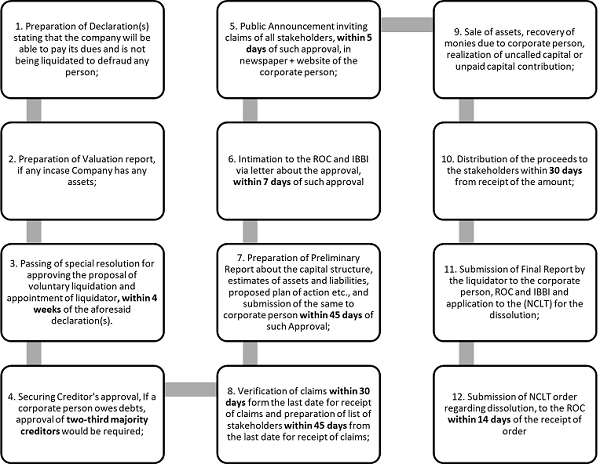
Corporate Law : The framework permits liquidation only where the company has not defaulted on debts and can pay liabilities. It ensures a clean an...
CA, CS, CMA : The High Court ruled that retrospective cancellation of GST registration is invalid if such action is not proposed in the original...
Corporate Law : Explains how the 2025 amendment removes going-concern sales from liquidation. Highlights the shift toward speed and finality over ...
Corporate Law : IBBI Regulations 32 & 32A for liquidation: defines asset sale modes and prioritizes selling the business as a going concern to max...
Corporate Law : Understand secured creditor rights under IBC Section 52 during liquidation: relinquish security to the estate or realize independe...
Corporate Law : The amendments arise from the inclusion of a unified “service provider” definition under the Code. The move expands regulatory...
Corporate Law : The issue addressed is ambiguity in authentication and evidentiary value of financial information in insolvency cases. The propose...
Corporate Law : The proposal aligns grievance regulations with the newly introduced definition under the amended Code. It aims to ensure uniform a...
Corporate Law : The amendments focus on better protection of creditor interests and structured insolvency processes. They introduce new mechanisms...
Corporate Law : The amendment replaces rigid statutory documentation requirements with a flexible framework. This change empowers regulators while...
Company Law : NCLAT Delhi held that each and every commercial transaction which has resulted in loss may not be labelled as fraudulent or to hav...
Company Law : The appellate tribunal quashed orders permitting bankruptcy against personal guarantors after a creditor consented to grant additi...
Company Law : NCLT Allahabad held that financial creditor duly established existence of financial debt and default thereon on the part of the Co...
Company Law : The tribunal held that the resolution plan was invalid because several valuable properties were omitted from the Information Memor...
Company Law : NCLAT Delhi held that Prospective Resolution Applicant or unsuccessful Resolution Applicant doesn’t have vested right to challen...
Corporate Law : The issue was whether IBBI must provide data held by a regulated entity. The Authority held that RTI applies only to information h...
Corporate Law : The appeal found that the RTI response was delayed beyond statutory timelines. The key takeaway is that delay breaches RTI provisi...
Corporate Law : The issue was whether an RVO could grant conditional enrolment to an unqualified applicant. The authority held that such enrolment...
Corporate Law : The amendment allows financial creditors to directly initiate insolvency with prior approvals, reducing delays. It ensures faster ...
Corporate Law : The study found that most MSME insolvency cases are resolved before admission, highlighting gaps in data and process efficiency. I...
NCLT Delhi held that application under section 7 of the Insolvency and Bankruptcy Code for initiation of Corporate Insolvency Resolution Process [CIRP] against Corporate Debtor [Era Infrastructure (India) Ltd.] admitted since financial debt and default thereon duly proved.
Since the existence of financial debt and default was undisputed and all procedural requirements under Section 7 were satisfied, the petition of Corporate Insolvency Resolution Process (CIRP) against Labhanshi Multitrade Private Limited (Corporate Debtor) deserved admission.
The Tribunal held that a loan advanced through cheque and supported by acknowledgments qualifies as a financial debt under IBC even without a written loan agreement.
The IBBI deferred disciplinary proceedings against an insolvency professional after finding that related matters were still pending before the Adjudicating Authority.
IBBI suspended an insolvency professional for including a related party in Committee of Creditors, violating Section 21(2) of Insolvency and Bankruptcy Code.
NCLT Delhi admitted R.J. Packwells Pvt. Ltd.’s application under Section 9 of the IBC against Maurya Printers for ₹2.20 crore default, declaring moratorium and appointing an IRP.
NCLT Mumbai held that non-payment of part of debt when it becomes due and payable amounts to default. Thus, application u/s. 7 of Insolvency and Bankruptcy Code [IBC] duly admitted since there exists financial debt, exceeding threshold limit, and the same is in default.
IBBI seeks comments on draft templates for Prospective Resolution Applicants (PRAs) to disclose beneficial ownership and Section 32A eligibility, ensuring transparency in CIRP.
NCLT Kochi held that application under Regulation 31A(11) of the IBBI (Liquidation Process) Regulations, 2016 valid as Stakeholders’ Consultation Committee [SCC] with majority vote has resolved to replace the present liquidator.
IBBI advises IPs to seek restitution of ED-attached assets under PMLA, requiring a standard undertaking for Special Courts, ensuring asset usage controls and ED cooperation.