
If your bank is deducting TDS on fixed deposit (FD) interest even when your total income is below the taxable limit, you could be losing money unnecessarily. Many taxpayers in India are unaware that they can legally avoid TDS on interest income by submitting a self-declaration form—commonly known as Form 15G or Form 15H under the current tax laws. With evolving tax rules and discussions around simplified compliance mechanisms like Form 121 under the new Income-tax framework, it is important to clearly understand who is eligible to stop TDS, how the rules differ for senior citizens and non-senior citizens, and what to do if TDS has already been deducted. In this complete guide, we break down TDS on bank interest, eligibility conditions, tax-saving strategies, and practical examples to help you avoid unnecessary deductions and maximize your savings legally.
| Did your bank deduct TDS on your Fixed Deposit interest even though your total income is below ₹12 lakh? You are not alone — and more importantly, you did not have to pay that tax.
Under the new Income-tax Act, 2025, w.e.f. 01/04/2026 a simple self-declaration called Form 121 (the equivalent of the old Form 15G / 15H) lets eligible residents tell their bank: “Please do NOT deduct TDS on my interest.” This guide explains exactly who can file it, how to file it, when you cannot file it — and what to do if TDS was already deducted. |
- ⚡ Quick Reference — At a Glance
- 1. What is TDS on Bank Interest and Why Does It Matter?
- TDS Thresholds on Interest Income [Section 393, Sl. No. 5]
- 2. New Tax Regime Slabs — Your Tax Liability at a Glance
- The Game-Changer: Rebate under Section 156(2)
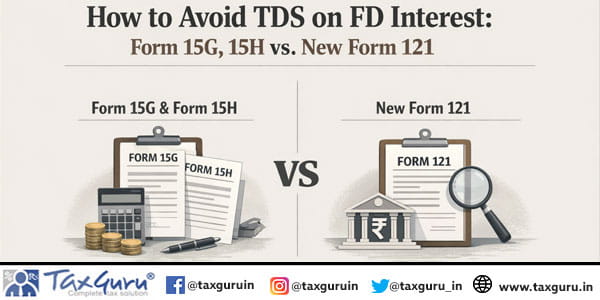
- 3. What is Form 121? — The New Form for old 15G/15H
- What Types of Income Does Form 121 Cover?
- What Information Do You Fill in Form 121?
- 4. Who Can File Form 121? (Eligibility Conditions)
- Condition 1: You Must Be a Resident Individual in India
- Condition 2: Your Estimated Total Tax for the Year Must Be NIL
- 5. When You Do NOT Even Need to File Form 121
- Your Interest Income is BELOW the TDS Threshold
- 6. Practical Examples — Can You File Form 121?
- 7. When Can You NOT File Form 121? (Summary)
- 8. How to File Form 121 — Step-by-Step Process
- 9. What If TDS Was Already Deducted? How to Get Your Refund
- 10. Quick Decision Guide — Can I File Form 121?
- 11. Common Mistakes to Avoid
- 12. Consequences of Filing a False Form 121
- 13. What Changed from the Old ITA 1961? (Old Form 15G / 15H vs New Form 121)
- Key Takeaways — Summary
⚡ Quick Reference — At a Glance
| Topic | Key Fact |
|---|---|
| Governing Section | Section 393(6) of Income-tax Act, 2025 |
| Prescribed Form | Form No. 121 [Rule 211, Income-tax Rules, 2026] |
| Replaces (Old Law) | Form 15G (non-senior citizens) & Form 15H (senior citizens) under old ITA 1961 |
| Who Can File | Individual Resident in India (below 60 years of age) — whose estimated total tax is NIL |
| Senior Citizens (60+) | MORE LIBERAL treatment — Senior citizens can file Form 121 simply if estimated total tax is NIL. They are EXEMPT from the ₹4,00,000 aggregate income cap that applies to non-senior citizens. |
| TDS Threshold — Bank FD | ₹1,00,000 per year (Senior Citizens) | ₹50,000 per year (Others)
[Section 393, Sl. No. 5(ii)] |
| TDS Rate on Interest | At rates in force (as per applicable slab / special rate) |
| NIL Tax Benefit | Under New Regime — No tax up to Total Income of ₹12,00,000
(due to rebate u/s 156(2)) |
1. What is TDS on Bank Interest and Why Does It Matter?
Every time a bank pays you interest on a Fixed Deposit (FD), Recurring Deposit (RD) they are legally required to check whether TDS (Tax Deducted at Source) needs to be deducted. This is governed by Section 393 of the Income-tax Act, 2025.
The key question the bank asks itself is: “Does this customer’s total interest with us cross the annual threshold?” If yes, TDS is deducted automatically — whether or not you actually owe any tax!
TDS Thresholds on Interest Income [Section 393, Sl. No. 5]
| Type of Payer | Person (Payee) | Threshold Limit | TDS Rate |
|---|---|---|---|
| Banking company / Co-operative bank / Post Office (Sl. No. 5(ii)) | Senior Citizen (Age 60+) | ₹1,00,000 | Rates in force (slab rate) |
| Banking company / Co-operative bank / Post Office (Sl. No. 5(ii)) | Any Other Resident | ₹50,000 | Rates in force (slab rate) |
| Any Specified Person — company / firm (NOT banking co. / co-op / PO) (Sl. No. 5(iii)) | Any Resident | ₹10,000 | Rates in force |
| Interest on Securities — NSC, bonds, debentures, etc. (Sl. No. 5(i)) | Any Person | ₹10,000 | Rates in force |
–
📌 Important: These thresholds are per year, per bank (per PAN). If the bank has adopted Core Banking Solutions (CBS), the threshold is aggregate across all branches. If NOT on CBS, it applies branch-wise.
2. New Tax Regime Slabs — Your Tax Liability at a Glance
W.e.f. April 1, 2026, the new Income-tax Act, 2025 governs taxation. The new regime under Section 202 is now the DEFAULT regime for individuals and HUFs. Here are the slab rates:
| Sl. | Total Income | Rate of Tax | Tax on Slab Amount |
|---|---|---|---|
| 1 | Up to ₹4,00,000 | NIL | ₹0 |
| 2 | ₹4,00,001 to ₹8,00,000 | 5% | ₹20,000 (max on this slab) |
| 3 | ₹8,00,001 to ₹12,00,000 | 10% | ₹40,000 (max on this slab) |
| 4 | ₹12,00,001 to ₹16,00,000 | 15% | ₹60,000 (max on this slab) |
| 5 | ₹16,00,001 to ₹20,00,000 | 20% | ₹80,000 (max on this slab) |
| 6 | ₹20,00,001 to ₹24,00,000 | 25% | ₹1,00,000 (max on this slab) |
| 7 | Above ₹24,00,000 | 30% | 30% on amount exceeding ₹24,00,000 |
The Game-Changer: Rebate under Section 156(2)
Here is the most important provision that every resident taxpayer must know. Under Section 156(2) of the Income-tax Act, 2025 — if your total income taxable under the new regime does NOT exceed ₹12,00,000 — you are entitled to a rebate of 100% of your income-tax payable (up to a maximum of ₹60,000). This means:
| Total Income Range | Effective Tax Payable (New Regime) |
|---|---|
| Up to ₹4,00,000 | NIL (zero slab rate) |
| ₹4,00,001 to ₹12,00,000 | NIL (tax computed but 100% rebate u/s 156(2) applies) |
| Above ₹12,00,000 | TAX PAYABLE — no full rebate available |
💡 Key Takeaway: The maximum amount not chargeable to tax under the new regime is ₹4,00,000 (by slab rate alone). However, thanks to the rebate u/s 156(2), effectively NO TAX is payable for total incomes up to ₹12,00,000. This distinction is CRITICAL for determining whether you can file Form 121 or not.
3. What is Form 121? — The New Form for old 15G/15H
Form 121 under Rule 211 of the Income-tax Rules, 2026 is a written declaration filed by a resident individual with the income payer (e.g., your bank). By filing this form, you declare that your estimated total income tax for the year is NIL — and therefore request the payer NOT to deduct TDS on the income mentioned in the form.
What Types of Income Does Form 121 Cover?
As per Note 5 of Form 121, this declaration applies to the following incomes [Section 393(6)]:
- Interest on bank fixed deposits, recurring deposits, savings accounts
- Interest from co-operative societies carrying on banking business
- Interest from post office deposits under Central Government notified schemes
- Interest on securities (bonds, debentures, NSC, etc.)
- Insurance commission
- Rent from specified person
- Income from units of mutual funds / administrator of specified undertaking
- Payment in respect of life insurance policies
- Dividends from domestic companies
What Information Do You Fill in Form 121?
Form 121 has two parts:
- Part A — To be filled by YOU (the person receiving income): Name, PAN, address, email, contact, tax year, nature of income, estimated income for which declaration is made, total number of Form 121 filed earlier in the year, estimated TOTAL income for the year, #details of ITR filed for last 2 years.
(# Important Change to note)
- Part B — To be completed by the BANK or payer: Verification that they received your Form 121 and confirming your details.
4. Who Can File Form 121? (Eligibility Conditions)
This is the section where most people get confused. Let us break it down simply.
Condition 1: You Must Be a Resident Individual in India
Form 121 under Section 393(6) is available to individuals who are residents in India. Non-Residents and Persons Not Ordinarily Resident (PNOR) are NOT eligible to file this declaration.
Condition 2: Your Estimated Total Tax for the Year Must Be NIL
This is the heart of the declaration. You are declaring that after computing your total income (including the interest income for which you are filing the form) and after considering applicable deductions and rebates — your estimated tax liability for the year is NIL.
| Criteria | Non-Senior Citizens (Below 60 years) | Senior Citizens (Age 60 or more at any time during tax year) |
|---|---|---|
| Can File? | YES — but subject to an ADDITIONAL restriction on Section 393(6) income (see below) | YES — simply if estimated total tax for the year is NIL. MORE LIBERAL treatment! |
| When is Tax NIL? | When total income ≤ ₹12,00,000 (rebate u/s 156(2) makes tax NIL) — BUT see additional restriction below for specified incomes | When total income ≤ ₹12,00,000 (rebate u/s 156(2) makes tax NIL) — NO additional restriction on specified aggregate income! |
| Additional Restriction on specified incomes | ⚠️ Form 121 CANNOT be filed if the aggregate of ALL Section 393(6) specified incomes (bank interest, dividends, insurance commission, etc.) exceeds ₹4,00,000 (maximum amount not chargeable to tax) — even if final tax after rebate is NIL. [Section 393(6) Note + Note 11 of Form 121] | ✅ No such restriction. Senior citizens are specifically EXCLUDED from this aggregate income cap. They only need to satisfy the NIL estimated tax condition. |
⚠️ Special Rule for NON-Senior Citizens (Below Age 60): Under Section 393(6) and Note 11 of Form 121, the payer (bank) SHALL NOT ACCEPT Form 121 from a non-senior citizen if the aggregate of ALL Section 393(6) specified incomes (bank interest, dividends, insurance commission, etc.) — credited, paid, or likely to be credited/paid during the tax year — EXCEEDS ₹4,00,000 (the maximum amount not chargeable to tax). This restriction applies even if the final tax after rebate u/s 156(2) is NIL. Senior Citizens (60+) are EXEMPT from this restriction — they enjoy more liberal treatment.
5. When You Do NOT Even Need to File Form 121
This is a very practical and useful point that very few people know! Under Section 393(6) read with Note in the table, TDS is simply NOT deducted in certain situations — even without any declaration from you. You do NOT need to file Form 121 if:
Your Interest Income is BELOW the TDS Threshold
Remember the thresholds we saw in Section 1? If your total interest income from a bank does NOT cross the threshold, the bank simply will not deduct TDS — no Form 121 required at all!
| 📋 Example A — No TDS, No Form 121 Required
Sagar (Age 25) has Fixed Deposits in SBI. Total interest credited by SBI in Tax Year 2026-2027: ₹48,000 TDS Threshold for non-senior citizens (banking company): ₹50,000 Since ₹48,000 < ₹50,000 threshold → SBI will NOT deduct TDS. Sagar does NOT need to file Form 121. However, Sagar must still include ₹48,000 in his ITR under ‘Income from Other Sources’ and pay tax if applicable on his total income. |
6. Practical Examples — Can You File Form 121?
| 📋 Example B — Non-Senior Citizen, Bank Interest ₹180,000, CAN File Form 121
Shruti (Resident, non-senior citizen) earns only bank FD interest. Bank interest from HDFC Bank (Tax Year 2026-27): ₹180,000 Other income: NIL | Total Section 393(6) aggregate income: ₹180,000 Check 1 — Estimated tax NIL? Total Income = ₹180,000 → Tax = NIL (below ₹4,00,000 slab). ✅ Check 2 — Aggregate Section 393(6) income ≤ ₹4,00,000 (basic exemption)? ₹180,000 < ₹4,00,000 → Condition satisfied. ✅ ✅ Shruti CAN file Form 121 with HDFC Bank. TDS threshold for non-senior citizens = ₹50,000. Since ₹180,000 > ₹50,000, without Form 121, HDFC would deduct TDS. Form 121 prevents this. |
–
| 📋 Example C — Salary + Bank Interest, Total Income ₹10.8 Lakh, CAN File Form 121
Gulshan (Age 42, Resident) is a salaried employee. Salary (Net, after standard deduction of ₹75,000): ₹10,00,000 Bank FD interest from ICICI Bank: ₹80,000 Total Income = ₹10,00,000 + ₹80,000 = ₹10,80,000 Tax Computation (New Regime, Section 202): Nil on first ₹4,00,000 = ₹0 5% on ₹4,00,001 – ₹8,00,000 = ₹20,000 10% on ₹8,00,001 – ₹10,80,000 = ₹28,000 Total Tax before rebate = ₹48,000 Less: Rebate u/s 156(2) [100% since income ≤ ₹12L, max ₹60,000] = ₹48,000 NET TAX PAYABLE = ₹0 (NIL) ✅ Check 2 — Aggregate Section 393(6) income ≤ ₹4,00,000? Section 393(6) income = FD interest only = ₹80,000 < ₹4,00,000 ✅ (Salary is NOT Section 393(6) income — it is not covered under that provision) ✅ Gulshan CAN file Form 121 with ICICI Bank. Both conditions satisfied: estimated tax NIL AND aggregate 393(6) income ≤ ₹4L. |
–
| 📋 Example C2 — Non-Senior, Interest ₹5 Lakh + Salary, Tax NIL — CANNOT File Form 121
Vikram (Age 45, Resident) has multiple FDs across banks. Salary income (Net): ₹7,00,000 Bank FD interest (aggregate from all banks): ₹5,00,000 Total Income = ₹7,00,000 + ₹5,00,000 = ₹12,00,000 Tax Computation (New Regime): Tax before rebate = ₹60,000 Rebate u/s 156(2) [income = exactly ₹12L] = ₹60,000 NET TAX PAYABLE = NIL ✅ (tax is NIL!) Check 2 — Aggregate Section 393(6) income ≤ ₹4,00,000? Section 393(6) income = FD interest = ₹5,00,000 ₹5,00,000 > ₹4,00,000 ❌ ❌ Vikram CANNOT file Form 121 — even though his final tax is NIL! Reason: He is below 60 (non-senior citizen) and his aggregate Section 393(6) income (₹5,00,000) EXCEEDS the maximum amount not chargeable to tax (₹4,00,000). Banks will NOT accept his Form 121 under the Note to Section 393(6) and Note 11 of Form 121. TDS will be deducted. He can claim full refund by filing his ITR. |
–
| 📋Example D — Income Crosses ₹12 Lakh, CANNOT File Form 121
Suresh (Age 50, Resident) is a businessman. Business income: ₹11,50,000 Bank FD interest from Punjab National Bank: ₹1,20,000 Total Income = ₹11,50,000 + ₹1,20,000 = ₹12,70,000 Tax Computation (New Regime, Section 202): Nil on first ₹4,00,000 = ₹0 5% on ₹4,00,001 – ₹8,00,000 = ₹20,000 10% on ₹8,00,001 – ₹12,00,000 = ₹40,000 15% on ₹12,00,001 – ₹12,70,000 = ₹10,500 Total Tax before rebate = ₹70,500 Rebate u/s 156(2): Income exceeds ₹12L → Marginal relief applies (Tax is reduced so that it does not exceed ₹70,000 — income over ₹12L). NET TAX PAYABLE is NOT NIL. ❌ Suresh CANNOT file Form 121. PNB will deduct TDS on the ₹1,20,000 interest. Suresh should pay advance tax/self-assessment tax on his total income and claim TDS credit in his ITR. |
–
| 📋 Example E — Senior Citizen (Age 65), Interest ₹5 Lakh, CAN File Form 121
Mrs. Kamala (Age 65, Resident Senior Citizen) Bank FD interest from SBI: ₹5,00,000 Other income: NIL Total Income = ₹5,00,000 Tax Computation (New Regime): 5% on ₹4,00,001–₹5,00,000 = ₹5,000 (before rebate) Rebate u/s 156(2) [income ≤ ₹12L] = ₹5,000 → Net Tax = NIL ✅ Check 2 (Senior Citizens are EXEMPT from the aggregate income cap restriction!) Senior citizens (60+) are specifically excluded from the Note to Section 393(6). They only need to satisfy the NIL estimated tax condition. ✅ Mrs. Kamala CAN file Form 121 with SBI. Even though her bank interest (₹5,00,000) exceeds ₹4,00,000, she can still file because senior citizens enjoy more liberal treatment under the law. The restriction on exceeding ₹4,00,000 applies ONLY to non-senior citizens. |
–
| 📋 Example F — Non-Senior Citizen (Age 45), Interest ₹4.5 Lakh, Tax NIL — CANNOT File Form 121
Mr. Ramanlal (Age 45, Resident — NON-Senior Citizen) Bank FD interest from Canara Bank: ₹4,50,000 Other income: NIL Total Income = ₹4,50,000 Tax Computation: 5% on ₹4,00,001–₹4,50,000 = ₹2,500 (before rebate) Rebate u/s 156(2) [income ≤ ₹12L] = ₹2,500 → Net Tax = NIL Even though Net Tax = NIL (due to rebate), Mr. Ramanlal CANNOT file Form 121. Reason: He is below 60 (non-senior citizen) and the aggregate income of the nature covered under Section 393(6) — i.e., ₹4,50,000 FD interest — EXCEEDS the maximum amount not chargeable to tax (₹4,00,000). As per the Note to Section 393(6) and Note 11 of Form 121, the bank shall NOT accept this declaration from a non-senior citizen. ❌ Mr. Ramanlal CANNOT file Form 121. Canara Bank will deduct TDS. He should file his ITR to claim full refund since his net tax payable is NIL. |
7. When Can You NOT File Form 121? (Summary)
Let us summarise all the situations where Form 121 CANNOT be filed:
| # | Situation | Why Form 121 is NOT Allowed |
|---|---|---|
| 1 | Tax is payable (Total Income > ₹12,00,000 for non-senior citizens) | You cannot declare that estimated tax is NIL if it is actually not NIL. Filing a false declaration attracts prosecution under Section 482. |
| 2 | You are a Non-Resident or PNOR | Section 393(6) declaration is only available to residents. Non-residents must bear TDS and claim treaty relief/refund separately. |
| 3 | You are a Company or Firm | Section 393(6) declaration is for individuals and persons other than companies and firms for specific incomes (as applicable). |
| 4 | Non-Senior Citizen (below 60) — aggregate of Section 393(6) incomes exceeds ₹4,00,000 (maximum amount not chargeable to tax) — even if tax after rebate is NIL | Per Section 393(6) Note and Note 11 of Form 121 — the payer shall NOT accept the declaration from a non-senior citizen if aggregate specified income exceeds ₹4,00,000. Senior citizens (60+) are EXEMPT from this restriction. |
| 5 | The income is NOT of the type covered under Section 393(6) | For example, business income, capital gains — these are not covered under Section 393(6) and Form 121 cannot be used to prevent TDS on such incomes. |
8. How to File Form 121 — Step-by-Step Process
Filing Form 121 is a simple process. Here is how you do it:
| Step | Action | Details |
|---|---|---|
| 1 | Collect Form 121 | Download Form 121 from bank’s e-portal or get it from your bank. Most banks had already made this available online through their net-banking portal or at the branch. |
| 2 | Fill Part A | Fill in your Name, PAN, address, email, mobile number, Tax Year, nature of income (e.g., interest from FD), and estimated interest income for the year from this particular bank. |
| 3 | Fill Estimated Total Income | In Column 13 of Part A, mention your estimated TOTAL income for the year — including ALL income from all sources, not just the FD interest. This is the critical number for eligibility. |
| 4 | Fill Previous ITR Details | Mention the acknowledgment numbers and return income for the last 2 tax years’ ITRs filed (Column 14). If you are a first-time filer, leave this blank. |
| 5 | Sign & Submit | Sign the declaration. Submit in DUPLICATE to the bank or payer — one copy is retained by the payer and one is forwarded to the tax department. |
| 6 | Submit Before Interest is Credited | Ideally submit at the start of the tax year (April) or before the first interest credit. Once TDS is deducted, the bank cannot reverse it — only an ITR refund is possible. |
| 7 | Renew Every Year | Form 121 is valid only for the tax year for which it is filed. You must file a fresh Form 121 every year. |
📌 The payer (bank) is required to: (a) allot a Unique Identification Number to each Form 121 received, (b) report it in their TDS statement for the relevant quarter, and (c) forward a copy to the Principal CIT / CIT / Principal Commissioner by the 7th of the month following the month of receipt.
[Section 393(7) of Income-tax Act, 2025]
9. What If TDS Was Already Deducted? How to Get Your Refund
If you missed filing Form 121 in time and TDS has already been deducted from your interest income, do not panic. Here is what you should do:
1. File your Income Tax Return (ITR): Include the full interest income in your ITR. The TDS deducted will appear as a credit in your Form 26AS / AIS (Annual Information Statement). The IT system will automatically compute your tax liability and show TDS credit.
2. Claim the TDS Credit: In your ITR, under ‘Tax Credits’, claim the TDS amount deducted by the bank. If your net tax payable is NIL or lower than TDS deducted, the excess becomes a refund.
3. ITR Due Date: Normally 31st July of the year following the tax year for non-audit cases. Filing on time ensures prompt processing of refund.
4. Refund Timeline: After filing the ITR and e-verification, refunds are typically processed within 30-60 days for straightforward cases.
| 📋 Example G — Claiming TDS Refund
Sunita (Age 40, salaried) earned ₹90,000 FD interest from Bank of Baroda. She forgot to file Form 121. Bank deducted TDS at applicable rates. Her total income (salary + interest) = ₹9,50,000. Tax on ₹9,50,000 = ₹15,000 (before rebate) Rebate u/s 156(2) = ₹15,000 → Net Tax = NIL Action: Sunita should file her ITR, claim TDS as credit. Since net tax = NIL, the entire TDS amount deducted becomes a REFUND. She will receive this refund directly to her bank account after ITR processing. |
10. Quick Decision Guide — Can I File Form 121?
| STEP 1: Are you a Resident Individual in India?
NO (I am Non-Resident) → Form 121 not available. TDS will be deducted. Claim credit/refund in ITR. YES → Proceed to Step 2 STEP 2: Is your estimated total tax for the year NIL? NO (Tax > 0) → CANNOT file Form 121. Deduct TDS, pay remaining tax via advance tax/SAT. YES (Tax = NIL, because total income ≤ ₹12L) → Proceed to Step 3 STEP 3: Are you a Senior Citizen (Age 60 or more at any time during the tax year)? YES (60 or above) → ✅ You CAN file Form 121! Senior citizens only need NIL estimated tax. NO (Below 60) → Proceed to Step 4 STEP 4 (Only for NON-Senior Citizens below 60): Does the aggregate of ALL your Section 393(6) specified incomes (bank interest, dividends, insurance commission, etc.) EXCEED ₹4,00,000? YES (Exceeds ₹4,00,000) → ❌ CANNOT file Form 121. Bank will not accept declaration. Even if tax is NIL via rebate, this bar applies to non-senior citizens. NO (Does NOT exceed ₹4,00,000) → ✅ You CAN file Form 121! |
11. Common Mistakes to Avoid
| Common Mistake | What You Should Do |
|---|---|
| Filing Form 121 when total income exceeds ₹12 lakh | Do NOT file. This constitutes a false declaration. Pay TDS, file ITR, and pay applicable taxes. |
| Filing only once at the start of the year and thinking it covers all banks | Form 121 must be filed separately with EACH bank / each payer from whom you receive covered income. |
| Not mentioning ALL sources of income in the ‘Estimated Total Income’ column | You must mention your complete estimated income from ALL sources — salary, business, interest, rent, etc. |
| Forgetting to renew Form 121 every year | Form 121 is valid for ONE tax year only. Renew every April. |
| Senior citizens filing Form 121 when bank interest alone exceeds ₹4,00,000 | As explained in Example F, senior citizens CANNOT file if aggregate Section 393(6) income exceeds ₹4 lakh. |
| Assuming Form 121 = No need to file ITR | Form 121 only prevents TDS. You still need to file an ITR if your gross income exceeds the basic exemption limit of ₹4 lakh. |
12. Consequences of Filing a False Form 121
⚠️ Filing a false declaration in Form 121 is a SERIOUS offence. Under Section 482 of the Income-tax Act, 2025, any person who makes a false statement in a declaration is liable to prosecution. The penalty can be rigorous imprisonment extending from 3 months to 2 years, along with a fine. Always ensure your estimated total income figure is honest and realistic.
13. What Changed from the Old ITA 1961? (Old Form 15G / 15H vs New Form 121)
If you are familiar with the old Form 15G and Form 15H under the Income-tax Act, 1961, here is a quick comparison with the new provisions:
| Feature | Old Law (ITA 1961) | New Law (ITA 2025) |
|---|---|---|
| Applicable Section | Section 197A | Section 393(6) |
| Form Name | Form 15G (non-senior) | Form 15H (senior citizens) | Form 121 (single form for all — two conditions differ) |
| Rules | Rule 29C, Income-tax Rules 1962 | Rule 211, Income-tax Rules 2026 |
| Basic Exemption (New Regime) | ₹3,00,000 (old regime) / ₹3,00,000 (new regime, old ITA) | ₹4,00,000 (Section 202 slab for new regime) |
| Effective NIL Tax Limit | Up to ₹7 lakh (old rebate u/s 87A, ITA 1961) | Up to ₹12,00,000 (rebate u/s 156(2), ITA 2025) |
| Senior Citizen Restriction | Form 15H: NIL tax condition sufficient — no aggregate income cap | Form 121: Aggregate Section 393(6) income must NOT exceed max amount not chargeable to tax (₹4L) |
| Duplicate Copy | Two copies required | Two copies required (one retained by payer, one forwarded to CIT) |
Key Takeaways — Summary
| ✅ TDS on bank FD/RD interest is mandatory once interest exceeds ₹50,000/year (non-senior) or ₹1,00,000/year (senior citizens) — under Section 393, Sl. No. 5(ii).
✅ Under the new tax regime (Section 202), income up to ₹4,00,000 attracts NIL slab rate. But thanks to rebate u/s 156(2), effectively NO TAX is payable up to ₹12,00,000 total income. ✅ Form 121 (Rule 211, ITA Rules 2026) is the new Form 15G/15H — filed with your bank under Section 393(6) to prevent TDS deduction when your estimated total tax is NIL. ✅ Senior citizens (60+) can file Form 121 if total income ≤ ₹12,00,000 (tax = NIL after rebate) — with NO restriction on the amount of their interest/Section 393(6) income. ⚠️ Non-senior citizens (below 60) face an additional restriction — Form 121 CANNOT be filed if aggregate Section 393(6) specified income (bank interest, dividends, etc.) exceeds ₹4,00,000, even if final tax is NIL due to rebate. Senior citizens are EXEMPT from this cap. ✅ If TDS is already deducted, file ITR on time to claim full refund — especially if total income ≤ ₹12 lakh. ❌ Filing a false Form 121 is a criminal offence under Section 482 — imprisonment up to 2 years. |
FAQs – How to Avoid TDS on FD Interest: Form 15G, 15H vs. New Form 121
Q1. What is Form 121 under the Income-tax Act, 2025?
Answer: Form 121 is the new self-declaration form introduced under the Income-tax Act, 2025, replacing Forms 15G and 15H. Eligible resident individuals can submit it to their bank or other payer to request that no TDS be deducted on specified income if their estimated tax liability for the year is nil.
Q2. Who is eligible to file Form 121?
Answer: Resident individuals whose estimated tax liability for the financial year is nil can file Form 121. Senior citizens (aged 60 years or above) only need to satisfy the nil tax condition, while non-senior citizens must also ensure that the aggregate of specified incomes covered under Section 393(6) does not exceed ₹4,00,000.
Q3. When is Form 121 not required?
Answer: Form 121 is generally not required if your interest income from a bank does not exceed the applicable TDS threshold—₹50,000 for non-senior citizens and ₹1,00,000 for senior citizens—because the bank is not required to deduct TDS in such cases.
Q4. What should I do if the bank has already deducted TDS on my FD interest?
Answer: If TDS has already been deducted, you should include the interest income in your Income Tax Return (ITR), claim credit for the TDS reflected in your tax records, and seek a refund if your final tax liability is lower than or equal to the TDS deducted.
Q5. What are the consequences of filing a false Form 121?
Answer: Filing a false declaration in Form 121 is a serious offence. If a person knowingly furnishes incorrect information while claiming eligibility, prosecution may be initiated under the Income-tax Act, 2025, which can result in imprisonment and a fine.
About the Author: Sagar Gambhir is a Chartered Accountant (CA) and US Certified Public Accountant (US CPA-License awaited).
Disclaimer: This article is for educational and informational purposes only and does not constitute professional tax advice. The provisions discussed are based on the Income-tax Act, 2025 and Income-tax Rules, 2026. Readers are advised to consult a qualified Chartered Accountant for advice specific to their situation. Tax laws are subject to amendments and notifications by the CBDT.
References: Income-tax Act, 2025 — Section 202 (New Regime Slabs), Section 156(2) (Rebate), Section 393 (TDS — Table Sl. No. 5), Section 393(6) (Declaration), Section 393(7) (Reporting); Form 121 — Income-tax Rules, 2026, Rule 211.





Please visit my article also.
https://taxguru.in/income-tax/computerization-form-121-earlier-form-15g-form-15h.html
Computerization of Form 121 (Earlier Form 15G & Form 15H)
Sir, (Reg: Taxguru website Articles dt. 13-04-2026 by CA Sagar Gambir on submission of Form 121 under IT Act 2025.)
I wish to point out the following discrepancies in the above article:
Item No: 11. Common Mistakes to Avoid:
Senior citizens filing Form 121 when bank interest alone exceeds ₹4,00,000:
What you should you do:
As explained in Example F, senior citizens CANNOT file if aggregate Section 393(6) income exceeds ₹4 lakh
But Example (F) gives explanation with repect Non- Senior Ciizens aged 45 and below 60 years.
Thus these two are giving contratictory statements. Which is correct? Kindly clarify.
Thanking you,
Yours faithfully,
ARUNACHALAM V
E-Mail: [email protected]
Dt. 14-04-2026.