Company Law : New MCA amendments permit companies to deploy a portion of CSR funds through Zero Coupon Zero Principal instruments listed on the ...
Corporate Law : India transformed CSR into a statutory obligation under Section 135. This shift raises key questions on its role in governance and...
Company Law : A comprehensive guide to applicability, 2% spending rule, governance structure, compliance requirements, and penalties under Secti...
Company Law : Understand CSR obligations under Section 135, including eligibility, expenditure, and reporting. Key takeaway: Proper CSR complian...
Company Law : Explains the strict consequences for failing to meet CSR spending and transfer obligations under Section 135. Highlights how penal...
Company Law : The MCA has widened CSR eligibility by recognizing subscriptions to Zero Coupon Zero Principal Instruments as a valid CSR activity...
Company Law : The issue concerns the inability to update trust details in CSR-1 registration records. It was highlighted that outdated informati...
Company Law : Public and private companies in Bihar increasingly invest in CSR, with key districts receiving substantial social development fund...
Company Law : The Ministry of Corporate Affairs confirms that CSR expenditure data for the last five years is publicly available on its CSR port...
Company Law : Government penalized companies for CSR non-compliance under the Companies Act. Details of penalties, CSR spending, and fund transf...
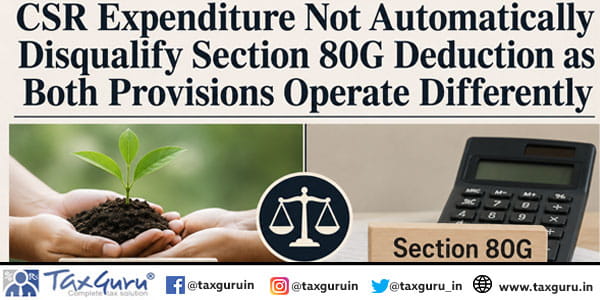
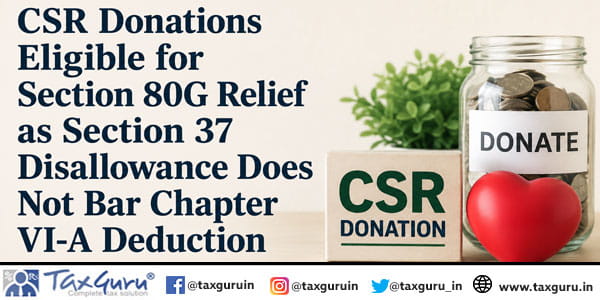
Income Tax : ITAT Mumbai held that eligible CSR donations qualify for Section 80G deduction if statutory conditions are met, despite disallowan...
Income Tax : The ITAT held that depreciation on goodwill arising from amalgamation could not be disallowed in subsequent years after it had bee...
Income Tax : ITAT Delhi held that donations forming part of CSR expenditure are eligible for deduction under Section 80G if the statutory condi...
Income Tax : The ITAT held that foreign exchange gains arising from realization of export proceeds from services rendered to associated enterpr...
Income Tax : Delhi ITAT held that donations qualifying under Section 80G do not lose eligibility merely because they form part of Corporate Soc...
Company Law : ROC Cuttack held that responsibility for inaccurate information in e-forms rests with the authorised signatory and certifying prof...
Company Law : MCA amends Schedule VII of the Companies Act to include subscription to zero coupon zero principal instruments on Social Stock Exc...
Company Law : MCA has amended the CSR Rules to recognize zero coupon zero principal instruments issued by Social Stock Exchange-listed NPOs. The...
Company Law : ROC Haryana ruled that non-transfer of unspent CSR amount within six months from the close of the financial year constituted a vio...
Company Law : ROC Kolkata penalized a company and its directors for delayed transfer of unspent CSR funds to the Swachh Bharat Kosh. The order h...
The Tribunal held that CSR expenditure disallowed under Section 37 does not bar deduction under Section 80G. Donations to eligible institutions remain deductible unless specifically excluded by law.
The adjudicating authority penalised a company for not spending mandatory CSR funds and failing to transfer unspent amounts on time. Subsequent rectification did not erase liability for the original default.
ITAT held that employee stock option expenses are deductible as business expenditure. ESOP costs linked to employee compensation and revenue generation cannot be disallowed.
The regulator held that non-spending of CSR amounts and failure to transfer unspent funds within timelines violates section 135. Subsequent voluntary payment does not absolve past defaults.
The regulator held that failure to spend CSR funds or transfer unspent amounts within statutory timelines violates sections 135(5) and (6). Subsequent voluntary payment does not erase the default, attracting penalties under section 135(7).
Failure to spend CSR funds or transfer unspent amounts within timelines was held to violate sections 135(5) and (6). Subsequent voluntary payment did not absolve liability, attracting penalties under section 135(7).
The regulator examined filing of statutory forms with incorrect financial figures. It held that later correction does not erase liability for filing defective information.
Understand CSR obligations under Section 135, including eligibility, expenditure, and reporting. Key takeaway: Proper CSR compliance ensures legal adherence and social impact.
The Tribunal held that CSR contributions received with strict donor directions and refund obligations may constitute tied-up grants rather than freely available income. Such funds require factual examination before taxing them under section 11.
The PCIT sought to revisit claims already scrutinized and partly disallowed. The Tribunal ruled this to be a change of opinion and invalid. Revision demands clear error and prejudice, not reappraisal.