Corporate Law : India transformed CSR into a statutory obligation under Section 135. This shift raises key questions on its role in governance and...
Company Law : A comprehensive guide to applicability, 2% spending rule, governance structure, compliance requirements, and penalties under Secti...
Company Law : Understand CSR obligations under Section 135, including eligibility, expenditure, and reporting. Key takeaway: Proper CSR complian...
Company Law : Explains the strict consequences for failing to meet CSR spending and transfer obligations under Section 135. Highlights how penal...
Company Law : Section 135 mandates companies above certain thresholds to spend 2% of profits on social initiatives, establish CSR committees, an...
Company Law : The issue concerns the inability to update trust details in CSR-1 registration records. It was highlighted that outdated informati...
Company Law : Public and private companies in Bihar increasingly invest in CSR, with key districts receiving substantial social development fund...
Company Law : The Ministry of Corporate Affairs confirms that CSR expenditure data for the last five years is publicly available on its CSR port...
Company Law : Government penalized companies for CSR non-compliance under the Companies Act. Details of penalties, CSR spending, and fund transf...
Company Law : Overview of proposed amendments in the Companies Act, 2013, CSR monitoring framework, and steps to ensure compliance and prevent m...
Income Tax : The issue was whether CSR expenditure disallowed under Section 37(1) can still qualify under Section 80G. The Tribunal held that b...
Income Tax : The Court held that reassessment based solely on an audit objection is invalid as it constitutes a change of opinion. It emphasize...
Income Tax : ITAT held that CSR contributions can qualify for deduction under Section 80G if conditions are met. The ruling clarifies that ther...
Income Tax : ITAT held that revision under Section 263 cannot be invoked when the Assessing Officer has already examined the issue. The ruling ...
Income Tax : The issue was whether CSR expenditure qualifies for deduction under section 80G. The Tribunal held that deduction is allowable as ...
Company Law : The authority penalized the company for failing to transfer unspent CSR funds within the statutory deadline. It held that delayed ...
Company Law : The authority penalized the managing director for wrongly declaring CSR as not applicable in financial filings. It held that signa...
Company Law : The adjudicating authority penalised a company for not spending mandatory CSR funds and failing to transfer unspent amounts on tim...
Company Law : The regulator held that non-spending of CSR amounts and failure to transfer unspent funds within timelines violates section 135. S...
Company Law : The regulator held that failure to spend CSR funds or transfer unspent amounts within statutory timelines violates sections 135(5)...
17,130 Implementing Agencies are registered with MCA21 registry The Government provides the broad framework for Corporate Social Responsibility (CSR) through Section 135 of the Companies Act, 2013 (‘Act’), Schedule VII of the Act and Companies (CSR Policy) Rules, 2014. This was stated by the Union Minister of State for Corporate Affairs Shri Rao Inderjit Singh […]
The word ‘AUDIT’ has Latin origins. It is derived from the Latin term ‘audire,’ which means to hear as back then auditor used to listen to the accounts read over by an accountant in order to check them.
FORM NO. CSR-1 is issued Pursuant to section 135 of the Companies Act, 2013 and Rule 4(1) and (2) of Companies (CSR Policy) Rules, 2014 for Registration of Entities for undertaking CSR Activities. In accordance with the Companies (Corporate Social Responsibility Policy) Amendment Rules, 2021, company can undertake CSR activities either itself or through entities […]
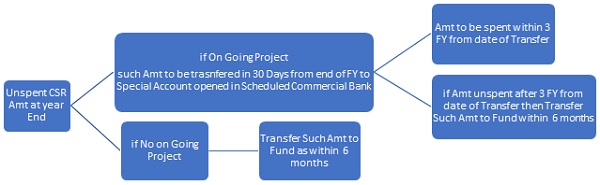
CORPORATE SOCIAL RESPONSIBILITY AMENDMENT UTILIZATION OF UNSPENT AMOUNT ON CSR ACTIVITIES (OTHER THAN ONGOING PROJECTS) [SECTION 135(5)] Reason for not spending the amount ⇓ Transfer such unspent amount ⇓ To a fund specified in Schedule VII ⇓ Within 6 months ⇓ Of the expiry of the financial Year UTILIZATION OF UNSPENT AMOUNT ON CSR ACTIVITIES […]
Corporate altruism in India has found a new purpose since advent of the COVID-19 pandemic. With the nationwide lockdown upending economic activity at one hand and disrupting lives, especially of the poor, on the other, companies have not only opened their purse strings but also rolled up their sleeves to respond proactively to the pandemic. […]
At present, provisions under section 135 of the Act regulate large companies i.e. (a) companies having net worth of INR 500 crores or more; (b) turnover of INR 1,000 crores or more; or (c) net profit of INR 5 crore or more, during the immediately preceding financial year, to spend at least 2% of the average net profits during the three immediate preceding financial years towards CSR activities.
The uncertainty on whether corporations can avail input tax credit (ITC) for any expenditure made under Corporate Social Responsibility (CSR) is a longstanding one. In the absence of a clear-cut law, corporations have had to rely on specific AAR rulings to ascertain whether they can avail ITC for their CSR expenditure. However, inconsistent findings by […]
Section 135(1) of the Companies Act 2013, deals with the CSR provisions and constitution of CSR committee. Modes of spending CSR expenditure: As per Rule 4(2), Companies can spend on CSR activity through any of the below 3 ways. 1. Eligible Companies coming together to form a Trust, Society, or Section 8 Company for conducting CSR […]
National Building Construction Corporation Ltd. Vs Add. CIT (ITAT Delhi) In the instant case before us also, the expenses have been incurred on the direction of the relevant Ministry / Government of India. Further, neither the Assessing Officer nor the learned DR has rebutted the contention of the assessee that expenses have been incurred for […]
Expectations of Humanities from Corporates World The basic existence of the Corporates is to satisfy the essential of the society by suppling goods and services as per the various consumer need. But the Corporates should also be allowed to make profit for their very being and sustainability. The Corporates drew a lot from the society […]