Praveg Communications India Limited Vs Commissioner of Central Excise & ST (CESTAT Ahmedabad)
In the present case, the appellant’s activity being of setting-up of stalls for exhibition or events cannot be considered to be classified under Interior Decorator’s service for the reason that there is neither any element of beautification of space nor any provision of advice or consultancy is provided by the appellant. The pattern and design for a stall is as per the layout provided by the customers to the appellant. Therefore, the ingredient to classify the service under Interior Decorator’s service, in the present case is not satisfied hence, the service cannot be classified under Interior Decorator’s service. Moreover, the post Negative List regime, with effect from 01.07.2007, the definition of service was done away and there is only service portion in execution of works contract is listed as a declared service for the purpose of levy of service tax. The appellant’s strong claim is that their service is nothing but Works Contract service.
It is settled law, as per Section 65B of the Finance Act, 1994, Works Contract means a contract wherein transfer of property in goods involved in the execution of such contract is leviable to tax as sale of goods and such contract is for the purpose of carrying out construction, erection, commissioning, installation, completion, fitting out, repair, maintenance, renovation, alteration of any movable or immovable property or for carrying out any other similar activity or a part thereof in relation to such property. In the present case, admittedly the appellant have installed stalls in the exhibition along with material.
With regard to the payment of VAT, the appellant have also submitted VAT Assessment order and VAT return in Form-205 under Section 33 of Gujarat VAT Act, 2003.
From the above documents which are undisputed it is absolutely clear that the appellant have purchased goods and used the same in execution of Works Contract for installation of stalls at exhibition centers. The appellant have also discharged VAT in respect of goods used in execution of Works Contract. In these undisputed facts, the entire activity of the appellant clearly falls under Works Contract service. Accordingly, the service tax at concessional rates discharged as per the Rule 3(1) of Works Contract Rules, 2007 is absolutely correct and legal. Therefore, no demand exists.
In view of the facts as narrated above there is no doubt that the service of the appellant is clearly classified as Works Contract Service. Accordingly, the service tax discharged on the concessional rates under Works Contract Service is correct and legal.
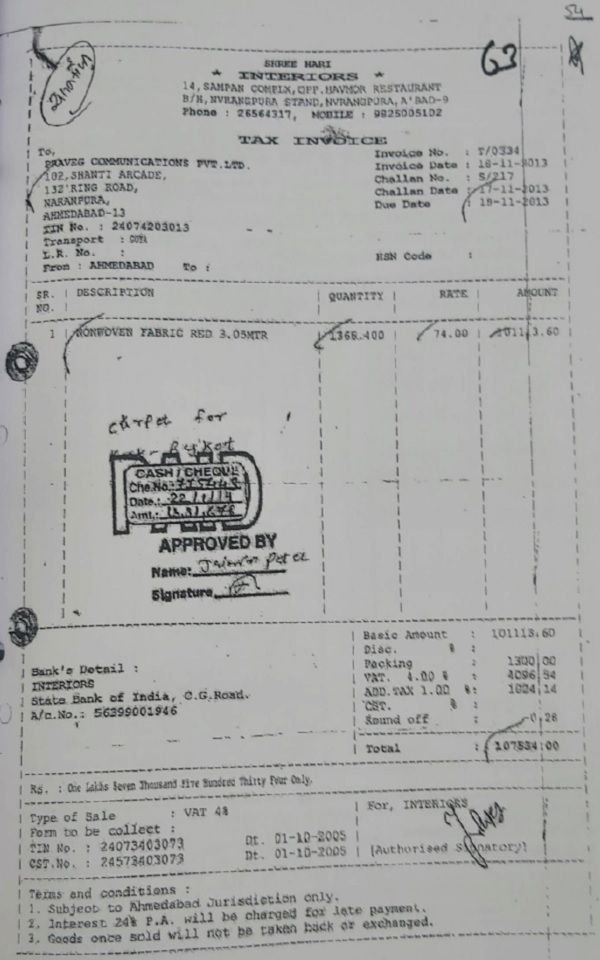
FULL TEXT OF THE CESTAT AHMEDABAD ORDER
The brief facts of the case are that the appellant are engaged in providing exhibition service, event management service, advertisement service, works contract service etc. They have carried out the activity of conceptualizing, designing and execution of stalls as per the customer’s requirement and for the same, the appellant were assigned work orders from the customers viz. Tourism Corporation of Gujarat Limited, Sports Youth and Cultural Activities Department, All India Conference on livestock and Dairy Development etc. The appellant classified the said activity as works contract under Section 65 (105)(zzzza) of the Finance Act, 1994 and availed the benefit of concessional rate of tax under Rule 3(1) of the Works Contract Rules, 2007 and paid service tax at the rate of 4 /8%. An audit was conducted by CERA audit team whereby it was alleged that the appellant classified the services as works contract services however, there was no sale of goods therefore service cannot be classified under works contract service and service tax @ 12.36% should have been paid by the appellant. The investigation and enquiry culminated into the issuance of show cause notice dated 15.11.2017 wherein it was proposed to demand service tax amounting to Rs. 1,06,37,604/- under Section 73(1) of the Finance Act, 1994 along with interest and penalty under Section 75, 76, 77(2) and Section 78 of the Finance Act, 1994 respectively. After considering the reply filed by appellant the learned Commissioner, CGST and CE, Ahmedabad vide order-in-original No. 03/ADC/2020-21 MLM dated 03.06.2020 confirmed the demand of service tax amounting to Rs. 1,06,37,604/- along with interest for delay in making payment of service tax and penalty. Aggrieved by the order-in-original dated 03.06.2020, the appellant preferred the appeal before learned Commissioner (Appeals) however, the learned Commissioner (Appeals) upheld the order-in-original and confirmed the demand along with interest and penalty and rejected the appeal filed by the appellant. Being aggrieved by the said impugned order dated 23.06.2021 the appellant preferred the present appeal before this Tribunal.
2. Shri Jigar Shah, learned Counsel appearing on behalf of the appellant submits that the setting up of exhibition stall is a turnkey project assigned to the appellant which is rightly classified under works contract service and service tax is rightly paid under the Works Contract (Composition Scheme for Payment of Service Tax) Rules, 2007. He submits that turnkey projects were assigned by the customers for designing, making layouts, execution and supervision of temporary structures in compliance of the terms of the agreement. The terms of the agreement made it clear that the appellant have to undertake all the activities mentioned therein under instructions of the Professional Advisor and the Director General, SAG representative. It was a consolidated work undertaken by the appellant which was inclusive of service as well as the materials required for the preparation of the stall. The materials such as cloth, plywood, nut, bolts, flags etc. which are used in the setup of the stall are subject to the approval of the Director General, SAG Engineer. The property in goods of the material gets transferred to the customers. Hence, the appellant has rightly classified the activity under ‘works contract service’. The VAT returns filed by the appellant during the impugned period also makes it abundantly clear that there is supply of both service and goods in the present case. He further submits that it is settled law that a contract that provide for the supply of goods as well as labour would a works contract and to the extent the property in goods actually passes from the contractor to the principal, the transaction would come within the purview of the extended definition of sale namely transfer of property in goods whether as goods or in some other form. This is the position after the Constitution (46th Amendment) Act, 1982 whereby the legislatures of the States were empowered to levy sales tax on certain transactions described in Article 366 (29A) of the Constitution of India. This position has been confirmed by Hon’ble Supreme Court in the case of Bharat Sanchar Nigam Limited vs. UOI – 2006 (3) SCC 1 wherein it was held by the Hon’ble Apex Court that the bifurcation of an activity into sale and service is permissible in the case of works contracts.
2.1 He further submits that Works Contract Composition Scheme Rules, 2007 were notified by the Legislature vide Notification No. 32/2007-ST dated 22.05.2007 providing the option to a taxable person towards determination and payment of its liability for works contract service on composition basis. He submits that the appellant have opted for the composition scheme prior to payment of service tax and benefit of composition scheme was availed throughout the period of ongoing contract and in terms of Rule 3(3), the composition scheme granted the option to pay service tax at the rate of 2% upto 28.02.2008 and from 01.03.2008 onwards, at the rate of 4% on the total value of the works contract. However, the condition was that the appellant must not have paid the service tax under other category. He submits that in terms of Rule 3(1) of Works Contract Rules, 2007 which is over-riding effect of the provisions of Section 67 of the Act and Rule 2A of the Determination of Value Rules. Therefore, for the same reason they availed the benefit of Composition Scheme. He placed reliance on the Hon’ble Apex Court judgment in the case of CCE vs. Larsen & Toubro Limited – 2015 (39) STR 913 (SC). He submits that learned Commissioner (Appeals) rejected the classification as ‘works contract service’ on the grounds that mere production of purchase bill does not support the ownership of the said goods were transferred. He submits that Commissioner has not considered the VAT returns submitted by the appellant towards sale of goods used in execution of works contract. He submits that show cause notice as well as the impugned order accepted that on or before 01.07.2012 the activity carried out by the appellant shall qualify under works contract service but after the period 01.07.2012 the activity carried out by the appellant shall fall under interior decorator despite the fact that appellant have not changed their scope of work then how the activity carried out by the appellant can change.
2.2 He further submits that demand of service tax under the category of taxable service under Section 65B(41) of the Finance Act, 1994 @ 12.36% is bad in law as the appellant is not engaged in providing service simpliciter in terms of Finance Act, 1994. It is his submission that pursuant to enactment of the Negative List regime with effect from 01.07.2012, all services provided from one person to another against consideration except those covered under Negative List, exclusion or exemption, were leviable to service tax. Under the Negative List regime, the service portion in execution of works contract has been listed as a declared service under Section 66E of Finance Act, 1994. He submits that the appellant are engaged in providing works contract service to their customers. The nature of their service has remained unchanged in the Negative List regime as per amended Rule 2A of Service Tax Rules, 2006. The appellant have been discharging service tax at the applicable rates (i.e. 12.36% on 40% of taxable value of the contract) since 01.07.2012 onwards.
2.3 Learned Counsel further submits that demand of service tax under ‘Interior Decorator Service’ is wholly incorrect and bad in law. He submits that in the present case, the ingredients provided for defining Interior Decorator service are not satisfied inasmuch as the primary ingredient of ‘Interior Decorator Service’ is the provision of service by way of advice, consultancy, technical assistance or in any other manner to the service recipients coupled with planning, designing or beautification of spaces. He submits that setting-up of stalls for exhibition or events cannot be considered to classify ‘Interior Decorator Service’. The work undertaken by the appellant, by no stretch of imagination can be considered to be ‘Interior Decorator Service’. It is merely a setup of stall as per the design and approval of the customers. There is neither any element of beautification of space involved nor any provision of advice, consultancy that is provided by the appellant. Every pattern and design for a stall is as per the layout which is provided by the customer to the appellant. The activity undertaken by the appellant is simply a works contract service since there is both labour and use of material as part of the contract and the property in goods gets transferred in favour of the customers. He placed reliance on the judgment in the case of R Nagendra Rao vs. CCE – 2018-TIOL-3280-CESTAT-MAD.
2.4 As regards the allegation in the show cause notice as to provision of tangible goods service he submits that it is supply of tangible goods service is completely baseless and not sustainable in law. There is no substantial basis to conclude that the appellant provided supply of tangible goods service. It has been arbitrarily concluded merely on the basis of the nomenclature used in the invoices issued by the appellant that the appellant are mainly providing Interior Decorator Service as the main service and the supply of tangible goods service is incidental or ancillary service. He submits that certain conditions are required to be satisfied in order to determine whether a transaction amounts to a ‘transfer of right to use goods’ which has not been satisfied. Therefore, classification ‘supply of tangible goods service’ is devoid of legal merits. He further submits that principle of bundled service has been incorrectly invoked in the present case. Without prejudice, he further submits that the demand under a wrong heading of service itself vitiates the proceedings and the impugned order. Since the service is not classifiable as ‘Interior Decorator’s Service’ even if the service is not classifiable as Works Contract, the demand cannot be sustained as held in the following judgment:-
(a) AT & Co. vs. CCE – 2017 (49) STR 574 (T)
(b) CCE vs. H.M. Satyanarayan Engineers and Contractors – 2018 TIOL 2676-CESTAT MUM
(c) CCE vs. Zenith Punjab Rollers Pvt. Limited – 2018-TIOL-2524-CESTAT CHD
(d) Crescent Organics Pvt. Limited vs. CCE – 2016 (46) S.T.R. 470 (T)
(e) DSP Merrill Lynch Limited vs. CST, 2016 (44) S.T.R. 436 (T)
2.5 Without prejudice he also submits that the demand of service tax Interior Decorator Service is not sustainable as there is mechanism to ascertain the value of service component in the facts of the present case. He takes support of the following judgments:-
(a) Commissioner of Central Excise & Customs, Kerala & Ors vs. Larsen & Toubro Limited & Ors – 2015 (39) STR 913 (SC)
(b) Suresh Kumar Bansal vs. UOI – 2016 (43) STR 3 (Del.)
He further submits that the demand was raised on the basis of definition of services in erstwhile regime which are not relevant in negative list based service tax regime. For this reason also service tax demand on the classification of service under Interior Decorator’s Service is not sustainable.
2.6 He also submits that there is no suppression of facts since the department was well aware of the facts hence invocation of extended period of limitation is wholly incorrect. He relied upon following decisions:-
(a) CCE vs. Vineet Electrical, 2002 (144) ELT A292 (SC)
(b) CCE vs. Raptakos Brett, 2006 (194) ELT 101 (T)
(c) CCE vs. Rishabh Velveleen, 1999 (114) ELT 839 (T)
(d) Pee Jay Apparels vs. CCE, 2001 (135) ELT 842 (T)
(e) Cosmic Dye Chemical vs. CCE, 1995 (75) ELT 721 (SC)
He further submits that extended period of limitation was also not applicable since the issue involves interpretation of law. He takes support of the following judgments:-
(a) Ispat Industries Limited vs. CCE – 2006 (199) ELT 509 (Tri.-Mum)
(b) NIRC Limited vs. CCE – 2007 (209) ELT 22 (Tri.-Del.)
(c) Chemicals & Fibres of India Limited vs. CCE 1988 (33) ELT 551 (Tri.)
(d) Homa Engineering Works vs. Commissioner of C. Ex., Mumbai – 2007 (7) STR 546 (Tri-Mum)
(e) Jaihind Projects Limited vs. CCE – [2010] 25 STT 196 (Tri-Ahmedabad)
3. Shri Prakash Kumar Singh, learned Superintendent (AR) appearing on behalf of the Revenue reiterates the findings of the impugned order.
4. We have carefully considered the submissions made by both the sides and perused the record. We find that Adjudicating Authority has confirmed the demand of service tax on the activity of the appellant treating as ‘Interior Decorator’s Service’. For ease of reference, definition of ‘Interior Decorator’s Service’ which was prevailing prior to 01.07.2012 under Section 65(59) of the Finance Act, 1994 reads as under:-
“‘Interior Decorator’ means any person engaged, whether directly or indirectly, in the business of providing by way of advice, consultancy, technical assistance or in any other manner, services related to planning, design or beautification of spaces, whether manmade or otherwise and includes a landscape designer.”
Section 65(105)(q) of the erstwhile Finance Act, 1994 defines taxable service of ‘Interior Decorator’s Service’ as under:-
“(q) “taxable service” means any service provided or to be provided to any person, by an interior decorator in relation to planning, design or beautification of spaces, whether man-made or otherwise, in any manner.”
In order to classify the service under Interior Decorator service the following ingredients are to be satisfied:-
(i) Providing by way of advice, consultancy, technical assistance or in any other manner.
(ii) Services related to planning, design or beautification of spaces
(iii) whether man-made or otherwise
(iv) includes a landscape designer
As stated above, the primary ingredient of Interior Decorator’s service is the provision of service by way of advice, consultancy and technical assistance or in any other manner to the service recipients coupled with planning, designing or beautification of spaces.
5. In the present case, the appellant’s activity being of setting-up of stalls for exhibition or events cannot be considered to be classified under Interior Decorator’s service for the reason that there is neither any element of beautification of space nor any provision of advice or consultancy is provided by the appellant. The pattern and design for a stall is as per the layout provided by the customers to the appellant. Therefore, the ingredient to classify the service under Interior Decorator’s service, in the present case is not satisfied hence, the service cannot be classified under Interior Decorator’s service. Moreover, the post Negative List regime, with effect from 01.07.2007, the definition of service was done away and there is only service portion in execution of works contract is listed as a declared service for the purpose of levy of service tax. The appellant’s strong claim is that their service is nothing but Works Contract service. In this regard post 01.07.2012, the Works Contract service has been specified as declared service under Section 66E as under:-
“66E. The following shall constitute declared services, namely:
(h) service portion in the execution of a works contract;
………….”
The Works Contract Composition Scheme Rules, 2007 were notified vide Notification No. 32/2007-ST dated 22.05.2007 providing the option to a taxable person towards determination and payment its liability for works contract service on composition basis. The said Notification No. 32/3007-ST dated 22.05.2007 reads as under:-
Works Contract (Composition Scheme for Payment of Service Tax) Rules, 2007
In exercise of the powers conferred by sections 93 and 94 of the Finance Act, 1994 (32 of 1994), the Central Government hereby makes the following rules, namely :-
1. Short title and commencement. – (1) These rules may be called the Works Contract (Composition Scheme for Payment of Service Tax) Rules, 2007.
(2) They shall come into force with effect from the 1st day of June, 2007.
2. Definitions. – In these rules, unless the context otherwise requires, –
(a) “Act” means the Finance Act, 1994 (32 of 1994);
(b) “section” means the section of the Act;
(c) “works contract service” means services provided in relation to the execution of a works contract referred to in sub-clause (zzzza) of clause (105) of section 65 of the Act;
(d) words and expressions used in these rules and not defined but defined in the Act shall have the meanings respectively assigned to them in the Act.
3.(1) Notwithstanding anything contained in section 67 of the Act and rule 2A of the Service (Determination of Value) Rules, 2006, the person liable to pay service tax in relation to works contract service shall have the option to discharge his service tax liability on the works contract service provided or to be provided, instead of paying service tax at the rate specified in section 66 of the Act, by paying an amount equivalent to two per cent. of the gross amount charged for the works contract.
Explanation. – For the purposes of this rule, gross amount charged for the works contract shall not include Value Added Tax (VAT) or sales tax, as the case may be, paid on transfer of property in goods involved in the execution of the said works contract.
(2) The provider of taxable service shall not take CENVAT credit of duties or cess paid on any inputs, used in or in relation to the said works contract, under the provisions of CENVAT Credit Rules, 2004.
(3) The provider of taxable service who opts to pay service tax under these rules shall exercise such option in respect of a works contract prior to payment of service tax in respect of the said works contract and the option so exercised shall be applicable for the entire works contract and shall not be withdrawn until the completion of the said works contract.
[Notification No. 32/2007-S.T., dated 22-5-2007]
6. It is settled law, as per Section 65B of the Finance Act, 1994, Works Contract means a contract wherein transfer of property in goods involved in the execution of such contract is leviable to tax as sale of goods and such contract is for the purpose of carrying out construction, erection, commissioning, installation, completion, fitting out, repair, maintenance, renovation, alteration of any movable or immovable property or for carrying out any other similar activity or a part thereof in relation to such property. In the present case, admittedly the appellant have installed stalls in the exhibition along with material. In this regard the appellant have submitted invoices of the material purchased for use in the execution of contract. Some sample invoices are scanned below:-