
Vinod Ojha Vs ITO (ITAT Hyderabad)
Hyderabad Tribunal examined validity of reassessment proceedings initiated by JAO by issuing notice u/s 148A(b) & final notice u/s 148 dated 28.07.2022, both issued in violation of the mandatory Faceless Reassessment Scheme notified vide CBDT Notification Nos.15/2022 & 18/2022. Tribunal noted from the record that the earlier notice dated 30.06.2021 was treated as 148A(b) notice pursuant to the directions of the Supreme Court in UOI vs Ashish Agarwal. However, the subsequent notices were again issued by the JAO & not the Faceless Assessing Officer, thereby rendering the entire initiation contrary to law.
Tribunal followed the binding judgment of the Telangana High Court in Kotha Kanthaiah (W.P.344/2025, 24.04.2025) which held that reassessment initiated by JAO after 01.04.2021, bypassing the Faceless Regime, is illegal. Tribunal also relied on its earlier decisions including Meghana Enterprises & Pitti Holdings Pvt Ltd. Accordingly, it held that the notices issued u/s 148A(b) & 148 are invalid & liable to be quashed.
Tribunal independently examined the second legal defect—approval u/s 151. Since the reopening for AY 2016-17 was beyond three years, approval of the Principal Chief Commissioner/Principal Director General was mandatory as per sec.151(ii). AO, however, obtained approval only from the Pr.CIT. Relying on the Supreme Court judgment in UOI vs Rajeev Bansal (167 taxmann.com 70) & Bombay HC decisions including Cipla Pharma & Life Sciences Ltd., Tribunal held that the sanction was incompetent & notice u/s 148 was void.
Once the 148 notice was quashed, the consequential reassessment u/s 147 stood vitiated. Other grounds became infructuous. Tribunal granted liberty to both parties to seek revival depending on the outcome of the pending SLPs before Supreme Court on the Faceless-Reassessment jurisdictional issue. The appeal was allowed in favour of the Assessee.
FULL TEXT OF THE ORDER OF ITAT HYDERABAD
This appeal by the Assessee is directed against the order dated 03.05.2024 of the learned CIT(A)-National Faceless Appeal Centre [in short “NFAC], Delhi, for the assessment year 2016-2017.
2. At the outset, there is a delay of 117 days in filing the present appeal before the Tribunal. The assessee has filed petition for condonation of delay which is supported by the affidavit of the assessee.
3. We have heard the learned Authorised Representative of the Assessee and the learned DR on condonation of delay and carefully perused the contents of the petition for condonation of delay which is supported by the affidavit. The assessee has explained the cause of delay in the petition as under :
“PETITION FOR CONDONATION OF DELAY
I, VINOD OJHA S/o.Damodhar Prasad Ojha, aged about 43 years, do hereby solemnly affirm and state as under.
The CIT (A) order in respect of the Assessment year 2016-17 dated 03-05-2024 was received on 06-05-2024, and the same could not be filed as the papers were misplaced by one of our office staff, wherein the accountant entrusted with the job to ensure statutory works has left my organization and further to submit that, my wife was hospitalized, I was attending her into hospital, accordingly, the appeal could be filed on 25-11-2024 with the delay of 117 days as the appeal was due for filing on 31-07-2024 and instead of that the same has been filed on 25-11-2024
In view of the above reasons, the delay may please be condoned and the appeal may please be considered due to circumstances which were beyond the control of the Assessee.
In view of the above reasons, the delay may please be condoned and the appeal may please be considered due to circumstances which were beyond the control of the Assessee. What is stated above is true to the best of my knowledge and belief.
Thanking you
Place : Hyderabad
Date : 24.12.2024
Sd/- Vinod Ojha
Appellant.”
3.1. Thus, the assessee has cited reason of delay that the Accountant who was dealing with the matters has left the job as well as the wife of the assessee was suffering from illness and he was attending her wife which has caused the delay in filing the present appeal.
4. On the other hand, the learned DR has submitted that the assessee is a habitual defaulter and there was no compliance to the various notices issues by the Assessing Officer. Even the assessee did not file any return of income either u/sec.139(1) or in response to notice u/sec.148 of the Act. Therefore, the assessee does not deserve for the condonation of delay in filing the present appeal as it is apparent from the reasons explained by the assessee that the assessee has shifted the blame on the Accountant/employee of the assessee for not filing the appeal intime which is not a ‘reasonable cause/explanation’ for the delay in filing the appeal. The assessee has also explained the cause of delay as attending of his ailing wife. However, it appears from the record that wife of the assessee was taken to hospital in the month of September, 2024, whereas, the limitation for filing appeal was already expired on 01.08.2024. However, having regard to the facts and circumstances of the case and in the interest of justice, we are taking a lenient view to condone the delay of 117 days, subject to cost of Rs.2000/- [Rs. Two Thousand Only] to be paid to the Prime Minister’s National Relief Fund within a period of 30 days from the date of this order.
5. The assessee has filed the following grounds of appeal :
1. The order passed by the A.O. under section 147 r.w.s 144 r.w.s 144B of the Income Tax Act 1961 dated 02.05.2023 by the Assessing Officer is erroneous both on facts and in law to the extent the order is prejudicial to the interest of the appellant.
2. The Ld. AO failed to provide reasonable opportunity of being heard and the same is against the principle of natural justice. The Order passed under section 144 of the Act is bad in law.
3. The Ld. AO failed to consider that the Reopening of Assessment under section 147 is time barred asper the provisions of section 149 as there is no such escapement of Income exceeding Rs.50 Lakhs represented in the form of asset as per the provisions of the Act.
4. The Ld. CIT(A) ought to have concluded that the initiation of impugned assessment itself is bad in law as the same is against the faceless scheme and thus the notice issued U/s 148 of the Act by the JAO itself is bad in law.
5. The Ld. CTT(A) erred in not considering that (CBDT) vide notification No. 15/2022 dated 28.03.2022, and notification No. 18/2022 dated 29.03.2022 that it is mandatory to conduct/initiate proceedings pertaining to reassessment under Section 147, 148 and 148A of the Act in a faceless manner
6. The Ld. CIT(A) erred in not considering that the appellant is a commission, cheque discounting agent, thus, estimating at higher rate of 29.26% of the total gross collections is bad in law
7. The Ld. CIT(A) erred in not telescoping the cash receipts and the cash paid towards purchase of property of Rs. 10700000/-and has erred in taxing the same under 115BBE of the Act.
8. The Ld. CIT(A) erred in not adjudicating the legal ground in respect of improper sanction and non-compliance with the provisions of section 151 of the Act. The approval of L.d. Pr. CIT in the present case is bad in law and leads to invalid initiation of assessment proceedings under the Income Tax act, 1961
9. The impugned notice u/s 148 is void ab initio and deserves to be quashed as the mandatory requirement of obtaining prior approval from the specified authority under section 151 of the Act has not been complied with, rendering the notice u/s 148 legally invalid.
10. The Ld. CIT(A) erred in not considering that the unreasonable estimation of income in the present case of income is not in conformity with the real income concept and thus, taxing the unreal income or the hypothetical income is against the article 265 of the constitution of India.
11. The Ld. CIT(A) failed to consider that the Assessment was concluded without supply of documents pertaining to valid “Reasons to Believe” that the income has escaped assessment and any cogent material indicating escapement of income.
12. The Appellant pleads to add, delete, substitute or modify any of the grounds of appeal during the course of appellate proceedings before the Hon’ble bench of ITAT, Hyderabad.
6. The assessee has filed the following additional grounds of appeal :
12. “The Hon. ITAT is requested to kindly admit the grounds which are taken for the first time before them, as per the ratio laid down by the Hon. Supreme court of India in the case of National Thermal Power Corporation Limited vs. CIT [1998] 229 ITR 383 (SC).
13. The Ld. CIT(A) erred in not appreciating that the Assessment Proceedings made under section 147 without passing and serving order under sec. 148A(d) is void ab initio. The Ld. CIT(A) ought to have quashed the assessment proceedings as the same is contrary to the law laid down by the Hon’ble Supreme Court in the case of Ashish Agarwal in Civil Appeal No. 3005/2022.
14. The learned CIT(A) ought to have considered that Ld. AO erred in concluding the Assessment by travelling beyond the scope of Show cause notice issued on 09.03.2023.
15. The learned CIT(A) ought to have considered that the issue of notice u/s 148 on 28-05-2022 is invalid and is without jurisdiction, as the assessment was completed u/s 147 instead of sec. 153C based on the seized/incriminating material found during the course of search of third party.
16. The learned CIT(A) ought to have appreciated that the Act does not permit conducting two parallel proceedings by issue of notice under sec.148 (two times) for the same assessment year.
17. The learned CIT(A) ought to have appreciated that issue of Notice under sec. 148 dated: 28-05-2022 without DIN, invalidates the very initiation of the Assessment Proceedings under sec. 147 of the Act, as per the circular no 19/2019 dated: 14th August, 2019.
18. The Appellant may add or alter or amend or modify or substitute or delete and/or rescind all or any of the grounds of appeal at any time before or at the time of appeal.”
7. The assessee has challenged the validity of notice issued u/sec.148 of the Act on the ground that the notice was issued by the jurisdictional Assessing Officer in contravention of the National Faceless Assessment Scheme as notified by the CBDT vide Notification No.15/2022 dated 28.03.2022 and, therefore, the said notice is not valid and liable to be quashed. In support of his contention, the assessee has relied upon various Judgments. The assessee has also challenged the validity of the assessment order on the ground of want of valid approval u/sec.151 of the Act. The learned Authorised Representative of the Assessee has submitted that the notice issued u/sec.148 of the Act was beyond three years from the end of the assessment year and, therefore, the Competent Authority to grant approval u/sec.151 of the Act is CCIT and not Pr. CIT, whereas the Assessing Officer has taken the approval only from Pr. CIT. Therefore, the same is invalid and liable to be quashed.
8. On the other hand, the learned DR has relied upon the orders of the authorities below and submitted that the issue of validity of the notice issued u/sec.148 by the jurisdictional Assessing Officer is pending adjudication before the Hon’ble Supreme Court and, therefore, this issue may be kept open. The learned DR has also relied upon Judgment of Hon’ble Gujarat High Court in the case of Dhanraj Govindram Kella vs., ITO, Ward-2, Surendranagar [2025] 177 com194 (Gujarat) and submitted that the Hon’ble High Court has held that when the notice u/sec.148 was issued as per the directions of the Hon’ble Supreme Court in the case of Union of India vs., Ashish Agarwal [2022] 138 taxmann.com 64 (SC) which is nothing, but, substitution of the notices which were issued under TOLA, the approval granted by the Specific Authority as per sec.151(1) of the Act for issuance of the order u/sec.148A(d) and notice u/sec.148 of the Act is valid.
9. The learned Authorised Representative of the Assessee in the rejoinder submitted that fresh notice u/sec.148A(d) was issued and not in continuation of the earlier notice issued u/sec.148 of the Act to be treated as notice u/sec.148A(b) as per the directions of the Hon’ble Supreme Court. He has referred to the order of the Assessing Officer whereby the earlier notice issued u/sec.148 was dropped and a fresh notice u/sec.148A(b) was issued. Thus, he has submitted that when the Assessing Officer has issued fresh notice u/sec.148A(b), then, the approval as per the new provisions of sec.151 is applicable. In support of his contention, he has relied upon the decision of this Tribunal in the case of Raziulla Syed, Hyderabad vs., The Income Tax Officer, [Int. TAXN.)-2, Hyderabad in ITA.No.986/Hyd./2024 dated 11.03.2025.
10. We have considered the rival submissions as well as the relevant material on record. The first notice was issued by the Assessing Officer u/sec.148 of the Act on 30.06.2021 and thereafter, in view of Judgment of Hon’ble Supreme Court in the case of Union of India vs., Ashish Agarwal (supra), the earlier notice was substituted by notice u/sec.148A(b) dated 27.05.2022 which is placed at Page-37 of the paper book. Thus, the Assessing Officer has clearly mentioned in the said notice that in view of Judgment of Hon’ble Supreme Court in the case of Union of India vs., Ashish Agarwal, the earlier notice issued on 30.06.2021 is deemed to be notice issued u/sec.148(b) of the Act. It is manifest from this notice issued by the Assessing Officer that the notice u/sec.148A(b) was issued by treating the old notice dated 30.06.2021 as the notice issued under the new scheme of re-assessment as per the directions of the Hon’ble Supreme Court. Thereafter, the Assessing Officer issued notice u/sec.148 on 28.07.2022 and these notices were issued by the Jurisdictional Assessing Officer [in short “JAO”] and not by the Faceless Assessing Officer [in short “FAO”]. Accordingly, in view of various Judgments including Judgment of Hon’ble jurisdictional High Court in the case of Kotha Kanthaiah, Karimnagar vs., The Income Tax Officer, Ward-2, Karimnagar in W.P.No.344 of 2025, Order dated 24.04.2025 which has been considered in the recent decision by us in the case of ITO, Ward-1, Mahabubnagar vs., Meghana Enterprises, Mahabubnagar in ITA.No.481/Hyd./ 2025 vide Order dated 12.11.2025 in Paras-7 and 8 as under :
“7. We have considered the rival submissions as well as perused the impugned order of the learned CIT(A). The learned CIT(A) has allowed the appeal of the assessee in Paras-5 and 6 of the impugned order as under :
“5.0. In the appellate proceedings, the assessee submitted that the HC of Telangana quashed the proceedings u/s 147.
I am writing to inform you that a WRIT petition has been filed in the Honourable High Court of Telangana challenging the Order passed under Section 147 for the Assessment Year 2018-19 in my case. We have recently received the order copy from the High Court, vide WRIT No. 5606 OF 2024, dated 04.03.2024. The Court has ruled in our favour, acknowledging our objections regarding the proceedings not being drawn in accordance with the amended provisions of the Income Tax Act. Furthermore, the Court has provided direction that consequently, any pending miscellaneous petitions shall stand closed.
In light of the above, I kindly request honourable CIT (A) to consider the same & delete the addition made as the initiation of proceedings are not valid. Enclosed herewith is a copy of the WRIT order for your reference and consideration.
6.0. I have considered the submissions. The issue is whether the JAO had the jurisdiction to issue notice u/s 148 under the newly introduced faceless regime w.e.f 1.4.2021. There is a cleavage of opinion on this matter by the High Courts. While the Bombay HC, in tune with the Telangana HC also held that the JAO is not vested with the power to initiate re-assessment, the Delhi HC and Madras HC vide their judgments in late 2024 have rendered a contrary decision.
Since the HC in the present case held the notice u/s 148 as invalid, the assessment u/s 147 cannot be sustained and hence the addition made is deleted.
In result, the appeal is allowed.”
7.1. Thus, it is clear that when the assessee brought this fact to the notice of the learned CIT(A) that the Hon’ble jurisdictional High Court has quashed the proceedings u/sec.147 of the Act, the learned CIT(A) has deleted the addition by holding that the assessment framed u/sec.147 of the Act is not sustainable. At the outset, we note that an identical issue has been considered by this Tribunal in series of decisions and in case of M/s. Pitti Holdings Pvt. Ltd., Hyderabad vs., ACIT, Central Circle-1(1), Hyderabad, in ITA.No.450/Hyd./2025 for the assessment year 2018-2019 vide order dated 08.10.2025 has considered this issue in Paras-5 to 5.1 as under :
“5. We have heard the Learned Authorised Representative and Learned Departmental Representative on this issue which is pending adjudication before the Hon’ble Supreme Court. Ld. AR has relied upon the judgment of Hon’ble jurisdictional High Court in the case of Kanakala Ravindra Reddy Vs. ITO 156 taxman.com 478 and submitted that the impugned reassessment order is not valid and liable to be set aside. Having considered the rival submissions as well as relevant material on record, at the outset we note that the co-ordinate bench of this Tribunal in the case of Kanakala Ravindra Reddy Vs. ITO (supra) [As per Corrigendum dated 10th October, 2025 the correct citation is Kotha Kanthaiah, Karimnagar vs., The Income Tax Officer, Ward-2, Karimnagar in ITA.No.1259/Hyd./2024] has considered an identical issue vide order dated 04.09.2025 in para Nos.9 to 16 as under :
“9. We have considered the rival submissions as well as material on record. In the case of the assessee, notice u/sec.148A(b) was issued on 21.02.2023 by JAO. For ready reference, the same is reproduced as under :
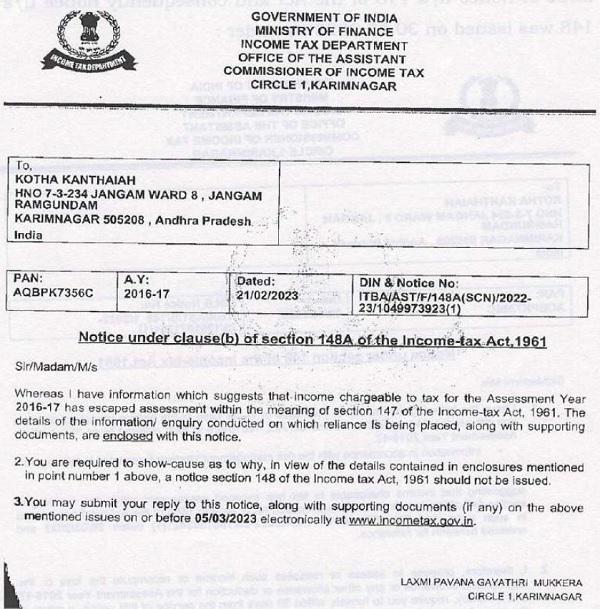
10. Thereafter, the AO also passed an order u/s 148A(d) on 29.03.2023, wherein, the AO has recorded that, despite sufficient time allowed to the assessee in accordance with the provisions of section 148A(b) for compliance to the show cause notice dated 21.02.2023, there is no compliance on behalf of the assessee to the said show cause notice. The AO decided that it is a fit case for issue of notice u/s 148 of the Act and consequently notice u/s 148 was issued on 30.03.2023 as under :
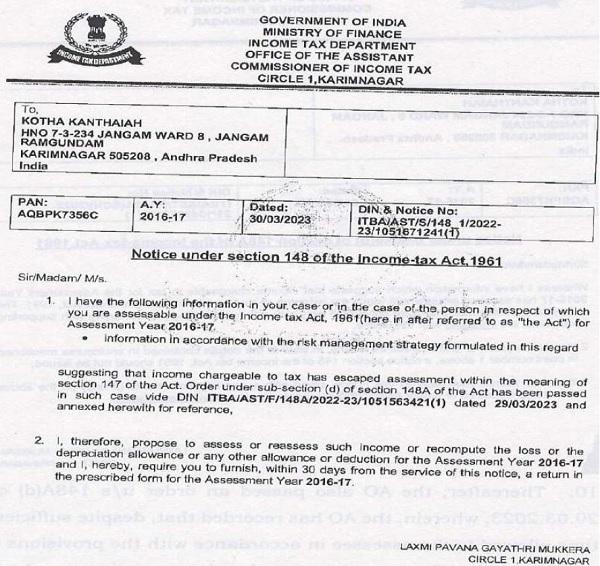
11. Undisputedly, the show cause notice u/s 148A(b) as well as notice u/s 148 were issued by the JAO and not by the faceless Assessing Officer. At the outset, we note that the Hon’ble Jurisdictional High Court has considered an identical issue in assessee’s own case for the immediate preceding assessment year i.e. 2015-16 vide judgement dated 24.04.2025 in W.P.No.344 of 2025 and has recorded the issue involved in the said petition in para 4 of the said judgement as under :
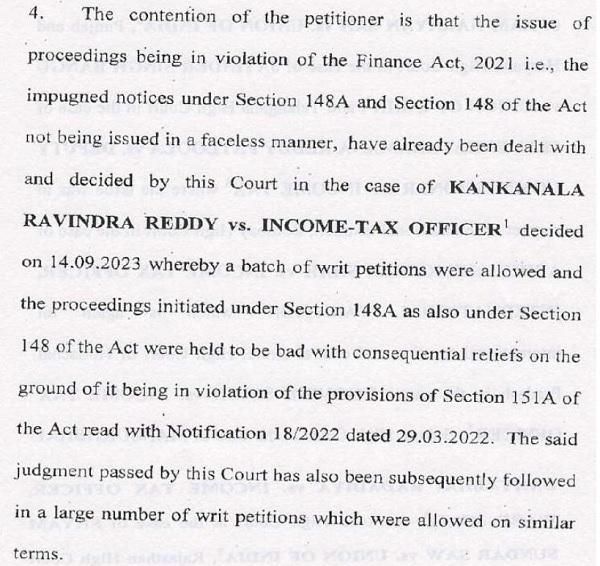
12. It was further noted by the Hon’ble jurisdictional High Court that this issue has been decided against the Revenue by various High Courts and the details of all the judgements of various High Courts are given in para 5 of the said judgement as under :
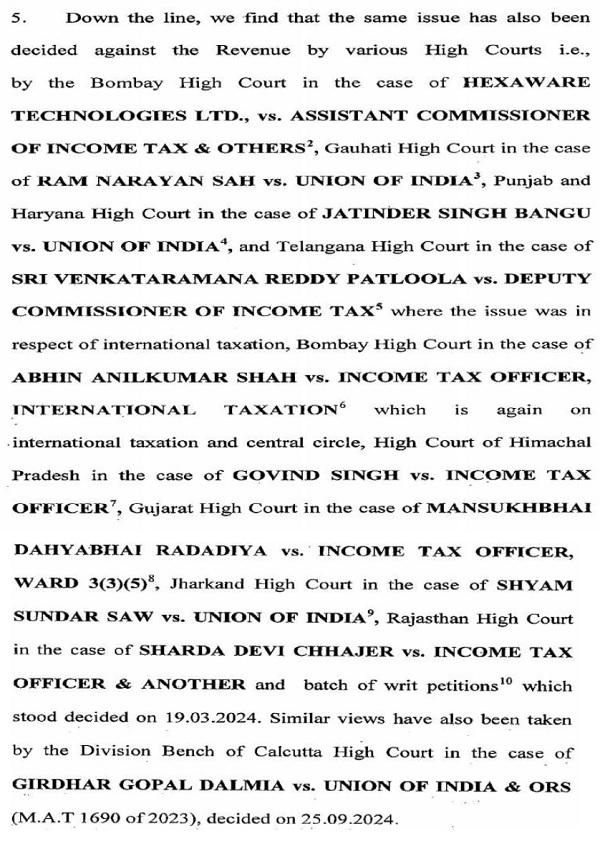
13. In light of various judgements of the Hon’ble High Courts, including the judgement of the jurisdictional High Court in the case of Kankanala Ravindra Reddy Vs. Income Tax Officer [2024] 156 taxmann.com 478 (Gauhati), the Hon’ble High Court has held in para 13 to 19 as under :
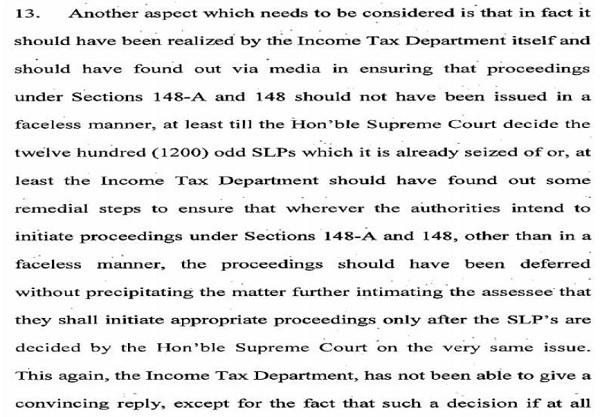
has to be taken, has to be taken for the whole of India, and which otherwise has to be by way of a policy decision and that too at the level of Central Board of Direct Taxes. Though the learned Standing Counsel for the Income Tax Department contended that the Delhi High Court dismissed a writ petition of similar nature, on the one hand when the High Court is struggling to reduce its pendency, such notices which are under challenge in this writ petition are forcing the assessee to knock the doors of this High Court resulting in filing of hundreds of new writ petitions which in the long run not only affects the disposal of the writ petitions but also consumes substantial time of the Bench in hearing these matters again and again on daily basis. Admittedly, in spite of the matter before the Hon’ble Supreme Court having been taken on many occasions, the Hon’ble Supreme Court which is seized of the matter has been reluctant in granting any interim protection to the Income Tax Department. Yet, the authorities concerned at the State level are not ready to accept the verdict passed by a majority of High Courts of different States on the same issue; and to make things further worse, the Income Tax Department is showing audacity by issuing notices continuously under Sections 148-A and 148 through the jurisdictional Assessing Officer whereas it ougl–to have been only in the faceless manner.
14. In the case of BANK OF *INDIA vs. ASSISTAN’ COMMISSIONER, INCOME TAXI1, on an issue whether it was justifiable on the part of the .Income Tax Department in nc following an order passed by the adjudicating authority only on though ground that the appeals are pending, .the Division Bench of th High Court of Bombay held at paragraph No.25 as under, viz., :
“25. Mr. Paridwalla has rightly drawn out attention to the decision of this Court in Commissioner of Income Tax vs. Smt. Godavaridevi Saraf12 as also the recent decision of the co-ordinate Bench of this Court in Samp Furniture AP) Ltd. v. IT013 of which one of us (Justice G.S. Kulkarni) was a member, wherein the Court categorically observed that the Revenue having not “accepted” the judgment of the High Court would not mean that till the same is set aside in a manner known to law, it would loose its binding force. Referring to the decision of the Supreme Court in Union of India vs. Kamlakshi Finance Corporation Ltd.”, the Court observed that the approach of the officials of Revenue of treating decisions being “not acceptable” was criticized by the Supreme Court. In such decision, following are the relevant observations made by the Supreme Court.
“6. Sri Reddy is perhaps right in saying that the officers were not actuated by any mala fides in passing the impugned orders. They perhaps genuinely felt that the claim of the assessee was not tenable and that, if it was accepted. the Revenue would suffer. But what Sri Reddy overlooks is that we are not concerned here with the correctness or otherwise of their conclusion or of any factual malafides but with the fact that the officers, in reaching in their conclusion, by-passed two appellate orders in regard to the same issue which were placed before them, one of the Collector (Appeals) and the other of the Tribunal. The High Court has, in our view, rightly criticized this conduct of the Assistant Collectors and the harassment to the assessee caused by the failure of these officers to give effect to the orders of authorities higher to them in the appellate hierarchy. It cannot be too vehemently emphasized that it is of utmost importance that, in disposing of the quasijudicial issues before them, revenue officers are bound by the decisions of the appellate authorities. The order of the Appellte Collector is binding on the Assistant Collectors working within his jurisdiction and the order of the Tribunal is binding upon the AsSistant Collectors and the Appellate Collectors who function under the jurisdiction of the Tribunal. The principles of judicial discipline require that the orders of the higher appellate authorities should be followed unreservedly by the subordinate authorities. The mere fact that the order of the appellate authority is not “acceptable” to the department — in itself an objectionable phrase – and is the subject matter of an appeal can furnish no ground for not following it unless its operation has been suspended by a competent court. If this healthy rule is not followed, the result will only be undue harassment to assesses and chaos in administration of tax laws.
.. … …
12. We have dealt with this aspect at some length, because it has been suggested by the learned Additional Solicitor General that the observations made by the High Court, have been harsh on the officers. It is clear that the observations of the High Court, seemingly vehement, and apparently unpalatable to the Revenue, are only intended to curb a tendency in revenue matters which, if allowed to become widespread, could result in considerable harassment to the assesses-public without any benefit to the Revenue. We would like to say that the department should take these observations in the proper spirit. The observations of the High Court should be kept in mind in future and the utmost regard should be paid by the adjudicating authorities and the appellate authorities to the requirements of judicial discipline and the need for giving effect to the orders of the higher appellate authorities which are binding on them.”
15. What is worrying this Bench more is the fact that an endeavour is being made whole heartedly to ensure not to generate further litigation on issues which have been laid to rest by a large number of High Courts all of whom have taken a consistent stand that the action of the Income Tax Department being violative of the Finance Act, 2020 and Finance Act, 2021. Now, in order to protect the interest of the Revenue as also that of the assessee, it would be trite at this juncture, if we dispose of the writ petition with an observation/direction that the disposal of the instant writ petition in terms of the judgment rendered by this High Court in the case of Kankanala Ravindra Reddy (1 supra) shall however be subject to the outcome of the SLPs which were filed by the Income Tax Department and which is pending consideration before the Hon’ble Supreme Court.
16. In the given facts and circumstances, this Bench is of the considered opinion that unless and until we do not timely dispose of matters which are squarely covered by the decision of this Court and which stands fortified by the decisions of the various other High Courts on the very same issue, the pendency of this High Court would further be burdened which otherwise can be decided and disposed of as a covered matter.
17. So far as the interest of the Revenue is concerned, we are of the considered opinion that the interest of the Revenue has already been considered and protected, as has been observed in paragraphs 36, 37 and 38 of the order which, for ready reference, is reproduced hereunder:
36. For all the aforesaid reasons, the impugned notices issued and the proceedings drawn by the respondent-Department is neither tenable, nor sustainable. The notices so issued and the procedure adopted being per se illegal, deserves to be and are accordingly set aside/quashed. As a consequence, all the impugned orders getting quashed, the consequential orders passed by the respondent-Department pursuant to the notices issued under Section 147 and 148 would also get quashed and it is ordered accordingly. The reason we are quashing the consequential order is on the principles that when the initiation of the proceedings itself was procedurally wrong, the subsequent orders also gets nullified automatically.
37. The preliminary objection raised by the petitioner is sustained and all these writ petitions stands allowed on this very jurisdictional issue. Since the impugned notices and orders are getting quashed on the point of jurisdiction, we are not inclined to proceed further and decide the other issues raised by the petitioner which stands reserved to be raised and contended in an appropriate proceedings.
38. Since the Honble Supreme Court had, in the race of Ashish Agarwal, supra, as a one-time measure exercising the powers under Article 142 of the Constitution of India, permitted the Revenue to proceed under the substituted provisions, and this Court allowing the petitions only on the procedural flaw, the right conferred on the Revenue would remain reserved to proceed further if they so want from the stage of the order of the Supreme Court in the case of Ashish Agarwal, supra.
18. We would only further like to make observations that since we are inclined to dispose of the instant writ petition, conscious of the fact that the earlier order of this High Court in the case of Kanakala Ravindra Reddy (1 supra) is subjected to challenge before the Hon’ble Supreme Court in SLP No.3574 of 2024, preferred by the Income Tax Department, we make it clear that allowing of the instant writ petition is subject to outcome of the aforesaid SLP preferred by the Revenue against the decision of this High Court in the case of Kanakala Ravindra Reddy (1 supra). This, in other words, would mean that either of the parties, if they so want, may move an appropriate petition seeking revival of this writ petition in the light of the decision of the Hon’ble Supreme Court in the pending SLP on the very same issue.
19. Accordingly, the instant writ petition stands allowed in favour of the assessee so far as the issue of jurisdiction is concerned. As a consequence, the impugned notice under challenge under Sections 148-A and 148 stands set aside/quashed.
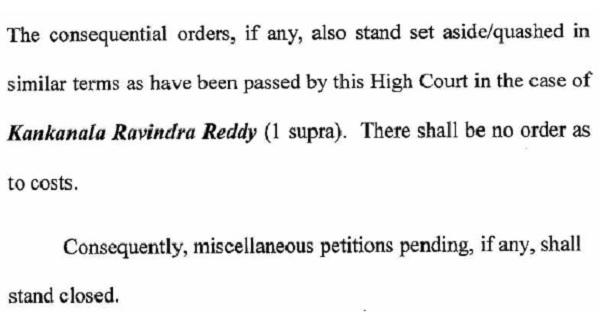
14. Thus, it is clear that the issue raised by the assessee in the present appeal is now covered by the decision of Hon’ble Jurisdictional High Court in the assessee’s own case for the A.Y.2016-17. As regards the contention of the Ld.DR that no such issue was raised by the assessee before the authorities below, we find from the Grounds of Appeal raised before the CIT(A) that the assessee had raised this issue in ground No.2 to 5 as under :
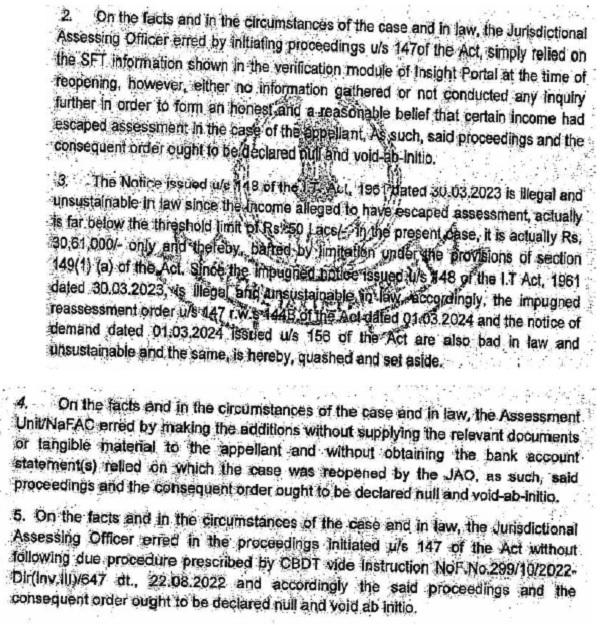
15. In view of the facts emanating from the record, we find that the assessee has duly raised this issue before the CIT(A) and therefore, the contention raised by the Ld.DR is devoid of any merit. Accordingly, the show cause notice issued u/s 148A(b) dated 21.02.2023 as well as notice issued u/s 148 dated 30.03.2023 by the JAO are not valid and liable to be quashed. We order accordingly.
16. However, since the matter is pending adjudication before the Hon’ble Supreme Court and Hon’ble High Court has also given the liberty to the parties to move an appropriate petition, seeking revival of W.P. in light of judgement of Hon’ble Supreme Court on this very issue, we also grant liberty to the parties to get this appeal revived, if, in case the judgement of the Hon’ble Supreme Court on this issue necessitate to modify this order.
5.1. In the case in hand it is not disputed that the notice u/s. 148 of the Act was issued by the JAO and not by the Faceless Assessing Officer. By following the judgment of Hon’ble jurisdictional High Court in the case of Kotha Kanthaiah dated 24.04.2025 in Writ Petition No.344 of 2025 as well as the decision of co-ordinate bench of this Tribunal (supra), we hold that the notice issued u/s. 148A(b) of the Act as well as the decision of co-ordinate bench as well as u/s. 148 of the Act in the case of the assessee by the JAO are not valid and liable to be set aside. We order accordingly.”
8. In case of the assessee when the Hon’ble Jurisdictional High Court has quashed the initiation of proceedings u/sec.147 of the Act, then, it would vitiate the re-assessment order passed by the Assessing Officer. Following the Judgment of Hon’ble Jurisdictional High Court as well as the decision of this Tribunal in the case of M/s. Pitti Holdings Pvt. Ltd., Hyderabad vs., ACIT, Central Circle-1(1), Hyderabad (supra), we do not find any reason to interfere with the Order of the learned CIT(A). The same is upheld. However, an identical issue is pending adjudication before the Hon’ble Supreme Court and the Hon’ble Jurisdictional High Court in the case of Kotha Kanthaiah (supra) has also given the liberty to the parties to move an appropriate petition seeking revival of the case in light of Judgement of Hon’ble Supreme Court on this very issue. Therefore, we also grant the liberty to the parties to get this appeal revived, if Judgment of Hon’ble Supreme Court on this issue necessitate to modify this order.”
11. Accordingly, in view of Judgment of Hon’ble jurisdictional High Court as well as the order of this Tribunal, we hold that the notice issued by the JAO without following the procedure as per the National Faceless Assessment Proceedings notified by the CBDT vide Notification No.15/2022 and 18/2022, dated 28.03.2022 and 29.03.2022, respectively. Since this issue is pending adjudication before the Hon’ble Supreme Court, therefore, we grant the liberty to the parties to get this appeal revived, if Judgement of Hon’ble Supreme Court on this issue necessitate to modify this order.
12. As regards the issue of validity of notice u/sec.148 of the Act for want of an appropriate approval u/sec.151 of the Act, this Tribunal in the case of Raziulla Syed, Hyderabad vs., The Income Tax Officer (Int. TAXN.)-2, Hyderabad in ITA.No. 986/Hyd./2024, vide Order dated 11.03.2025, has considered an identical issue in Paras-7 to 7.4 as under :
“7. We have heard the rival submissions of both the parties and perused the material available on record. There is no dispute between the parties that the assessee is a Non-Resident Indian. Admittedly, in the instant case, the assessment has been reopened u/sec.147 of the Act by issuance of notice u/sec.148 of the Act dated 23.04.2021 and by virtue of the order of Hon’ble Supreme Court in the case of Union of India vs. Ashish Agarwal reported in 2022-SC-Online-SC-543, re-assessment notice issued has been treated as notice issued u/sec.148A of the Act and after due procedure final notice u/sec.148 of the Act dated 30.07.2022 was issued. The assessee contends that any re-assessment notice issued u/sec.148 of the Act after 1st April, 2021 falls under New Scheme of re-assessment proceedings and as per sec.151, the approval of the Specified Authority as specified therein should be obtained. According to the assessee, under New Scheme of re-assessment proceedings, the Specified Authority u/sec. 151(ii) of the Act, in case an assessment is reopened after a period of three years from the end of the relevant assessment year, the Principal Chief Commissioner or Principal Director General are the Specified Authority(ies). Since in the present case, the Assessing Officer has issued notice u/sec.148 of the Act dated 30.07.2022 after approval from Principal Commissioner of Income Tax-1, Hyderabad, the said approval is not in accordance with provision of sec.151(ii) of the Act and consequently, the notice issued by the Assessing Officer and assessment order passed u/sec.147 r.w.s.144C(13) of the Act dated 02.03.2024 is illegal, void abinitio and liable to be quashed.
7.1. There is no dispute with regard to the fact that the Assessing Officer issued original notice u/sec.148 of the Act for the assessment year in question on 23.04.2021 and as per new scheme of re-assessment procedure, the same has been treated as notice issued u/sec.148A of the Act in light of decision of Hon’ble Supreme Court in the case of Union of India vs. Ashish Agarwal (supra) and finally re-assessment notice u/sec.148 was issued to the assessee on 30.07.2022 after approval from the Principal Commissioner of Income Tax-1, Hyderabad dated 27.07.2022. As per the provisions of sec.151(ii) of the Act, if the reopening of the assessment is after three years from the end of the relevant assessment year, then the Specified Authority for grant of approval is Principal Chief Commissioner of Income Tax or Principal Director General of Income Tax and this legal principle is supported by the decision of Hon’ble Supreme Court in the case of Union of India vs. Rajeev Bansal [2024] 167 taxmann.com 70 (SC) wherein the Hon’ble Supreme Court has analysed the issue in light of decision of Hon’ble Supreme Court in the case of Union of India vs. Ashish Agarwal (supra), relevant Circulars/Notifications issued by CBDT and provisions of Taxation and Other Laws Amendment Act, 2021 [in short “TOLA”] and after considering relevant facts held that after 01.04.2021, the New Regime has specified different authorities for granting sanction u/sec.151(ii) of the Act and in case the assessment is reopened after three years from the end of the relevant assessment year, then the Specified Authority to grant sanction is the Principal Chief Commissioner of Income Tax or Principal Director General of Income Tax. In the present case, there is no dispute with regard to the fact that the Assessing Officer issued notice u/sec.148 of the Act dated 30.07.2022 with the prior approval of Principal Commissioner of Income Tax-1, Hyderabad accorded on 27.07.2022 vide Ref.F.No.Pr.CIT-1/Hyd/147/2022-23. Therefore, in our considered view, notice issued by the Assessing Officer u/sec.148 of the Act dated 30.07.2022 with the approval of Principal Commissioner of Income Tax-1, Hyderabad dated 27.07.2022 is not in accordance with the provisions of sec.151(ii) of the Act and consequently, the re-assessment order passed by the Assessing Officer u/sec.147 r.w.s.144C(13) of the Act is illegal, void abinitio and liable to be quashed.
7.2. The assessee has relied upon the decision of ITAT, Mumbai in the case of ACIT vs. Manish Financial ITA.No.5055/Mum./2024 wherein the Tribunal after considering the relevant provisions of law and also by following decision of Hon’ble Supreme Court in the case of Union of India vs., Rajeev Bansal (supra) held as under : “In assessee’s case from the perusal of para 3 of the notice issued under section 148 for AY 2016-17 we notice that the same is issued with the prior approval of Pr.CIT-19 Mumbai accorded on 29.07.2022 vide reference No.Pr.CIT-19/148/2022-23 and this fact is not contravened by the ld DR. For AY 2016-17, the period of three years have elapsed as of 31.03.2020 and the notice is issued beyond three years on 30.07.2022. Therefore as per the decision of the Hon’ble Supreme Court, the approval should have been obtained under the amended provisions of section 151(ii) of the Act i.e. the approval should have been obtained from the Principal Chief Commissioner whereas the approval has been obtained from Pr. CIT as stated in the notice under section 148 itself. Therefore we see merit in the contention of the assessee that the notice under section 148 for AY 2016-17 is issued without obtaining the prior approval from the appropriate authority. Accordingly we hold that the notice under section 148 is invalid and the consequent assessment under section 147 is liable to be quashed.”
7.3. The assessee also relied upon the decision of ITAT, Mumbai Bench in the case of Manish Jagdish Joshi vs. CIT ITA.No.1617/Mum./2024 and the Mumbai Bench of the Tribunal by following the decision of Hon’ble Bombay High Court in the case of Siemens Financial Services (P.) Ltd., vs. DCIT [2023] 457 ITR 647 (Bom.) held as under :
“We find that while considering the similar issue and similar submissions the Hon’ble Jurisdictional High Court in Siemens Financial Services (P.) Ltd. v/s DCIT, (2023) 457 ITR 647 (Bom.) held that TOLA would not affect the scope of section 151 and sanction of Specified Authority was to be obtained in accordance with the law existing when the sanction was obtained. It was further held that where the Assessing Officer issued a reopening notice beyond the period of three years, approval was required to be taken as per provisions of amended section 151 from the Principal Chief Commissioner or Principal Director General or Chief Commissioner or Director General.
Therefore, respectfully following the aforesaid decision of the Hon’ble Jurisdictional High Court we find no merits in the reliance placed by the Revenue on the provisions of TOLA. As, in the present case, the period of three years has elapsed from the end of the relevant assessment year and the order dated 23/05/2022 was passed under section 148A(d) of the Act after obtaining the approval of the Principal CIT-1, Mumbai vide letter dated 15/07/2022, we are of the considered view that the Revenue has not followed the mandatory provisions of the Act while initiating the reassessment proceedings and sanction of the Specified Authority is not in conformity with the law prevalent at the time of grant of sanction.”
7.4. In this view of the matter and by respectfully following the decision of Hon’ble Supreme Court in the case of Union of India vs. Rajeev Bansal (supra) and also the decisions of ITAT, Mumbai Benches, Mumbai in the cases of ACIT vs. Manish Financial and Manish Jagdish Joshi vs. CIT (supra), we are of the considered view that the notice issued by the Assessing Officer u/sec.148 of the Act dated 30.07.2022 by obtaining prior approval from the Principal Commissioner of Income Tax-1, Hyderabad dated 27.07.2022 and consequential final assessment order dated 02.03.2024 passed by the Assessing Officer u/sec.147 r.w.s.144C(13) of the Act is illegal, void abinitio and thus, we quash the final assessment order dated 27.07.2022 passed by the Assessing Officer.”
13. Thus, it is clear that the Tribunal has decided this issue in favour of the assessee by following various Judgments. We further note that the Hon’ble Bombay High Court in the case of Cipla Pharma and Life Sciences Ltd., vs., DCIT 300 Taxman 295 (Bom.) has decided an identical issue in favour of the assessee when the approval was not taken as per the new scheme of reopening while issuing notice u/sec.148 after 01.04.2021. Though the learned DR has relied upon Judgment of Hon’ble Gujarat High Court in the case of Dhanraj Govindram Kella vs., ITO, Ward(2), Surendranagar (supra), however, in view of Judgment of Hon’ble Supreme Court in the case of CIT vs., Vegetable Products Ltd., [1973] 88 ITR 192 (SC), we follow the decision of Hon’ble Bombay High Court as well as the earlier decision of this Tribunal and accordingly held that the notice issued by the Assessing Officer u/sec.148 without approval of the Competent Authority u/sec.151 of the Act which is CCIT as against the approval of Pr. CIT taken by the Assessing Officer, is not valid and liable to be quashed. We order accordingly.
14. Since, we have quashed the notice issued u/sec.148 which vitiates consequential re-assessment order passed by the Assessing Officer, therefore, the other grounds raised by the assessee becomes infructuous and not taken-up for adjudication.
15. In the result, appeal of the Assessee is allowed.
Order pronounced in the open Court on 28.11.2025.
Notes:
” R2025) 170 taxmann.com 422 (Bombay)]
12 [1978] 113 ITR 589 (Bombay)
13 [2024] 165 taxmann.com 581/300 Taxman 452 (Bombay).
14 [1992] taxmann.com 16/55 ELT 433 (SC)




