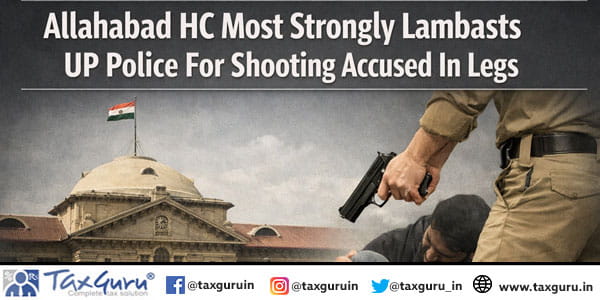
It is definitely most refreshing, most reinvigorating and so also most reassuring to note that while catching the bull by the horns, the Allahabad High Court which is the biggest High Court in not only just India alone, not only in just Asia alone, not only in just few continents alone but in the whole world in a most learned, laudable, landmark, logical and latest judgment titled Raju Alias Rajkumar Vs State of UP in Criminal Misc. Bail Application No. – 45637 of 2025 that was pronounced just recently on January 28, 2026 has most strongly lambasted taking potshots at the growing most reprehensible tendency of Uttar Pradesh police shooting the accused in their legs and then later claiming it as encounters. It merits noting that the Single Judge Bench comprising of Hon’ble Mr Justice Arun Kumar Singh Deshwal who has authored this most commendable, courageous and creditworthy judgment has also most courageously ordered the Director General of Police (DGP) as well as State’s Additional Chief Secretary (Home) to appear before it through video conference on January 30. In addition, the DGP and the Home Secretary have been asked to inform the Court whether any oral or written directions have been issued to police officers to shoot accused persons in the legs or otherwise by claiming it to be a police encounter.
It needs no Albert Einstein to conclude that police in any State cannot ever dare to shoot any accused person without the full patronage of the concerned State Government! It is known all too well that there has been a huge increase in police encounters ever since the incumbent State Government led by CM Yogi Adityanath took over in 2017 who publicly endorses encounter of criminals as we keep listening in various news channels and from then till now more than 15,000 official encounters have taken place which is the biggest testimony to what I have pointed out! It was pointed out by the Bench in no uncertain terms that the practice of police encounters, particularly firing at the legs of accused persons, has seemingly become a routine affair.
It was also laid bare by the Bench that this is ostensibly done to please superior officers or to teach the accused a so-called lesson by way of punishment. It directed the DGP and Home Secretary to answer whether any instructions have been issued to ensure compliance with the directions of the Supreme Court in People’s Union for Civil Liberties (PUCL) regarding registration of FIR, recording of statements of injured persons, and investigation by officers senior in rank to the head of the police party in cases resulting in death or grievous injury during police encounters. It was also pointed out rightly by the Bench that certain police officers may be misusing their authority to attract the attention of higher officers or to create an impression of public sympathy by portraying incidents as police encounters.
At the very outset, this brief, brilliant, bold and balanced judgment authored by the Single Judge Bench comprising of Hon’ble Mr Justice Arun Kumar Singh Deshwal sets the ball in motion by first and foremost putting forth in para 1 that, “Heard Ms. Kusum Mishra, learned counsel for the applicant, Sri Pankaj Saxena, learned A.G.A. for the State and perused the record.”
While stating the purpose of the bail application, the Bench lays bare in para 2 that, “Instant bail application has been filed with a prayer to release the applicant on bail during the trial in Case Crime No.344 of 2025, under Sections 305(a), 331(4), 317(2) BNS, Police Station- Kotwali Dehat, District Mirzapur.”
As we see, the Bench then points out in para 3 that, “Upon perusal of the F.I.R., this Court found that the matter pertains to a police encounter in which the applicant sustained grievous injuries. Thereafter, vide order dated 13.01.2026, this Court directed the learned A.G.A. to seek instructions in compliance with the judgment of the Hon’ble Apex Court in People’s Union for Civil Liberties (PUCL) and another vs. State of Maharashtra, (2014) 10 SCC 635, specifically as to whether any F.I.R. has been registered in respect of the police encounter and whether the statement of the injured has been recorded before a Magistrate or any Medical Officer.”
Do note, the Bench notes in para 4 that, “Today, the learned A.G.A. produced instructions indicating that an F.I.R. in respect of the police encounter has been registered as Case Crime No. 0343 of 2025 at Police Station Lalganj, District Mirzapur. However, it is admitted that the statement of the injured has neither been recorded before the Magistrate nor by any Medical Officer. Further, in the F.I.R. for the incident of police encounter, the Investigating Officer has been shown as a Sub-Inspector, though it has been informed that subsequently an Inspector has been appointed as the Investigating Officer in the said case.”
While citing the relevant case law, the Bench then observes in para 5 that, “From a perusal of the directions issued by the Hon’ble Apex Court in People’s Union for Civil Liberties (PUCL) and another (supra), it is clear that in the event of a police encounter in which the accused sustains grievous injuries, an F.I.R. must be registered forthwith and the investigation should be conducted either by the CBCID or by the police of another police station, and in any case by a police officer of a rank senior to the head of the police party involved in the encounter. Para 31 of PUCL’s case is being quoted as under;
31. In the light of the above discussion and having regard to the directions issued by the Bombay High Court, guidelines issued by NHRC, suggestions of the appellant PUCL, amicus curiae and the affidavits filed by the Union of India, the State Governments and the Union Territories, we think it appropriate to issue the following requirements to be followed in the matters of investigating police encounters in the cases of death as the standard procedure for thorough, effective and independent investigation:
31.1. Whenever the police is in receipt of any intelligence or tip-off regarding criminal movements or activities pertaining to the commission of grave criminal offence, it shall be reduced into writing in some form (preferably into case diary) or in some electronic form. Such recording need not reveal details of the suspect or the location to which the party is headed. If such intelligence or tip-off is received by a higher authority, the same may be noted in some form without revealing details of the suspect or the location.
31.2. If pursuant to the tip-off or receipt of any intelligence, as above, encounter takes place and firearm is used by the police party and as a result of that, death occurs, an FIR to that effect shall be registered and the same shall be forwarded to the court under Section 157 of the Code without any delay. While forwarding the report under Section 157 of the Code, the procedure prescribed under Section 158 of the Code shall be followed.
31.3. An independent investigation into the incident/encounter shall be conducted by the CID or police team of another police station under the supervision of a senior officer (at least a level above the head of the police party engaged in the encounter). The team conducting inquiry/investigation shall, at a minimum, seek:
(a) To identify the victim; colour photographs of the victim should be taken;
(b) To recover and preserve evidentiary material, including bloodstained earth, hair, fibres and threads, etc. related to the death;
(c) To identify scene witnesses with complete names, addresses and telephone numbers and obtain their statements (including the statements of police personnel involved) concerning the death;
(d) To determine the cause, manner, location (including preparation of rough sketch of topography of the scene and, if possible, photo/video of the scene and any physical evidence) and time of death as well as any pattern or practice that may have brought about the death;
(e) It must be ensured that intact fingerprints of deceased are sent for chemical analysis. Any other fingerprints should be located, developed, lifted and sent for chemical analysis;
(f) Post-mortem must be conducted by two doctors in the district hospital, one of them, as far as possible, should be incharge/head of the district hospital. Post-mortem shall be videographed and preserved;
(g) Any evidence of weapons, such as guns, projectiles, bullets and cartridge cases, should be taken and preserved. Wherever applicable, tests for gunshot residue and trace metal detection should be performed.
(h) The cause of death should be found out, whether it was natural death, accidental death, suicide or homicide.
31.4. A magisterial inquiry under Section 176 of the Code must invariably be held in all cases of death which occur in the course of police firing and a report thereof must be sent to the Judicial Magistrate having jurisdiction under Section 190 of the Code.
31.5. The involvement of NHRC is not necessary unless there is serious doubt about independent and impartial investigation. However, the information of the incident without any delay must be sent to NHRC or the State Human Rights Commission, as the case may be.
31.6. The injured criminal/victim should be provided medical aid and his/her statement recorded by the Magistrate or Medical Officer with certificate of fitness.
31.7. It should be ensured that there is no delay in sending FIR, diary entries, panchnamas, sketch, etc. to the court concerned.
31.8. After full investigation into the incident, the report should be sent to the competent court under Section 173 of the Code. The trial, pursuant to the charge-sheet submitted by the investigating officer, must be concluded expeditiously.
31.9. In the event of death, the next of kin of the alleged criminal/victim must be informed at the earliest.
31.10. Six-monthly statements of all cases where deaths have occurred in police firing must be sent to NHRC by DGPs. It must be ensured that the six-monthly statements reach to NHRC by 15th day of January and July, respectively. The statements may be sent in the following format along with post-mortem, inquest and, wherever available, the inquiry reports:
(i) Date and place of occurrence.
(ii) Police station, district.
(iii) Circumstances leading to deaths:
(a) Self-defence in encounter.
(b) In the course of dispersal of unlawful assembly.
(c) In the course of affecting arrest.
(iv) Brief facts of the incident.
(v) Criminal case no.
(vi) Investigating agency.
(vii) Findings of the magisterial inquiry/inquiry by senior officers:
(a) disclosing, in particular, names and designation of police officials, if found responsible for the death; and
(b) whether use of force was justified and action taken was lawful.
31.11. If on the conclusion of investigation the materials/evidence having come on record show that death had occurred by use of firearm amounting to offence under IPC, disciplinary action against such officer must be promptly initiated and he be placed under suspension.
31.12. As regards compensation to be granted to the dependants of the victim who suffered death in a police encounter, the scheme provided under Section 357-A of the Code must be applied.
31.13. The police officer(s) concerned must surrender his/her weapons for forensic and ballistic analysis, including any other material, as required by the investigating team, subject to the rights under Article 20 of the Constitution.
31.14. An intimation about the incident must also be sent to the police officer’s family and should the family need services of a lawyer/counselling, same must be offered.
31.15. No out-of-turn promotion or instant gallantry rewards shall be bestowed on the officers concerned soon after the occurrence. It must be ensured at all cost that such rewards are given/recommended only when the gallantry of the officers concerned is established beyond doubt.
31.16. If the family of the victim finds that the above procedure has not been followed or there exists a pattern of abuse or lack of independent investigation or impartiality by any of the functionaries as abovementioned, it may make a complaint to the Sessions Judge having territorial jurisdiction over the place of incident. Upon such complaint being made, the Sessions Judge concerned shall look into the merits of the complaint and address the grievances raised therein.”
Most damningly, the Bench then points out in para 6 that, “From the aforesaid facts, it is evident that in the present case, although the applicant sustained grievous injuries in a police encounter, the directions issued by the Hon’ble Apex Court in People’s Union for Civil Liberties (PUCL) and another (supra), as further affirmed in the case of Andhra Pradesh Police Officers Association vs Andhra Pradesh Civil Liberties Committee (APCLC) reported in (2022) 16 SCC 514, have not been complied with. The police have neither recorded the statement of the injured before a Medical Officer or a Magistrate, nor has the investigation of the police encounter been conducted by an officer of a rank higher than the head of the police party involved in the encounter.”
Most forthrightly, the Bench underscores in para 7 holding that, “This Court is frequently confronted with cases where, even in matters involving petty offences such as theft, the police indiscriminately resort to firing by projecting the incident as a police encounter, without following the procedure laid down by the Hon’ble Apex Court in People’s Union for Civil Liberties (PUCL) and another (supra). Although this Court recognizes that police personnel also have the right of private defence and may use force in appropriate circumstances, it is well settled that where death occurs or grievous injuries are caused to the accused, the procedure mandated by the Hon’ble Apex Court, as referred to above, must be strictly followed.”
To put things in perspective, the Bench envisages in para 8 while elaborating on the facts of the case stating that, “The Criminal Misc. Bail Application No. 45870 of 2025 and Criminal Misc. Bail Application No. 227 of 2026 are also listed today, the cases likewise pertains to a police encounter in which the applicant sustained grievous injuries. In the bail application no. 45870 of 2025, the In-charge Inspector, Santosh Kumar Singh, who led the police party during the encounter, has himself stated that the bullet fired by him hit the injured applicant. Accordingly, vide order dated 14.01.2026, this Court directed him to appear before the Court and apprise it as to whether any F.I.R. had been registered in respect of the police encounter and whether any investigation had been conducted.”
It is worth noting that the Bench then notes in para 9 that, “Today, the In-charge Inspector, Santosh Kumar Singh, informed the Court that no F.I.R. has been registered in connection with the police encounter and, consequently, no investigation has been conducted. He further apprised the Court that the statement of the injured applicant has not been recorded either before a Medical Officer or a Magistrate.”
Most astoundingly, the Bench then points out in para 10 that, “The aforesaid incidents clearly demonstrate non-compliance with the directions issued by the Hon’ble Apex Court in People’s Union for Civil Liberties (PUCL) and another (supra) in cases of police encounters where the accused sustains grievous injuries. It is indeed surprising that, despite the directions of the Hon’ble Apex Court in People’s Union for Civil Liberties (PUCL) and another (supra) having been duly circulated, the police appear to be either unaware of or indifferent to the said directions.”
Most significantly and most remarkably, the Bench encapsulates in para 11 what constitutes the real cornerstone of this notable judgment postulating precisely that, “This Court has noticed that the practice of police encounters, particularly firing at the legs of accused persons, has seemingly become a routine feature, ostensibly to please superior officers or to teach the accused a so-called lesson by way of punishment. Such conduct is wholly impermissible, as the power to punish lies exclusively within the domain of the Courts and not with the police. India being a democratic State governed by the rule of law, the functions of the Executive, the Legislature, and the Judiciary are distinct and well defined, and any encroachment by the police into the judicial domain cannot be countenanced.”
It would be instructive to note that the Bench hastens to add in para 12 noting that, “The aforesaid facts indicate that neither has the State Government issued any oral or written direction to police officers to teach a lesson to accused persons by firing at their legs, even in cases involving petty offences, nor can such acts be justified on that basis. On the contrary, it appears that certain police officers may be misusing their authority in order to attract the attention of higher officers or to create an impression of public sympathy by portraying incidents as police encounters involving firing upon the accused.”
It cannot be glossed over that the Bench points out in para 13 that, “It is pertinent to note, for the sake of clarity, that in the present matters no police officer has sustained any injury, which further calls into question the necessity and proportionality of the use of firearms in the alleged encounters.”
Most rationally, the Bench then deems it fit to direct and hold in para 14 that, “This Court directs the Additional Chief Secretary (Home) U.P. as well as the Director General of Police, U.P., to appear through video conferencing before this Court at 10:00 a.m. on 30.01.2026 and inform the Court whether any oral or written directions have been issued to police officers to fire upon accused persons in the legs or otherwise in the name of a police encounter or to ensure compliance with the directions of the Hon’ble Apex Court in People’s Union for Civil Liberties (PUCL) and another (supra) regarding registration of F.I.R., recording of statements of injured persons, and investigation by officers senior in rank to the head of the police party in cases resulting in death or grievous injury during police encounters.”
What’s more, the Bench then directs and holds in para 15 that, “Put up this case, as fresh, on 30.01.2026 at 10:00 A.M along with bail application nos.45870 of 2025 and 227 of 2026.”
Finally, the Bench then aptly concludes by directing and holding in para 16 that, “The Registrar (Compliance) is directed to send a copy of this order to the Additional Chief Secretary (Home), U.P., Lucknow, as well as to the Director General of Police, U.P., Lucknow.”
In a nutshell, we thus see that the Allahabad High Court has made it indubitably clear that it will no longer take shooting of leg of accused by the UP police for granted and erring police officials would definitely be held accountable. It has thus also send a very loud and clear message that, “Be you ever so high, the law stands above you.” Of course, the long and short of this notable judgment is that there has to be complete zero tolerance for such most reprehensible crime by the police themselves who openly indulge in such despicable act and shamelessly disgrace the uniform which they wear and cannot be allowed to go scot free with impunity! No denying or disputing it!