The note outlines key personal tax expectations from Budget 2026, focusing on equity, simplification, and inflation alignment. It proposes introducing an optional joint taxation framework for married couples to better reflect household-level economic realities while retaining individual filing as the default. For senior citizens, it highlights the mismatch between enhanced TDS thresholds on interest income and the unchanged deduction limit under Section 80TTB, recommending alignment at ₹1,00,000. The paper also seeks a higher deduction under Section 80D, extension of medical expenditure benefits beyond senior citizens, and availability of this deduction under the new tax regime. Other suggestions include raising the gift taxation threshold under Section 56(2)(x) to ₹1,50,000, explicitly exempting family settlements from capital gains under Section 47, extending the belated return filing deadline to March 31 of the assessment year, and extending rebate benefits under Section 87A to capital gains taxed at special rates under Sections 111A and 112A. Collectively, the proposals aim to reduce inequities, litigation, and compliance pressure while supporting voluntary tax compliance.
1.0 Background
The Union Budget remains a key policy instrument influencing individual tax outflows, disposable income and household financial decisions, particularly as a growing share of the population is brought within the formal tax net.
2.0 Some of the expectations on the personal tax front from the Budget 2026 are as follows:
2. Introduction of an Optional Joint Taxation Framework for Married Couples
In accordance with the existing income-tax framework, India follows an individual-based system of taxation, under which each spouse is assessed separately, irrespective of marital status or the pooling of household resources. While this approach ensures individual tax accountability, it does not fully reflect the economic realities of married households, where income, savings, and expenditure decisions are often made jointly.
Several developed and emerging economies permit some form of joint or family-based taxation, recognising the household as an economic unit and providing flexibility to married couples in structuring their tax affairs. On the other hand, the absence of an optional joint taxation framework in India may result in inequities, particularly in single-income or uneven-income households, where the higher-earning spouse bears a disproportionately higher tax burden.
The introduction of an optional joint taxation mechanism would recognise household-level economic realities, and support families in managing tax liabilities more efficiently, while preserving individual choice within the tax system. Such a framework may allow for aggregation or partial pooling of income for rate or rebate purposes.
Accordingly, it is suggested that an optional joint taxation regime be introduced for married couples, allowing spouses to elect joint filing of tax return while retaining the existing system of separate taxation as the default.
2.2 Disparity between enhanced TDS thresholds u/s 80TTB and deduction limits for non-senior citizens
Section 80TTB provides senior citizens with a higher deduction of up to Rs. 50,000 in respect of interest income from deposits. The Government has extended additional relief to senior citizens by enhancing the threshold for non-deduction of tax at source on interest income under section 194A (corresponding to Section 393(1)[Table: S.No. 5(ii) of the ITA 2025) to Rs. 1,00,000, post the amendments introduced by the Finance Act, 2025. However, the deduction limit under section 80TTB has not been aligned with this policy approach, leading to continued tax incidence and compliance burden for senior citizens.
In view of the enhanced threshold for non-deduction of tax at source, it would be appropriate to align the deduction limit under section 80TTB be enhanced to Rs. 100,000 to provide relief to senior citizens.
2.3 Enhancing the threshold limit for Section 80D and applicability of medical expenditure to be extended to individuals other than Senior citizens
Section 80D [corresponding section 126 in ITA 2025] of the IT Act provides deduction for premium paid by an Individual in respect of medical insurance or contribution to Central Government Health Scheme / notified scheme for self, spouse, dependent children or parents. Further as per the present laws, citizens above the age of 60 years (i.e. senior citizens) who are not covered by Health Insurance are allowed deduction of Rs. 50,000 towards actual medical expenditure.
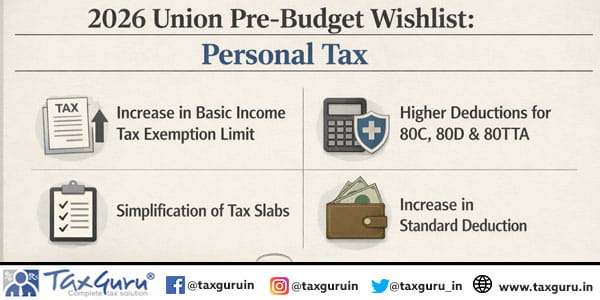
As the scope of such expenditure is restricted only to senior citizens, it is recommended to expand this benefit to other individuals as well. Also, the quantum of deduction under this section should be revised upwards to Rs. 100,000, considering the inflation in the economy. Also, it is expected that the benefit of 80D be allowed under the New tax regime.
2.4 Threshold limit of Gifts received from non-relative under section 56(2)(x) which was last amended in 2006 to be enhanced to Rs.1,50,000/-
In accordance with Section 56(2)(x) [corresponding section 92(2)(m)] of the IT Act, if any person receives any property on or after 1 April 2017, without consideration or for consideration which is less than the aggregate fair market value by an amount exceeding Rs. 50,000, the difference shall be subjected to tax under the head ‘Income from Other Sources’ in the hands of the recipient.
The existing threshold limit of Rs. 50,000 under this section was last revised in the Budget 2006 (which was earlier covered in section 56(2)(vi). Thus, considering the inflation and increased cost of living, the threshold limit should be enhanced to Rs. 1,50,000.
2.5 Family settlement to be included within the ambit of section 47
As per the provisions of the IT Act, tax on capital gains is attracted on transactions where a capital asset is transferred. Section 47 (corresponding section 70 of ITA 2025) of the IT Act carves-out/exempts certain transactions from the ambit of transfer and accordingly, would not be subjected to capital gains tax.
Specified individuals often receive capital assets as a part of family settlement. Section 56(2)(x) of the IT Act provides that transfer of assets between specified relatives would not be treated as income of the recipient. Further, various courts have passed their rulings in the favour of assessee, stating that family settlement does not attract capital gains.
However, till date section 47 does not explicitly provide for an exemption for assets transferred pursuant to a family settlement amongst relatives. Hence, in order to reduce litigation and bring more clarity, it is recommended that section 47 should explicitly include family settlements so as to exempt them from the purview of ‘transfer’ for capital gains purposes.
2.6 Extension in the due date for filing Belated tax return [corresponding section 263(4) of ITA 2025] to the end of the assessment year
The existing due date for filing a belated return is 31st December of the relevant assessment year. For instance, the belated return for Financial Year 2025-26 can be filed by 31st December 2026. Such filing of a belated return would attract late fees of Rs. 5,000 (restricted to Rs. 1,000 wherein the total income of the taxpayer does not exceed Rs. 5 lakhs).
Extending the said due date would provide the individual taxpayers with additional time to fulfill their tax filing obligations. This can lead to increased compliance as taxpayers are more likely to file their returns when they have sufficient time to gather necessary documents and information.
Thus, providing a more lenient timeline encourages voluntary compliance, allowing taxpayers to fulfill their tax obligations without feeling rushed or pressured. This approach is aligned with fostering a tax system based on voluntary compliance rather than punitive measures.
While extending the due date for belated tax returns may have these advantages, it’s essential to strike a balance between providing flexibility for taxpayers and maintaining the efficiency of the tax administration system. Thus, it is desirable that the due date for filing of belated return needs to be extended to the end of the relevant year i.e. March 31.
2.7 Extension of Rebate Benefit to Income Taxed at Special Rates under Sections 111A and 112A
Certain categories of capital gains are taxed at special rates, including short-term capital gains on equity shares and equity-oriented funds under section 111A (corresponding to Section 196 of ITA 2025) and long-term capital gains on such assets under section 112A (corresponding to Section 198 of ITA 2025). While these provisions prescribe special tax rates of 20% and 12.5% respectively, the rebate available under section 87A is presently restricted to income taxed at normal slab rates and does not extend to income chargeable at special rates.
As a result, taxpayers with total income comprising largely of equity-linked capital gains may not be able to fully avail the rebate benefit, even where their overall income remains within the effective “no-tax” threshold introduced in recent years. This creates an unintended disparity between different classes of taxpayers, particularly small and retail investors, whose income profile increasingly includes capital market-linked returns.
The Finance Act, 2025 significantly enhanced taxpayer relief by increasing the effective “no-tax” threshold to Rs. 12 lakh through revised slabs and rebate provisions. However, the continued exclusion of income taxable under sections 111A and 112A from the scope of rebate dilutes the intended benefit of this relief for a segment of individual taxpayers.
Accordingly, it is suggested that the rebate under section 87A be extended to include tax payable on income chargeable under sections 111A and 112A, at least up to the specified income threshold.