Budget 2026 and the Moral Economy of Taxation – From Fiscal Relief to Constitutional Justice
“A nation’s budget is not merely a statement of revenue and expenditure; it is a mirror reflecting its moral priorities.”
Abstract
Union Budget 2026 marks a decisive moment in India’s evolving fiscal architecture. As the new tax regime gradually replaces the deduction-driven old regime, the State confronts a fundamental question: Should taxation prioritise simplicity, or must it remain anchored in equity and distributive justice? This research critically analyses five key reforms expected in Budget 2026 expansion of tax-free income, rationalisation of slabs, reintroduction of deductions, procedural simplification, and digital-era tax reforms through the lenses of constitutional philosophy, tax jurisprudence, and public policy. It argues that Budget 2026 has the potential to transform India’s tax system from a revenue-centric mechanism into a citizen-centric instrument of economic justice.
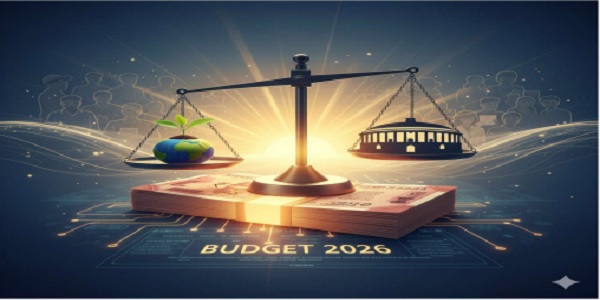
1. INTRODUCTION
Taxation as a Constitutional Dialogue
Taxation is often perceived as a technical exercise governed by statutes. Yet, in constitutional democracies, taxation is a dialogue between the State and its citizens a negotiation between power and consent, obligation and justice. Article 112 of the Constitution mandates the presentation of the annual budget, which reveals how the State interprets its constitutional duty under Articles 14 (equality before law) and 39(b) (equitable distribution of resources)1.
In India’s context, Budget 2026 has been preceded by widespread calls for reforms that ease compliance, expand tax thresholds, and provide relief to taxpayers. Experts and industry bodies alike have highlighted the need for a citizen-friendly tax structure that aligns with modern economic realities. Among these, individual taxpayers have sought relief from tax burdens and simplified compliance mechanisms; the Institute of Chartered Accountants of India has urged joint filing options for spouses; and research bodies have proposed aligning fixed deposit tax treatment with capital gains principles all indicative of a broader demand for fairness and equity in the tax system23.
To understand the stakes of Budget 2026, one must look beyond macroeconomic indicators and examine lived realities. Consider Ravi, a software professional earning ₹14 lakh annually who pays significant tax despite belonging to neither the wealthy elite nor the economically vulnerable. Budget 2026 has the potential to recalibrate this imbalance.
II. EXPANSION OF THE TAX-FREE THRESHOLD
Reimagining the “Ability to Pay”
Under the new tax regime, individuals can enjoy no income tax liability up to ₹12 lakh of income4. This effective exemption is due to a combination of revised tax slabs and the Section 87A rebate, which has been expanded under the new regime5. Economists and taxpayers alike are now speculating whether Budget 2026 could raise this threshold to ₹15 lakh, thereby enhancing relief for middle-income groups6.
The principle of “ability to pay” is a foundational normative standard in tax law, which holds that taxation should correspond to economic capacity rather than nominal income. Although the Supreme Court’s jurisprudence recognises this in cases like CIT v. Keshavlal, modern economic conditions particularly in metropolitan India have rendered older income thresholds less reflective of real living standards.
For taxpayers like Ravi, raising the exemption threshold could translate into significant annual tax savings and greater discretionary spending. From a macroeconomic perspective, increasing disposable income among middle-income groups can stimulate demand, savings, and investment an insight consistent with Keynesian demand-side theory, which emphasises the role of consumption in driving economic growth.
III. RATIONALISING TAX SLABS
From Formal Progressivity to Substantive Equity
The current new tax regime applies a 30% tax rate on annual incomes above ₹24 lakh7. However, many policy analysts argue that this threshold is too low to reflect real economic stratifications, and there are growing calls for shifting the highest rate to ₹30–₹40 lakh or beyond.8
Such rationalisation would better align India’s tax structure with the principle of vertical equity the idea that taxpayers with greater economic capacity should bear progressively larger tax burdens. In the absence of such adjustments, formal progressivity risks becoming symbolic rather than substantive.
Moreover, rationalising slabs could enhance economic efficiency by reducing the marginal tax burden on productive professionals, thereby encouraging entrepreneurship, investment, and innovation. From a structural perspective, slab reform is more than a fiscal adjustment; it is an intervention that shapes incentives, behaviour, and long-term economic trajectories.
IV. DEDUCTIONS AND THE ETHICS OF INCENTIVES
The new tax regime was designed to be simpler by limiting exemptions and deductions a departure from the old regime’s multitude of tax breaks, including broad deductions under sections such as 80C, 80D, and interest under Section 24(b) for home loans.9While simplicity can reduce compliance costs, it can also undermine incentives for savings, insurance, and investment behaviours that have positive macroeconomic externalities.
Tax incentives serve normative and behavioural purposes. In Union of India v. Azadi Bachao Andolan, the Supreme Court recognised that tax incentives can be legitimate instruments of public policy. Restoring selective deductions, or enhancing the standard deduction (which is currently ₹75,000), has been part of pre-budget expectations for 2026, with suggestions that standard deduction could rise to ₹1 lakh and some exemptions like 80D may be allowed under the new regime.10
For taxpayers like Ravi, partial deduction of home loan interest would restore the economic rationale of homeownership. At the societal level, such incentives could strengthen capital formation and encourage prudent financial behaviour.
V. PROCEDURAL JUSTICE
From Tax Enforcement to Tax Legitimacy
Taxation is not only about rates it is also about procedures. India’s tax system has long been characterised by complex compliance requirements and protracted litigation, which can undermine taxpayer confidence and erode the legitimacy of the fiscal regime.
Flexible dispute resolution mechanisms and streamlined compliance are increasingly seen as essential components of a modern tax system. Ahead of Budget 2026, Treasury discussions and industry feedback emphasise reducing administrative burdens, reconsidering TDS structures, and simplifying procedures for digital and mobile taxpayers.11
When taxpayers perceive the system as fair and predictable, compliance becomes voluntary rather than coercive transforming enforcement into legitimacy.
VI. TAXING THE DIGITAL FUTURE
The Challenge of Modernity
The rise of digital assets, gig economy platforms, and cross-border transactions has exposed the limitations of traditional tax frameworks. India’s treatment of cryptocurrencies taxed at a flat 30% on gains with a 1% TDS on transactions reflects caution but also policy rigidity.1213 Budget 2026 provides an opportunity to clarify and rationalise digital-era taxation. By adjusting crypto tax rules, clarifying capital gains treatment, and integrating digital compliance, the State can balance innovation with regulation. Tax policy that adapts to structural economic change is not optional in a digitised world it is necessary.
VII. BUDGET 2026 AS A POLICY TURNING POINT
Taken together, the five reforms discussed represent an integrated approach to fiscal governance, signalling a paradigm shift from revenue maximisation to citizen-centric taxation.
| Traditional Model | Emerging Model |
|---|---|
| Revenue-centric | Justice-centric |
| Complexity-driven | Simplicity with equity |
| Litigation-heavy | Trust-based compliance |
| Static taxation | Adaptive digital taxation |
If effectively implemented, Budget 2026 could reconceptualise the relationship between the State and the taxpayer, transforming taxation from a burden into a collective investment in national progress.
VIII. CONSTITUTIONAL PHILOSOPHY
Towards a Theory of Tax Justice
The Constitution of India does not define “tax justice” explicitly, yet its values permeate fiscal policy. Article 14 guarantees equality before law, while Article 39(b) calls for equitable distribution of resources. Together, these principles impose a moral obligation on the State to design fair, proportional, and inclusive tax frameworks.
Justice P.N. Bhagwati observed that economic justice is inseparable from constitutional democracy. Likewise,
Oliver Wendell Holmes famously stated that “taxes are what we pay for civilisation.” Yet civilisation demands not only taxation but justification where tax design reflects dignity, equity, and opportunity.
CONCLUSION
From Fiscal Arithmetic to Moral Architecture
Union Budget 2026 is more than a fiscal document it is a structural blueprint of India’s moral economy. By expanding tax-free thresholds, rationalising slabs, reintroducing meaningful deductions, simplifying procedures, and modernising digital taxation, the State can craft a tax regime that reflects constitutional values rather than mere fiscal expediency.
For taxpayers like Ravi, these reforms are not abstract debates they are tangible determinants
of dignity, security, and aspiration. Ultimately, the true measure of Budget 2026 will not lie in revenue figures but in its ability to answer a fundamental constitutional question:
Can a modern democracy tax its citizens without diminishing their dignity?
If Budget 2026 answers this question in the affirmative, it will mark not merely a fiscal reform but a civilisational milestone in India’s journey toward economic justice.
REFERENCES
1. “New tax regime slabs and features (FY 2025–26),” ClearTax, Jan 2026.
2. “Union Budget 2026 Income Tax Expectations Live: Standard Deduction & 80D under New Regime,” Economic Times, Jan 2026.
3. “Will Budget 2026 provide clarity on cryptocurrency taxation,” Times of India, Jan 2026.
4. SBI Research pre-budget proposals for Budget 2026, Economic Times, Jan 2026.
5. ICAI proposal for joint filings in Budget 2026, Economic Times, Jan 2026.
6. SBI recommendation on tax-saving FD lock-in, Economic Times, Jan 2026.
7. Reuters coverage of India’s 2025 Budget tax relief emphasis.
8. Constitution of India, arts. 14, 39(b), 112, 265.
9. Income Tax Act, 1961, s. 115BAC.
10. Income Tax Act, 1961, s. 87A.
11. CIT v. Keshavlal, AIR 1965 SC 866.
12. John Maynard Keynes, The General Theory of Employment, Interest and Money (1936).
13. Kunnathat Thathunni Moopil Nair v. State of Kerala, AIR 1961 SC 552.
14. K. Garg v. Union of India, (1981) 4 SCC 675.
15. Income Tax Act, 1961, ss. 80C, 80D, 24(b).
16. Union of India v. Azadi Bachao Andolan, (2004) 10 SCC 1.
17. Vodafone International Holdings BV v. Union of India, (2012) 6 SCC 613.
18. Nicholas Kaldor, An Expenditure Tax (George Allen & Unwin, 1955).
19. Constitution of India, arts. 14 & 39(b).
20. John Rawls, A Theory of Justice (Harvard University Press, 1971).
21. Ministry of Finance, Government of India, Union Budget 2025–26 and Finance Bill, 2025.
22. Economic Survey of India 2024–25, Ministry of Finance, Government of India.
23. OECD, Tax Policy Reforms 2024: OECD and Selected Partner Economies (OECD Publishing).
Notes:
1 Available at: Constitution of India, arts. 14, 39(b), 112, 265.
2 Available at: Budget 2026: India’s top audit body has suggested Nirmala Sitharaman to change tax process for husband, wife – The Economic Times
3 Available at: Eliminate or reduce TDS, give relief on EV purchase and more; what Budget 2026 should do for individual taxpayers? – The Economic Times
4 Available at: Union Budget 2026–27: Expectations, Tax Changes & Reforms
5Available at: Income Tax Slabs for FY 2025-26 (AY 2026-27): New and Old Regime Rates, Rebate &
Surcharge
6 Available at: Budget 2026 Expectations Highlights: What May Change in Income Tax Slabs, New vs Old Tax Regime and Exemptions – Money News | The Financial Express
7Available at: Income Tax Slabs for FY 2025-26 (AY 2026-27): New and Old Regime Rates, Rebate &
Surcharge
8Available at: Bigul’s Perspective on the Union Budget 2024-25
9 Available at: Income Tax Slabs for FY 2025-26 (AY 2026-27): New and Old Regime Rates, Rebate & Surcharge
10Available at: Income Tax Budget 2026 Expectations Live: No tax up to Rs 15 Lakh, ₹1 lakh standard
deduction on taxpayers’ radar; Check Union Budget date, time and where to watch it live – The Economic Times
11 Available at: Eliminate or reduce TDS, give relief on EV purchase and more; what Budget 2026 should do for individual taxpayers? – The Economic Times
12 Available at: Crypto Tax in India: Complete Guide to Crypto Tax & Filing Rules (2026)
13 Available at: Will Budget 2026 provide clarity on cryptocurrency taxation, simplify compliance?
****