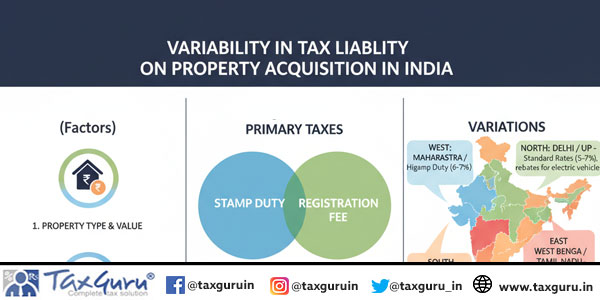
Acquiring real estate in India triggers multiple tax obligations at both State and Central levels. At the State level, stamp duty and registration fees (governed by the Indian Stamp Act, 1899 and state Stamp Acts) apply on sale deeds and conveyances. Stamp duty rates vary widely by state and by property classification (residential vs commercial vs agricultural). Typically, duty on an urban sale deed ranges roughly 5–7% of value (plus ~1% registration fee). These rates can be higher for commercial property or prime urban locations. Conversely, agricultural land often attracts minimal or no duty (especially if rural), and many states exempt intra-family transfers. For example, transfers of agricultural land to a Class I heir (as defined under Hindu Succession Act) are explicitly exempt from stamp duty. Stamp duty authorities also police undervaluation: Section 47A of the Stamp Act authorizes reassessment of a sale deed if its declared value seems below market. In CRCO v. P. Babu (2025), the Supreme Court reaffirmed that officers must follow the prescribed procedure (issue a provisional order with reasons and grant a hearing) before fixing a higher market value. Failure to do so (e.g. non-issuance of reasons) will invalidate the reassessment. In short, stamp liability depends on state rules, and buyers must budget for substantial state duty and registration fees when buying property.
I. Central Goods and Services Tax (GST) on Property
Under the GST regime, the sale of land or completed buildings is exempt (outside GST) – only under-construction real estate (a “service” of construction) is taxable. In practice this means ready-to-move-in flats or plots (land) incur no GST, but apartments/complexes sold before completion draw GST on the builder’s supplies. The GST Council has fixed these rates by property type: residential apartments are taxed at 5% (no input-credit) and affordable housing at 1% (no input-credit). Commercial real estate rates differ: by default, new commercial units attract 12% (with ITC) when sold by developers, though developments with small commercial components (<15% of floor area) can opt for 5% non-ITC rates. Standalone commercial projects (shops, offices, etc.) attract 18% GST. These rates (implemented from April 2019) replaced higher earlier rates (12%/8%). Crucially, GST on property is payable by the seller/promoter, not the buyer – but sellers generally pass this cost to buyers in the price. In contrast to VAT or service tax era, there is no separate entry tax or luxury tax on property under GST. Developers receive no input-credit under the 5%/1% schemes, and certain supplies (like land itself, or completed flats with Occupancy Certificate) remain explicitly out of GST’s ambit.
In summary, GST liability on acquisition depends on the project status and property use. A buyer of an under-construction residential flat will effectively bear GST at 5% (1% if “affordable”), whereas purchase of a completed flat or bare land will carry no GST (only stamp duty/registration). Commercial deals trigger higher GST (12–18%). Buyers and investors should verify GST compliance and invoicing (developers must register for GST) and factor GST into cost comparisons when selecting between new projects and resale properties.
II. Income Tax Implications: TDS and Capital Gains
TDS on Purchase. At the Central level, Section 194-IA of the Income-tax Act (introduced in 2013) imposes a withholding obligation on the buyer. Any person (buyer) acquiring an immovable property (other than agricultural land) for ≥₹50 lakh must deduct tax at 1% of the consideration as TDS. The ₹50 lakh threshold applies to the higher of the agreement value or stamp-duty value. If met, the buyer must deposit this TDS and issue Form 16B to the seller. Importantly, agricultural land is excluded from Section 194-IA (unless it falls in an urban area). Thus, purchases of farms in rural zones generally do not attract TDS, whereas a plot near city limits (within municipal distances) would. Non-compliance (failure to deduct or remit TDS) entails interest and penalties for the buyer. The income-tax department’s guidelines stress timely e-payment (Challan 26QB) and return filing.
Capital Gains Tax. Although capital gains arise on sale (transfer) rather than acquisition, the purchase price and classification of the property heavily influence future CG liability for investors. Long-term capital gains (LTCG) from immovable property (held >2 years) are taxed at a flat 20% (with indexation) under Section 112 of the Act. Short-term gains (≤2 years) are taxed at the seller’s marginal rate. Key provisions affect computation: notably, Section 50C deems the stamp-duty (circle) value as the “full value of consideration” if it exceeds the sale price by more than 10%. This prevents undervaluation: whenever a property’s declared sale consideration is below its official stamp rate, the higher circle rate is used for CG calculation. Importantly, if the actual sale price is higher than the stamp value, Sec.50C does nottrigger – the court-recognized rule is that the actual (higher) consideration governs. Thus buyers should record true market value, as any substantial undervaluation at purchase could inflate CG when selling.
Exemptions and Rollovers. Certain exemptions can relieve acquisition costs from CG tax. For agricultural land, the law is especially favorable. By definition (Section 2(14)), land in rural areas used for farming is deemed “agricultural land,” and any gain on such land (held by an individual/HUF) is generally exempt from tax. Further, Section 54B provides a deferral: if an individual/HUF sells agricultural land and within two years buys another agricultural land, the capital gains on the sale are exempt to the extent of the reinvestment. (By contrast, Section 10(37) completely exempts the individual/HUF from CG only in cases of compulsory acquisition of agricultural land by government authorities.) For non-agricultural property, Sections 54 and 54F allow deferral if gains are invested in residential housing.
Non-Residents and TCS. Foreign buyers of property must also heed tax rules. While TDS under Sec.194-IA applies to purchases from any resident seller, any foreign remittance for buying property is governed by FEMA (and restricted from overseas-acquired agricultural land). Recently, the Finance Act introduced a small 1% TCS on receipt of payment for under-construction apartments (Section 206C(1G)), effective October 2020. This means developers must collect TCS 1% on amounts received over ₹50 lakh from a buyer. (This is distinct from, and in addition to, the buyer’s TDS of 1%.) For ready properties, there is no TCS by law on the buyer or seller beyond the above rules.
III. Impact of Property Type, Location and Use
The tax incidence on acquisition depends critically on the nature and location of the property.
1. Residential vs. Commercial: Stamp duty is frequently lower on residential property than on commercial units (some states impose an extra levy on commercial deeds). In GST terms, residential projects enjoy lower rates (1–5%) than purely commercial developments (12–18%). For Income-tax, both types are capital assets, but there is no special CG rate difference – the distinction matters only in the cost base (Sec.50C valuations can vary by property type).
2. Agricultural Land: As noted, genuine rural farmland is largely tax-advantaged – exempt from GST, excluded from TDS and often from CG (if reinvested). However, becoming “urban” strips those benefits: the Income-tax Act (Sec.2(14)) excludes lands within municipal limits (or within prescribed kms) from being treated as agricultural. Thus, a plot on the outskirts of a city may lose the agri exemptions: TDS applies and CG is chargeable. Similarly, many states levy stamp duty on land regardless of use, so buying “farm” land near town can attract the full stamp rate.
3. Location and Concessions: Stamp duty and other surcharges vary by state and region. For example, several states offer stamp-duty rebates for first-time homebuyers or female purchasers. Conversely, metropolitan municipalities may levy additional infrastructure or conversion charges (e.g. agricultural land conversion to urban). Investors should check the local stamp registry’s rates.
To illustrate the interplay: a Mumbai investor buying a new luxury flat pays ~5% GST, ~7% stamp duty, ~1% TDS (if >₹50L), and later 20% CG on any gains (with indexation). In contrast, purchasing an equivalent plot in a rural district would involve no GST, minimal stamp duty, and no TDS, although it may yield no rental income and (depending on local law) might still attract CG if sold after development. Thus, the nature of property (land vs built-up, farm vs non-farm), its location (urban vs rural jurisdiction), and its use (residential vs commercial) all critically shape the tax burden at acquisition and beyond.
In sum, legal professionals and investors must analyse each real estate deal under multiple tax lenses. Central statutes (Income-tax and CGST Acts) impose uniform obligations like TDS and GST, but state laws (stamp and registration) create considerable variability. Recent rulings underscore procedural safeguards (e.g. P. Babu on stamp valuations) and the need to track legal thresholds and exemptions (Sections 194-IA, 50C, 54B, etc.). A structured due diligence – reviewing state duty schedules, GST applicability, and tax notifications – is essential to accurately estimate the acquisition cost and future tax exposure of any property investment.
****
Author- Shweta Upadhyay | Founder & Partner | Solace Law Practice | [email protected]