Using a Republic Day parade metaphor, the dialogue explains how India’s tax authorities showcase their modern “weapons” to enforce compliance and curb evasion. On the Income Tax side, key tools include the upcoming Income Tax Act, 2025 effective from April 2026, strengthened search and seizure provisions, survey powers, revised limits for filing TDS revised returns, and scrutiny through faceless assessments. These measures emphasize deeper reach, tighter timelines, and technology-driven oversight. On the GST front, the focus is on data-driven compliance through GSTR-1/1A and GSTR-3B linkage, the invoice management system for ITC control, mandatory e-invoicing and e-way bills, intensified GST audits, and blocking of ITC where suppliers fail to pay tax. The central message is clear: as enforcement becomes smarter and more interconnected, taxpayers must remain vigilant, transparent, and timely in compliance. Preparedness, accurate reporting, and proactive correction are essential to avoid disputes and penalties.
Arjuna (Fictional Character): Krishna, on 26th January, India celebrates its Republic Day. This day showcases the might and strength of our country, as the Army, Navy, and Air Force display their advanced weapons. Can you tell me, what weapons are the tax departments showcasing in the grand “Taxpayer’s Parade”?
Krishna (Fictional Character): Arjuna, just as India’s Republic Day parade highlights the strength and unity of the nation, it’s also a demonstration of the powerful tools our tax authorities have to maintain law and order in the economic system. The Income Tax and GST departments, in particular, have upgraded their inventory of weapons to ensure compliance and stop evasion.
Arjuna: Krishna, how will Income Tax department take Taxpayer’s Parade and what are the weapons which the Income Tax department have?
Krishna: Arjuna, The Income Tax department have the following weapons:
1. New Income Tax Act 2025 – A Parade of Reforms: A new Income Tax Act 2025 has been introduced which shall be applicable from 1st April 2026. It is also expected that government may bring some changes in the above act in this Budget 2026 to be announced on 1st February 2026. So taxpayers must wait to see whether the changes are “missile” which brings significant changes or just a “bullet” which might be more of a small or minor adjustments to existing provisions.
2. Search and Seizure Missile-
Section 132 of the Income Tax Act 1961, which has now been revised to Section 247 of the Income Tax Act 2025 gives power to Income Tax Department for conducting Search and Seizure. This weapon of Income tax does most damage to the taxpayers. Under new amendments under Search and Seizure, the missile can harm the taxpayer in the past 6 years and a single assessment is made for the Block Period of 6 years in such cases. Here tax evaders should be aware of this.
3. Survey Bomb-
Section 133A of the Income Tax Act 1961 which has now been revised to Section 253 of the Income Tax Act 2025 gives power to Income Tax Department for conducting Survey. The survey bomb weapon does not have any impact at the start, but if the Income Tax department finds a clue of any concealment of Income, then this bomb makes a huge impact on the taxpayer.
4. Limitation on TDS Revised Return –
Due to introduction of new Income Tax Act, 2025, w.e.f 1st April 2026 TDS revised return can be filed only within two years from the end of the tax year in which such statement is required to be delivered.
5. Scrutiny and Faceless Assessment
This is the kind of weapon where Income Tax sends in scrutiny notice under section 143(2) of the Income Tax Act 1961 which has now been revised to Section 270 of the Income Tax Act 2025. It is worth noting that nowadays the Assessments are held through faceless mechanism due to which the taxpayer is unaware which officer is conducting his assessment, it’s just like a camouflage in a war situation where you are unaware that who is attacking you.
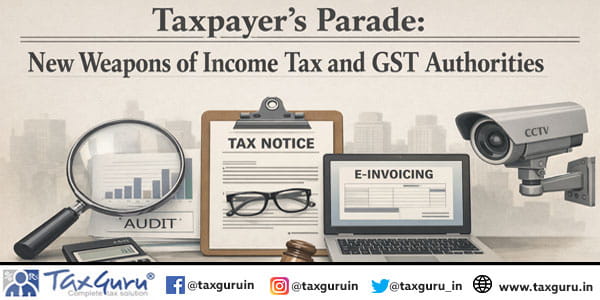
Krishna (Fictional Character): Arjuna, the GST department has introduced several powerful weapons to tackle GST evasion. These “weapons” ensure better compliance and help the department identify discrepancies. Following are some of the weapons:
1. GSTR-1/1A and GSTR-3B Returns: The data entered in GSTR-1 (sales data) automatically gets populated in GSTR-3B return. The taxpayer cannot edit these auto-populated figures in GSTR-3B. So, if there’s a mistake in GSTR-1 and it’s not corrected in GSTR-1A, the taxpayer will be forced to file GSTR-3B with those incorrect figures, which could lead to issues down the line. Therefore, for correcting the mistake a new important weapon GSTR-1A is introduced for better compliance. Before filing GSTR-3B any mismatch arises then correct it by filing GSTR-1A.
2. Invoice Management System: The GST department has introduced a new invoice management dashboard for availment of input tax credit where taxpayers must accept, reject, or keep invoices pending which are reflecting in GSTR-2B. Currently non-compliance of such dashboard may not result in penalties, but soon it could become mandatory. This weapon ensures that ITC is correctly claimed and are in line with the GST laws.
3. E-invoicing and E-way Bill System: Large businesses are now required to generate e-invoices and e-way bills in real-time on the GST portal. This ensures a continuous flow of data, allowing the department to track compliance effectively. Additionally, GST roving squads are actively intercepting vehicles to verify invoices and e-way bills. If any discrepancies are found between the documents, it could lead to heavy penalties for non-compliance.
4. Conduct of GST Audits: The department has stepped up GST audits and anti-evasion measures. They are closely scrutinizing returns like GSTR-1, GSTR-3B, and GSTR-9, as well as taxpayers’ books of accounts. Any mismatch between sales, purchases, or taxes could trigger notices and lead to penalties.
5. Blocking of Input Tax Credit (ITC) for Non-Payment of Taxes by Suppliers (Section 16(2)(c)): Taxpayers cannot claim ITC on invoices where the supplier has not paid taxes to the government. This rule ensures that the entire supply chain remains tax compliant. If a taxpayer claims ITC in such cases, a notice may be issued by the department.
Arjuna (Fictional Character): Krishna, what lesson should one learn from this?
Krishna (Fictional Character): Arjuna, the lesson here is that vigilance, transparency, and timely action are essential for every taxpayer. Just as a soldier prepares and stays alert in battle, a taxpayer must be proactive in filing returns, paying taxes, and maintaining accurate records. Ultimately, by staying prepared and responsible, taxpayers can navigate the system smoothly and avoid unnecessary trouble.