‘Power to Arrest’ CGST Act and Customs Act:
Section 69 of the CGST Act, 2017 states that where a Commissioner has reasons to believe that a person has committed any offence specified in clauses (a) to (d) of sub-section (1) to Section 132, which is punishable under clauses (i) or (ii) of sub-section (1), or sub-section (2) of the said section, he may authorise any officer to arrest such person. Similarly, Sec 104 of the Customs Act, 1962 grants powers to Commissioner of Customs to arrest a person for any offence specified under Sec 132 or 133 or 135 or 136 ibid. Now the question arises whether such Powers to Arrest granted under Taxation law are absolute powers. To know whether such powers to arrest can be used by Tax Authority without any limitations from laws or constitution, we need to understand constitutional provisions relating to the ‘Right to Life and Personal Liberty’ granted to a person.
Judicial Review under Constitution:
Hon’ble Supreme Court and High Courts of India are empowered to Judicial Review under Article 32 and Article 226 of the Constitution of India, to protect the Legal and Fundamental Rights of the citizens.
Many a times, the Apex Court has interpreted that while appreciating an action complained of by a petitioner, the court shall protect all the Fundamental Rights together, enshrined under Article 12-35 of Part-III of the Constitution. A person may be deprived of his fundamental right ‘Right to Life & Personal Liberty’ granted to him under Article 21 of the Constitution, provided the alleged detention or arrest shall be done strictly according to the Rule of Law as provided under Article 22 of the Constitution. Thus, on the one hand, the Constitution grants a person ‘Right to Life and Personal Liberty’, on the other hand, it curtails his right by authorising the Detaining Authority for ‘Punitive and Preventive Detention’ provided it is done in accordance with the procedure established by the special law, e.g. the Customs Act, CGST Act, Income Tax Act, PMLA etc.
Whenever any Detention or Arrest is challenged by the Detenue, the Court takes into consideration the nature of right infringed, the scope and object of the specific legislation, the need to balance the rights and interests of the individual as against those of the society, the circumstances under which and the persons by whom the jurisdiction is invoked etc. The Court does not appreciate any question of law or the question of fact. Judicial intervention is warranted only in exceptional circumstances when the arrest is prima facie found to be malafide. Thus, the court looks into whether such arrest is prompted by extraneous circumstances, or is made in contravention of or in breach of provisions of the concerned statute; or when the authority acting under the concerned statute does not have the requisite authority etc.
Judicial Review of ‘Power to Arrest’ under Taxation:
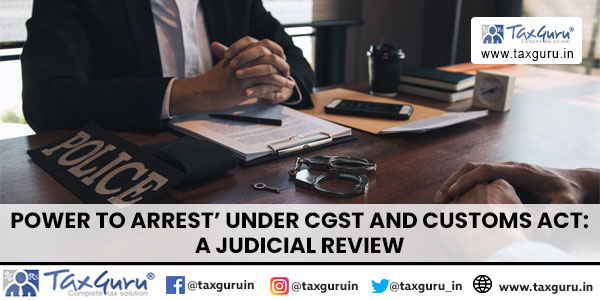
Section 69 of the CGST Act, 2017 and the corresponding Section 104 of the Customs Act, 1962 provides that the Commissioner has power to arrest a person if he has reasons to believe that such person has committed an offence falling under the sections specified therein. Tax Statutes e.g. the Customs Act and the GST Acts are not a complete code when it comes to provisions of search and seizure, and arrest, for provisions of Code would equally apply when they are not expressly or impliedly excluded by provisions of GST Acts. Powers to summon, arrest and prosecute are ancillary and incidental to power to levy and collect GST and sections 69 and 70 of GST Acts are not ultra vires the Constitution, as GST Acts, in pith and substance, pertain to Article 246A of Constitution of India.
Hon’ble Supreme Court in Union of India v. Padam Narain Aggarwal [2008 (231) E.L.T. 397 (S.C.)], observed that the power to arrest a person by an officer is statutory in character. Such power of arrest can be exercised only in those cases where the officer has a reason to believe that the person is guilty of an offence punishable under the said Act. Thus, the power must be exercised on objective facts of commission of an offence enumerated, and when the officer has a reason to believe that the person sought to be arrested has been guilty of commission of such offences. It has been further observed that the law on one hand allows an officer to exercise power to arrest a person who has committed certain offences, and on the other hand takes due care to ensure individual freedom and liberty, by laying down norms and providing safeguards so that the power of arrest is not abused or misused by the authorities.
The Larger Bench of Apex Court, in its recent Judgment dated 27.02.2025 in Radhika Agarwal v. Union of India [(2025) 27 Centax 425 (S.C.)], has once again emphasised on robust safeguards and precautions while arresting any person. Hon’ble Supreme Court held that Customs and GST officers are not police officers and that their powers to arrest are limited and regulated by the respective Acts (i.e., Customs or GST); that the Revenue Officers may only arrest a person if they have ‘reasons to believe’ that he has committed an offence and not otherwise; this ‘reasons to believe’ represents a more stringent standard than ‘mere suspicion’ threshold as provided under section 41 of Cr. PC, 1973; that the officer shall record ‘reason to believe’ leading to arrest in writing, otherwise the arrest would be considered as illegal; that officer shall inform the arrested person of the reasons to arrest and also share copy of the relied upon documents because to deny and not give grounds in writing to the taxpayer would be to deprive the accused of his right of bail under provisions of code; that the arrested taxpayer has to be presented before a Magistrate within 24 hours of arrest, so that Magistrate can examine whether proper procedures safeguards were followed and that for non-cognizable and bailable offences, officers cannot arrest taxpayers without prior judicial approval from a Magistrate, unless offence is a specific serious case. Apex Court observed that the unbridled exercise of power to arrest without a warrant can result in arbitrariness and errors in decision making process
Conclusion:
The safeguards provided against the arrest of a person under the Special Acts (e.g. the Customs Act, CGST Act, Income Tax Act, PMLA etc.) or the Code of Criminal Procedure, must be observed not only to protect his fundamental right of personal liberty but also to prevent a potential misuse of the power to arrest a person at the instance of the authorized officer.
As per Article 21 of the Constitution, no person could be deprived of his life or personal liberty except according to procedure established by law. Since, the personal liberty of a person is deprived, when he is arrested, the procedure laid down in the Statute while depriving his personal liberty, has to be followed.
Similarly, as per Article 22(1) of the Constitution, no person who is arrested, could be detained in custody without being informed, as soon as may be, of the grounds for such arrest. Thus, the grounds for such arrest have to be communicated to him as soon as may be after the arrest is made. There has to be due compliance of the Constitutional and Statutory mandates, whenever an arrest is made of a person under the Special Acts.
The safeguards are – the requirement to have “material” in possession of the authorized officer, to form an opinion and record in writing the “reasons to believe” that the person arrested is guilty of an offence or has committed an offence as the case may be, under the provisions of the concerned Act, and the requirement to inform the person arrested, as soon as may be, of the grounds of arrest.