Introduction
The Goods and Services Tax (GST) regime in India has been continuously evolving since its introduction in 2017. With the objective of simplifying indirect taxation, improving compliance, and enhancing ease of doing business, the Government has introduced several key reforms during 2024–25 and 2025–26. The most significant among them is the transition towards GST 2.0, along with procedural, compliance, and dispute-resolution related changes.
This article attempts to highlight the latest and most important GST changes, their rationale, and practical implications for taxpayers, professionals, and businesses.
1. GST 2.0 – Structural Reforms and Rate Rationalisation
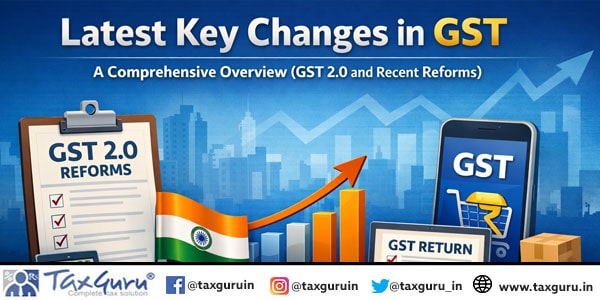
One of the most important developments in recent times is the introduction of GST 2.0, aimed at simplifying the tax structure and addressing long-standing issues in the GST framework.
1.1 Reduction and Rationalisation of GST Rate Slabs
Under GST 2.0, the Government has initiated steps towards rate rationalisation, reducing complexity caused by multiple slabs. The revised structure broadly focuses on:
- Lower rate for essential goods and services
- Standard rate for most goods and services
Higher rate for luxury and sin goods
This rationalisation is expected to:
- Reduce classification disputes
- Improve compliance
- Make GST more transparent and predictable
1.2 Relief on Commonly Used Goods and Services
Several goods and services that were earlier taxed at higher slabs have been shifted to lower or standard rates, providing direct relief to consumers and helping control inflation.
2. Compliance and Procedural Changes under GST
2.1 Mandatory Multi-Factor Authentication (MFA)
From 1st April 2025, Multi-Factor Authentication has been made mandatory for all GST portal users.
Objective:
- Enhance data security
- Prevent unauthorised access
- Reduce GST-related frauds
2.2 Mandatory Input Service Distributor (ISD) Registration
Entities having multiple GST registrations under the same PAN are now required to mandatorily obtain ISD registration for distribution of common input service credits.
Impact:
- More structured ITC distribution
- Reduced disputes on cross-charging
- Better audit trail
2.3 Amendments in GSTR-7 and GSTR-8
Revised formats for:
- GSTR-7 (TDS under GST)
- GSTR-8 (TCS under GST)
These changes require invoice-level reporting, improving transparency and reconciliation.
3. Strengthening of E-Way Bill and E-Invoicing System
The GST authorities have introduced:
- Stricter e-way bill validity norms
- Enhanced real-time data matching
- Extended e-invoicing requirements to more categories of taxpayers
These measures aim to curb tax evasion and ensure seamless flow of goods.
4. Operationalisation of GST Appellate Tribunal (GSTAT)
One of the most awaited reforms under GST has been the constitution and operationalisation of the GST Appellate Tribunal (GSTAT).
Key Benefits:
- Faster disposal of GST disputes
- Reduced burden on High Courts
- Uniformity in interpretation of GST laws
This marks a major step towards strengthening the GST dispute-resolution mechanism.
5. Changes Relating to Sin Goods and Luxury Items
The Government has announced a special tax structure for sin goods, such as:
- Tobacco products
- Pan masala and similar items
These goods will attract higher effective tax incidence, aligning GST policy with public health and revenue considerations.
6. Sector-Specific Impact
6.1 MSMEs
- Simplified compliance
- Better credit flow
- Reduced classification litigation
6.2 Real Estate & Infrastructure
- Clearer tax structure
- Reduced ambiguity in rate applicability
6.3 Consumers
- Lower tax burden on essential goods
- Improved price stability
7. Key Takeaways for Taxpayers and Professionals
- GST is moving towards simplicity and stability
- Technology-driven compliance is increasing
- Litigation infrastructure has significantly improved
- Businesses must revisit pricing, accounting systems, and ITC mechanisms
Conclusion
The recent GST reforms, including the rollout of GST 2.0, compliance enhancements, and establishment of GSTAT, reflect the Government’s intent to make GST a mature, transparent, and taxpayer-friendly tax system. While initial adjustments may pose challenges, these reforms are expected to strengthen India’s indirect tax framework in the long run.
******
Disclaimer: The contents of this article are for informational and academic purposes only. The views expressed are personal and based on the understanding of the author of the provisions of the Goods and Services Tax laws, rules, notifications, and circulars as applicable at the time of writing. This article does not constitute professional advice or a legal opinion. Readers are advised to refer to the relevant statutory provisions and seek appropriate professional guidance before acting on the basis of the information contained herein. The author shall not be responsible for any loss or liability arising from reliance on this article.