The article examines the issue of whether uploading notices or orders on the GST portal constitutes valid “communication” under Section 169 of the CGST Act, particularly in cases where taxpayers claim they were unaware of such uploads. Section 169 prescribes multiple modes for serving notices and orders, including personal delivery, post, email, publication, or making the communication available on the GST common portal. Although the law allows service through any of these modes, disputes have arisen when authorities rely solely on portal uploads without evidence that the taxpayer actually received or became aware of the communication. This issue has gained judicial attention, notably in the decision of the Allahabad High Court in Bambino Agro Industries Ltd. v. State of Uttar Pradesh (2025), where the court held that mere uploading of an order on the GST portal does not automatically amount to valid communication when the taxpayer disputes receipt or knowledge of the order. The court observed that the GST portal does not record whether a taxpayer has viewed or downloaded a document, and therefore the assumption that the taxpayer had constructive knowledge of the order merely from the dat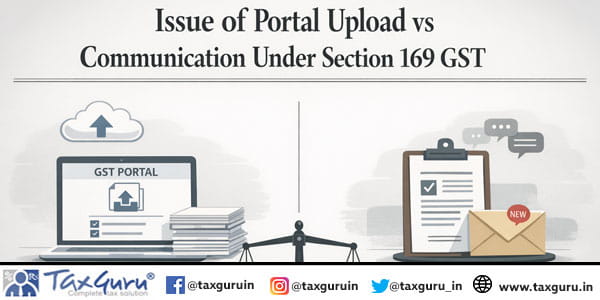 e of upload may be unreliable. The court directed that such portal-only service could violate principles of natural justice and ordered fresh service of notices. Similar concerns have also been discussed by the Madras High Court, which emphasised that portal upload should not be used as the sole mode of service where other methods are practicable. The issue also affects the limitation period for filing appeals under Section 107, as authorities often calculate limitation from the upload date. Courts have indicated that limitation should begin only from the date of effective communication or actual knowledge of the order.
Section 169, Limitation, and the Ordeal of Bona Fide Taxpayers
Over the last few years, the GST system has grown into a completely digital tax environment. The GST common portal has become the single window through which the department serves notices, accepts replies, and issues orders. While this shift to electronic governance has brought efficiency, it has also created a subtle but serious problem: orders and show cause notices are often silently uploaded on the GSTN portal without any real communication to the taxpayer.
Many honest taxpayers first discover an adverse adjudication order only when their bank accounts are attached or recovery proceedings are initiated. By that time, the statutory limitation for filing an appeal under Section 107 of the CGST Act has already expired, as the department mechanically takes the date of upload as the date of service.
This mechanical approach has been questioned by several High Courts, most recently by the Allahabad High Court in Bambino Agro Industries Ltd. v. State of Uttar Pradesh (Nov 2025), which held that uploading alone does not constitute “communication” under Section 169 when the assessee disputes actual receipt or knowledge of the order.
2. Understanding the statutory scheme u/s 169:
Section 169 of the CGST Act, 2017, governs service of decisions, orders, summons, and notices. It recognises several alternative modes of service under sub‑section (1):
- Direct tender or personal delivery;
- Registered post, speed post, or courier;
- E‑mail addressed to the registered e‑mail ID;
- Making the communication available on the common portal;
- Publication in a newspaper when the address is not traceable; and
- Affixing it at the address of the taxable person in specified circumstances.
The expression “in any one of the following manners” means that each mode is separately valid, but it does not make all of them equally reliable in every case.
Sub‑section (2) introduces a deeming presumption that a document shall be deemed to have been served when it is tendered, delivered, published, or uploaded as above. Sub‑section (3) further provides a presumption regarding service by post, which can always be rebutted by proving that the letter was not in fact received.
This structure of multiple optional modes + limited deeming fiction was carried forward from Section 37C of the Central Excise Act, 1944, which required credible evidence of service and was always interpreted strictly by courts. GST law cannot be read as a relaxation of these due process safeguards.
3. The Allahabad High Court’s interpretation – Uploading is not communication
In Bambino Agro Industries Ltd. and connected cases decided in December 2025, the assessees contended that they never received show cause notices or final orders through e‑mail or post. They came to know of the orders only when coercive recovery measures were initiated. The State defended itself by saying that both the notice and the order had been uploaded on the GST portal, which was sufficient service under Section 169(1)(d).
The central question before the Court was whether the act of uploading a document on the GST portal, without any evidence of e‑mail delivery or other communication, amounts to valid “service” so as to start the limitation clock for appeal.
The Court gave an emphatic “no.” It held that while making an order available on the common portal is one of the recognised statutory modes, mere server‑side availability cannot by itself prove that the taxpayer has been made aware of it. Communication implies that the contents have actually reached or become accessible to the person concerned.
The Court observed that the GST portal presently has no functionality to record whether an assessee has viewed, downloaded, or acknowledged the document. Without such proof, it would be unsafe and unfair to assume that the assessee had constructive knowledge of the order from the date of upload.
Consequently, it was held that such portal‑only service, especially when disputed, violates principles of natural justice. The department was directed to serve the orders afresh and give the assessees an effective opportunity of hearing.
One of the most important aspects of the Allahabad judgment is the discussion on the limits of legal fictions. The Court explained that the deeming provisions in Section 169 cannot be stretched to deny substantive rights. Deeming service by upload may be permissible in routine matters, but cannot be used to deprive a person of the right to appeal or to uphold an ex parte order when the taxpayer never actually knew of it.
This reasoning aligns with settled constitutional principles that “no person shall be condemned unheard,” and that technical presumptions cannot substitute procedural fairness.
The Madras High Court has also considered this issue in several decisions between 2024 and 2025. In one case, the department relied exclusively on portal uploads to serve show cause notices and adjudication orders. The Court accepted that Section 169(1)(d) permits making a document available on the portal, but cautioned that the State must not use this option as the only mode, especially when earlier communications have elicited no response.
The Court further held that Section 169 should be applied hierarchically—if personal or postal delivery is practicable, those modes should be used before resorting to publication or portal‑only service. Uploading is intended as a facilitative measure, not as a substitute for basic notice.
After noting that the assessee had not received any e‑mail or postal copy, the Court quashed the order and directed fresh adjudication after proper service. The judgment echoed the principle that service must be “meaningful communication,” not a mere procedural step.
Another Division Bench of the Madras High Court later clarified that while portal upload is a valid statutory mode, officers must ensure that it operates consistently with natural justice—thus balancing electronic governance and taxpayer rights.
From a practitioner’s perspective, the portal‑only service model has created several operational hardships:
- Silent uploads: Orders and notices are uploaded without any e‑mail or SMS alert, and the taxpayer has no reason to open the portal unless a compliance deadline is pending.
- Cancelled registrations: Where registration has been suspended or cancelled, it is unrealistic to expect the taxpayer to keep checking the portal of an inactive registration.
- Portal glitches or incorrect emails: Many small entities have outdated e‑mail IDs or rely entirely on consultants for portal access. If the consultant changes, messages go unseen.
- Ex parte orders and missed appeals: By the time the assessee learns of the order, the appeal limitation under Section 107 has already lapsed, causing avoidable litigation.
Courts have repeatedly recognised these real‑world difficulties and have observed that natural justice cannot be reduced to a hollow formality under the guise of digitisation.
A telling example from Allahabad involved a dealer whose registration was cancelled before the show cause notice was issued. The department uploaded the notice and order on the same inactive portal and straightaway began recovery. The Court rightly held that the assumption of service in such cases is absurd and directed fresh proceedings after proper notice through post or e‑mail.
Departments frequently argue that the limitation period for filing appeal under Section 107 begins from the portal upload date. However, High Courts have cautioned that limitation can start only from the date of actual or effective communication.
When an assessee disputes communication, the burden shifts to the department to produce evidence of e‑mail delivery or postal acknowledgment. Merely showing that the order exists on the GST portal does not discharge this burden.
The Allahabad High Court explicitly held that if the department cannot show effective notice, the appellate authority must compute limitation from the date the assessee actually became aware of the order, or else condone delay where bona fides are evident. This is consistent with similar reasoning under Central Excise and Service Tax jurisprudence.
At its heart, the question is not technical but constitutional. Service of notice is the foundation of due process, an element of natural justice. The law gives the department several options to serve an order precisely to ensure that no taxpayer can be penalised without having a fair chance to respond.
Interpreting Section 169 as permitting “upload‑only service” would turn this principle on its head. It would convert the portal from a vehicle of transparency into a trap for the unwary, defeating the very purpose of the statutory safeguards built into the section.
Decisions like Bambino Agro Industries and subsequent Madras rulings reaffirm that procedural fairness is not optional—even in the digital era. The High Courts have emphasised that technology must serve justice, not replace it.
Given the recurring disputes, the following practical steps can greatly reduce portal‑related controversies:
- Mandatory alerts: Every upload of a show cause notice or order should automatically trigger e‑mail and SMS alerts to the registered contact details, with system logs preserved.
- Requirement of “one hard mode”: If there is no response to portal or e‑mail communication within a reasonable time, the officer should be required to serve a physical copy by registered or speed post before proceeding ex parte.
- Proof of communication in orders: Adjudication orders should clearly record the mode of service used, date of e‑mail dispatch, and whether acknowledgment or delivery confirmation is available.
- CBIC/State Circular under Section 168: The Board can issue instructions clarifying that for limitation computation, “communication” means effective intimation—that is, accessible knowledge by the assessee, not mere portal availability.
- Adjudication checklists: Before passing ex parte orders, officers should certify that at least two service modes have been attempted. This simple rule will prevent most disputes.
- Appeal condonation guidance: Appellate authorities should liberally construe “sufficient cause” for delay when communication itself is defective or when no e‑mail/post proof is on record.
Such measures would preserve the advantages of digital administration while restoring fairness to the process.
Until the system is refined, taxpayers and consultants need to adopt their own safeguards:
- Frequent portal checks: Advisors should log in at least once a week to check for new notices or orders.
- Accurate registration data: Keep the registered e‑mail ID and mobile number updated at all times, especially after changes in ownership or consultants.
- Download and acknowledge: Whenever a communication is viewed, download and save it with date/time records.
- Appeal filing strategy: In delayed‑awareness cases, file an appeal with a detailed affidavit explaining the absence of communication and rely on case law such as Bambino Agro Industries to seek condonation.
The debate around Section 169 exemplifies a larger challenge in e‑governance. Technology can improve transparency only if it respects the human element. Uploading a notice is not equivalent to communicating it. Machines can transmit data, but only human systems can ensure that justice is served.
The judiciary has begun restoring balance by reading Section 169 in harmony with natural justice principles. The next step should come from the administration through clear instructions that affirm this view.
Author’ Note:
Section 169 was never meant to create a procedural trap for honest taxpayers. Its multiple modes of service were introduced to facilitate communication, not to allow revenue authorities to hide behind technicalities. The courts have rightly reminded us that digital convenience cannot override fairness.
For every officer, consultant, and taxpayer, these rulings are a timely reminder that the foundation of tax administration is not automation but communication. Orders must not merely exist on servers; they must reach the citizen they concern. Only then can the GST system claim to be both efficient and justice.