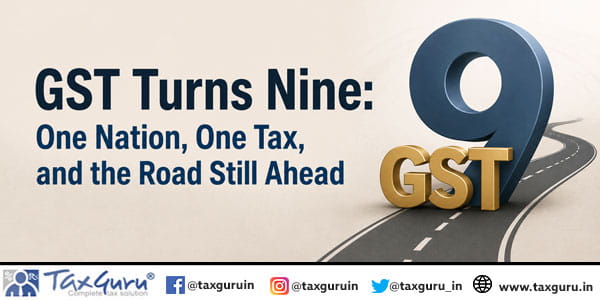
GST Turns Nine: One Nation, One Tax, and the Road Still Ahead
Nine years after India replaced a maze of levies with a single tax, a look at why it was built, what it changed, and what still needs fixing
Summary: Nine years after its launch on 1 July 2017, GST has transformed India’s indirect tax system by replacing multiple Central and State taxes with a unified tax regime based on the principle of “One Nation, One Tax, One Market.” It eliminated cascading taxes, removed inter-State tax barriers, digitised compliance through the GSTN portal, e-way bills and e-invoicing, and strengthened input tax credit-based compliance, encouraging formalisation of the economy. Jammu & Kashmir adopted GST on 8 July 2017 through its own legislative process due to its then-special constitutional status. The GST Council has emerged as a successful example of cooperative federalism, while the 2025 rate rationalisation simplified the tax structure into two principal slabs of 5% and 18%, with 40% for luxury and sin goods. Registered taxpayers have grown from 66.5 lakh to 1.65 crore, and annual GST collections reached ₹22.27 lakh crore in 2025-26. Going forward, better GST-Income Tax integration, revised registration thresholds, and expansion of GST Appellate Tribunal benches remain key priorities.
Why GST:
For decades before 2017, a manufacturer moving goods from one state to another paid tax on tax: excise duty at the factory gate, sales tax or VAT at the state border, entry tax at the city limit, and yet another layer the moment those goods were resold. Every state taxed differently, every check-post added time and cost, and the same product carried a different effective tax burden depending on which state line it crossed. The logic behind GST, as conceived by the Modi government, was to dissolve all of this into a single tax, levied once on the actual value added at each stage, collected jointly by the Centre and the states, and passed through seamlessly via input tax credit. At a special midnight sitting of Parliament’s Central Hall on the night of 30 June-1 July 2017, Prime Minister Narendra Modi described it, in one memorable line, simply as a “Good and Simple Tax” — a phrase that has stayed with GST ever since.
Jammu and Kashmir’s own tryst with GST came a day later. Because of the region’s then-special constitutional position, the Union’s GST laws could not automatically extend here; the J&K Legislative Assembly first had to pass its own GST Bill, which it did on 7 July 2017, before Presidential ordinances extended the Central and Integrated GST Acts to the State, bringing the J&K GST Act into force on 8 July 2017. It was a reminder that even a “one nation, one tax” reform had, in this one corner of the country, to be built through the region’s own legislative process before it could take effect.
One Nation, One Tax, One Market
“One nation, one tax, one market” is the core principle behind India’s Goods and Services Tax (GST), introduced to replace so many indirect taxes with a single, unified system. In Jammu and Kashmir, as elsewhere, GST folded in a long list of Central and State levies that had, until then, been collected separately, often by separate departments under separate laws:
- Central Excise Duty on the manufacture of goods
- Service Tax on the provision of services
- Additional Excise Duty and Countervailing Duty on imports
- Special Additional Duty of Customs
- Central Sales Tax on inter-State sales
- J&K General Sales Tax/VAT on intra-State sales of goods
- Purchase Tax
- Toll Tax collected at the Lakhanpur check-post on goods entering the Valley
- Entry Tax/Octroi-type levies
- Luxury Tax on hotels and similar establishments
- Entertainment Tax/Duty
- Taxes on advertisements
- Assorted State cesses and surcharges on the supply of goods and services
All of these disappeared into a single tax invoice, a single return, and a single administration — Central GST and State GST levied concurrently on every intra-State transaction, and Integrated GST on every inter-State one.
How GST Changed Taxation
GST’s first and most visible achievement was to erase India’s internal tax borders. Before 2017, it was common to see long lines of trucks waiting at state check-posts for tax verification and document checks, with warehousing decisions often driven more by state tax structures than by business efficiency. The e-way bill system, introduced from April 2018, let goods move across State lines without stopping for tax clearance at every border, freeing businesses to design their logistics around efficiency rather than tax arbitrage.
The second achievement was digitisation. The GSTN portal moved registration, return filing and payments online; e-invoicing, rolled out for large taxpayers from 2020 and progressively extended to smaller businesses, created a standardised electronic invoice trail that feeds directly into returns, while e-way bills and invoice matching built a document-level audit trail across the entire supply chain. Because input tax credit flows only when a supplier’s invoice is actually reported, GST gave businesses of every size a direct, self-enforcing incentive to get onto the tax net and stay there — pulling a meaningful part of the informal economy into the formal fold for the first time.
The third, and perhaps the least visible, achievement has been cooperative federalism in practice. The GST Council, bringing the Union and every State and UT finance minister to the same table under Article 279A of the Constitution, has met dozens of times since 2017 to decide rates, exemptions and procedure by consensus — a model of shared federal decision-making with no real precedent in India’s tax history. Its most recent, and arguably most significant, exercise came with the Next-Generation GST reforms approved at its 56th meeting: the old four-slab rate structure was collapsed into two principal rates of 5% and 18%, with a 40% rate reserved for luxury and sin goods, effective from 22 September 2025 — the biggest rate simplification since GST’s launch.
Going Forward: What Still Needs to Improve
The numbers tell their own story of how far the reform has come. As per the Press Information Bureau’s own backgrounder marking nine years of GST, the number of registered taxpayers has grown from 66.5 lakh at launch in 2017 to 1.65 crore by May 2026, which the release describes as evidence of the economy’s greater formalisation. Gross GST collections have climbed in step: from roughly ₹7.4 lakh crore in 2017-18, collections rose to about ₹13.76 lakh crore in 2021-22 and touched a record ₹22.27 lakh crore in 2025-26, with the current year opening on an even stronger note — around ₹4.37 lakh crore collected in April-May 2026 alone.
Strong as this trajectory is, the reform’s own architects and independent commentators agree that GST is not a finished product. Several areas need sustained attention going forward:
- Integration with direct taxes: GST turnover data and income tax data still largely sit in separate systems; closer, real-time data-sharing between GSTN and the Income Tax Department would sharpen risk-based scrutiny on both sides and cut down the duplicated compliance burden of maintaining two parallel financial trails for the same business.
- Registration thresholds: the goods threshold of ₹40 lakh and the considerably lower services threshold of ₹20 lakh have stood unchanged since April 2019, even as the composition scheme limit was raised to ₹1.5 crore; a fresh, sector-sensitive relook at these thresholds — especially for small service providers and artisans in regions like J&K — is overdue.
- The GST Appellate Tribunal: launched only in September 2025 after eight years without a dedicated appellate forum, GSTAT’s Principal Bench and a handful of State Benches are now functional, but the remaining Benches, out of the 31 sanctioned across 45 locations nationwide, need to be fast-tracked so the backlog of pending appeals does not simply shift from the High Courts to a still half-built Tribunal.
Nine years on, GST has done what no single tax reform had managed before it in India: it erased internal tax borders, built a digital paper trail for the economy, and gave the Centre and the States a genuine forum in which to argue and agree. The task now is not to defend the reform but to keep refining it — because a “good and simple tax”, as the Prime Minister called it at its birth, stays simple only if it keeps being simplified.
*****
About the Author: Aijaz Hussain Malik is a State Taxes Officer of the Jammu and Kashmir Administrative Service, currently posted at Circle-C, Srinagar. He writes on GST compliance and administration in his personal capacity and can be reached at [email protected].
Disclaimer: The views expressed in this article are personal, are offered in the author’s individual capacity, and do not represent the official position of the Department of State Taxes, Jammu and Kashmir, the Government of Jammu and Kashmir, or any other authority.