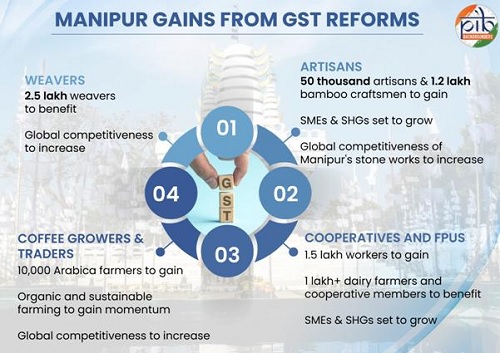
The GST reforms implemented in 2025 are projected to provide substantial economic benefits across Manipur’s key sectors, aiming for inclusive growth and improved ease of doing business. By reducing the GST rate to 5% on handloom fabrics, an estimated 2.5 lakh weavers are expected to gain from increased affordability and market competitiveness. Similarly, a tax reduction to 5% on bamboo and cane crafts, as well as on stone carvings and ceramic tableware, will benefit over 1.2 lakh artisans and roughly 50,000 stone carvers by lowering product prices and stimulating demand. The processed food industry, which employs approximately 1.5 lakh workers, will see lower tax on items like pickles and fermented foods, leading to higher demand and better incomes. Furthermore, a GST reduction to 5% on packaged coffee will boost profitability for about 10,000 Arabica growers in the highlands, and nil/5% GST on dairy products (ghee, paneer, etc.) will improve profit margins and affordability for over 1 lakh dairy producers. The overall objective of the reforms is to lower input costs, enhance the global appeal of Manipur’s unique products, and empower local communities and small enterprises.
PIB Headquarters
GST Reforms 2025: How Manipur’s Economy Will Gain Across Sectors
Posted On: 10 OCT 2025 10:38AM by PIB Delhi
Key Takeaways
- 5% GST boosts Manipur’s handloom affordability and global appeal; 2.5 lakh weavers to benefit
- 1.2 lakh artisans gain from cheaper crafts; SHGs & SMEs expected to grow under 5% GST
- 1.5 lakh workers in food processing see higher demand and better incomes with reduced GST
- From 1 lakh+ dairy producers to 10,000 coffee growers, lower GST to improve profits and market reach
Introduction
The new GST reforms are aimed at driving inclusive growth and improving the ease of doing business for all, including small traders and businessmen. Manipur’s economy, rooted in small-scale industries, traditional crafts, and agro-based livelihoods, stands to gain significantly from these changes. From coffee cultivation in the highlands of Ukhrul and Senapati to bamboo crafts and stone carving in Churachandpur and Imphal, the state’s diverse economic activities are driven largely by regional communities. By lowering input costs and encouraging demand, the reforms aim to make Manipur’s unique products more competitive in both domestic and global markets.
Further, as these reforms take effect, they are expected to empower local communities to preserve traditional livelihoods while contributing to India’s growing economy.
Arabica Coffee
The reduction in GST on packaged coffee from 18% to 5% brings substantial relief across Manipur’s coffee industry. Districts such as Ukhrul, Senapati, and Chandel are important hubs for coffee cultivation, particularly for high-quality Arabica varieties. Around 10,000 farmers are engaged in coffee cultivation. The sector generates additional employment in processing, packaging, and distribution networks that support the value chain.
The revised rates will reduce costs for both consumers and producers, improving affordability and stimulating demand. It is also expected to boost profitability and strengthen competitiveness across domestic and export markets. Moreover, the reforms encourage the adoption of organic and sustainable farming practices.
Bamboo and Cane Crafts
Manipur’s bamboo and cane crafts are traditionally made by skilled communities in Churachandpur, Ukhrul, and Tamenglong. With approximately 1.2 lakh artisans, the sector provides supplementary income to rural households.
The reduction of GST from 12% to 5% on furniture, baskets, mats, and other wooden crafts, will directly lower product prices and stimulate demand in both urban and rural markets. The reforms also strengthen SMEs and SHGs in the craft sector.
Handloom Textiles
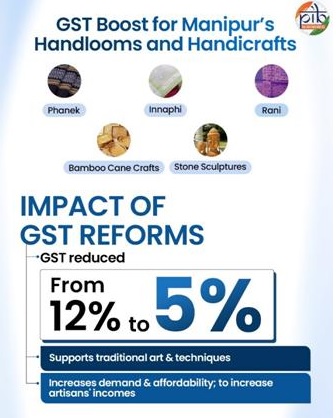
Handloom textiles such as Phanek, Innaphi, and Rani are primarily crafted by women artisans from regional communities across Imphal, Thoubal, Bishnupur, and Senapati. These crafts not only sustain traditional weaving practices but also provide steady income to approximately 2.5 lakh weavers.
The reduction of GST from 12% to 5% on handloom woven fabrics is expected to directly improve affordability for consumers while increasing market competitiveness for artisans. The reforms will enhance the global appeal of Manipur’s handloom products and also help preserve Manipur’s traditional weaving techniques.
Stone Carving and Sculpture
Imphal, Churachandpur, and Ukhrul are central to communities renowned for their skill in stone carving and sculpture. Around 50,000 artisans are engaged in this traditional craft.
The reduction in GST from 12% to 5% on ceramic tableware significantly lowers the cost of raw materials and finished goods. This tax relief improves affordability and global competitiveness of Manipur’s stone products. The reforms also support the preservation and promotion of traditional carving techniques, ensuring that the state’s rich artisanal heritage continues to thrive.
Processed Foods
Concentrated in Imphal, Senapati, and Chandel districts, Manipur’s processed food industry is driven by numerous small and medium enterprises (SMEs) and self-help groups (SHGs). With around 1.5 lakh workers employed in food processing units, the sector sees significant participation from rural women in production and packaging.
The reduction of GST from 12% to 5% on processed food items such as pickles, bamboo shoots, fermented foods, vegetable preparations, etc., is a major boost for producers and consumers alike. Lower tax rates reduce product prices, increasing affordability and market reach.
Dairy Products
In Imphal, Thoubal, and Bishnupur districts, dairy farming is largely managed by small-scale rural and tribal communities, employing 1 lakh+ dairy farmers and cooperative members. The GST reduction to Nil/ 5% on ghee, butter, paneer and cheese offers significant relief to consumers by making essential dairy products more affordable.
The revised rates are also expected to lower production costs. This will improve profit margins for farmers and cooperatives, enhancing their competitiveness in both domestic and export markets.
Conclusion
The revised GST rates mark a significant step toward economic reforms across India. By easing the tax burden on essential and value-added sectors, these changes are set to boost production, affordability, and market competitiveness. For smaller yet high-potential states like Manipur, the impact is especially meaningful, empowering local farmers, artisans, and entrepreneurs.
Together, these reforms support a balanced and inclusive growth, empowering India’s Northeastern states to contribute more strongly to the nation’s economy.
***