#AD
A car means different things to different people. For some, it carries sentimental value. For others, it reflects their personality and lifestyle. But when you look at it from a financial angle, a car is always an asset, and in most cases, a depreciating one.
In financial terms, an asset is simply anything that holds monetary value. Land, stocks, or gold usually fall into the category of appreciating assets because their worth tends to rise with time. Cars, on the other hand, sit on the opposite side. They lose value as the years go by, which makes them depreciating assets. This gradual drop in value is called depreciation.. The concept of depreciation is what essentially makes buying a second hand car a lucrative option from a financial lens.
- What Exactly is Depreciation on Cars?
- How much does a car depreciate?
- Factors That Affect Car Depreciation
- Car Type
- Mileage
- Number of Owners
- Condition
- Fuel Type
- Buying Smart: How Much Can You Save by Buying a Used Car
- Tata Punch
- 2. Hyundai Venue
- 3. Kia Seltos
- 4. Honda City
- 5. Maruti Ciaz
- 6. Honda Amaze
- Final Thoughts
What Exactly is Depreciation on Cars?
This might sting a little, but your car starts losing value the moment you drive it out of the showroom.
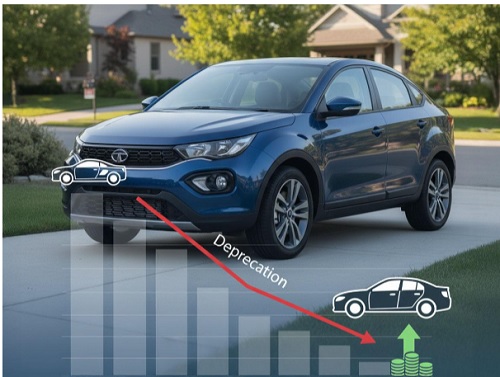
Depreciation is just a fancy way of saying an asset becomes less valuable over time. And when it comes to cars, almost every car falls into that category. But the drop in value doesn’t happen evenly. A new car sheds value much faster in its first few years, and then the rate of depreciation slows down as it gets older.
Think of it this way: every passing year, your car’s worth shrinks by a percentage of its original price. Factors like age, mileage, and everyday wear and tear all play a part. Take a hatchback, for example. It can lose 20 to 25 per cent of its value in just the first year.
That’s why used car prices reflect these drops so clearly, and why smart buyers always pay attention to the used car market for the best deals.
How much does a car depreciate?
In India, the Insurance Regulatory and Development Authority of India (IRDAI) has set standard depreciation rates. These rates help insurers decide the Insured Declared Value (IDV) of your car.
Here are the IRDAI-approved depreciation slabs based on a car’s age:
| Car’s Age | Depreciation Rate (%) |
|---|---|
| Up to 6 months | 5% |
| 6 months to 1 year | 15% |
| 1 year to 2 years | 20% |
| 2 years to 3 years | 30% |
| 3 years to 4 years | 40% |
| 4 years to 5 years | 50% |
These percentages give insurers a fixed way to calculate how much value your car loses over time. That figure directly impacts your IDV.
Remember: But when you step into the real-world used car market, depreciation doesn’t always follow these neat slabs. The actual price of a used car depends on many other factors, including brand, model, fuel type, and even buyer demand. For example, cars from brands like Maruti Suzuki or Hyundai usually hold their value better.
Factors That Affect Car Depreciation
Car Type
The type of car you choose makes a huge difference. Smaller hatchbacks like the Maruti Alto or Hyundai i10 usually hold on to their value better.
Sedans, on the other hand, see a faster drop in value during the first few years. On average, a sedan retains about 75% of its value in the first year, and by the time it reaches the fifth year, the value drops to around 56%. SUVs tend to perform slightly better. They usually hold 75% of their value in year one, while it is around 54% by year five.
Mileage
Mileage is another piece of the puzzle. A higher odometer reading usually drags down the resale price, because buyers often equate distance covered with wear and tear.
Number of Owners
The number of times a car has changed hands plays a big role in how much value it loses. If you’re looking at two cars of the same model with similar mileage, the one that’s had just a single owner will usually be worth more than one that has passed through several.
Condition
A car that’s been well taken care of holds its value far better. Regular servicing, accident-free history, and original parts all work in its favour. On the other hand, scratches, dents, broken bumpers, or mechanical troubles can push the price down quickly. As a used car buyer, even small cosmetic flaws are good points for you to negotiate, as a car’s resale value is tied to its overall care and maintenance.
Fuel Type
By 2025, the kind of fuel your car runs on makes a noticeable difference in its depreciation and, eventually, the resale value. Petrol cars usually depreciate more slowly than diesel cars in Tier-1 cities, as used petrol cars now outsell diesels there, with strong demand for models like the Swift, Baleno, i20, or Venue Petrol DCT. Meanwhile, in states such as Punjab, Uttar Pradesh, and across South India, diesel SUVs continue to hold an edge. Buyers in these regions often need extra torque for long drives, which keeps resale demand strong.
Buying Smart: How Much Can You Save by Buying a Used Car
Depreciation means that smart buyers when they need a vehicle in their home, they are looking to buy a used car. Let’s see how much you would save buying used on popular models.
Tata Punch
- New Car Price (Mid-Top Variant): ₹8 lakh
- Fourth-Year Depreciation: 40.75%
- Price After 4 Years: ₹4.76 lakh
- Potential Savings: ₹3.24 lakh
Tata Punch is a compact SUV with rugged styling, a high driving position, and a surprisingly spacious interior. Known for its safety ratings and reliable performance in city conditions, it’s ideal for urban commuters looking for a small yet capable SUV.
2. Hyundai Venue
- New Car Price (Second-Top Variant): ₹14 lakh
- Fourth-Year Depreciation: 39%
- Price After 4 Years: ₹8.40 lakh
Hyundai Venue is a stylish subcompact SUV with modern tech, efficient engines, and a comfortable cabin. Its combination of features, reliability, and resale value makes it one of the most popular choices in the segment.
3. Kia Seltos
- New Car Price (High Variant): ₹20 lakh
- Third-Year Depreciation: 36%
- Price After 3 Years: ₹12.8 lakh
Kia Seltos stands out for its bold design, feature-packed interiors, and turbocharged engine options. It balances style, comfort, and performance, making it a favourite in the compact SUV segment.
4. Honda City
- New Car Price (Well-Equipped Variant): ₹15 lakh
- Fourth-Year Depreciation: 41%
- Price After 4 Years: ₹9 lakh
Honda City is a premium mid-size sedan known for its smooth driving dynamics, spacious interior, and long-lasting reliability. It remains a preferred choice for buyers seeking comfort and a strong resale value.
5. Maruti Ciaz
- New Car Price (Mid Variant): ₹11 lakh
- Fifth-Year Depreciation: 45%
- Price After 5 Years: ₹6 lakh
Maruti Ciaz is a practical sedan offering fuel efficiency, low maintenance costs, and a spacious cabin. It’s popular among city commuters and families looking for a value-for-money sedan.
6. Honda Amaze
- New Car Price (Basic Model): ₹8.5 lakh
- Third-Year Depreciation: 37%
- Price After 3 Years: ₹5.5 lakh
Honda Amaze is a compact sedan that provides a refined engine, comfortable ride, and premium feel in the budget segment. Its reliability and efficiency make it a smart choice for first-time sedan buyers.
Key takeaway: Buying a 3–5-year-old used car can save anywhere from ₹3 lakh to ₹7 lakh on popular models, while still offering modern features, reliability, and comfort. Smart buyers can leverage depreciation trends to get excellent value for their money.
Moreover, buying used opens up a much wider range of choices. With the same budget, you can often afford a higher-spec model or a brand that would be out of reach if purchased new. This means you can enjoy features, comfort, and style that you might not have been able to access otherwise.
Final Thoughts
Buying a used car can be a smarter financial decision than going for a new one, thanks to how cars depreciate. A car begins losing value the moment you drive it off the showroom, with the steepest drop occurring in the first few years.
Several factors influence depreciation, and by buying a well-chosen used car, you can save a significant amount compared to a new purchase. For popular models, a five-year-old car can retain an approximate resale value of ₹4.5–6.5 lakh, offering substantial savings while still getting a reliable, functional vehicle.