The Uttarakhand Mega Industrial and Investment Policy-2025: Driving Large-Scale Manufacturing Investment
Introduction to Policy
The Uttarakhand Mega Industrial and Investment Policy-2025 is a strategic initiative by the State Government designed to attract and foster capital investment in large category manufacturing enterprises. This policy has been framed considering the current economic scenario and future prospects in Uttarakhand.
The policy recognizes that the secondary (Manufacturing) sector contributes about 47 percent to the State Gross State Domestic Product (GSDP) 2023-24, while the tertiary (service) sector contributes about 43 percent. To encourage capital investment, the State Government has also issued the separate ‘Uttarakhand Service Sector Policy-2024’ and the ‘Uttarakhand Micro, Small and Medium Enterprises Policy-2023’ alongside this Mega Policy.
The overarching goal is to make capital investment in large enterprises in the state more attractive and competitive.
About the Policy:
The core Objective of the policy is manifold:
- To establish Uttarakhand as a competitive and attractive destination for capital investment in large category manufacturing enterprises.
- To sustainably increase the contribution of the manufacturing sector to the state’s economy.
- To promote balanced, sustainable and inclusive economic development.
- To promote entrepreneurship, innovation, research & development.
- To generate more employment in the manufacturing sector and maximum utilization of the production capacity of industrial units.
To achieve these objectives, the State Government’s Strategy focuses on:
1. Creation of land bank to ensure the availability of land for setting up industrial units.
2. Infrastructure Development by promoting industrial estates and utilizing logistics policy and related policies of the Government of India and the State Government.
3. Promotion of Ease of Doing Business (EoDB) by simplifying the process of obtaining necessary approvals, permissions, and licenses.
4. Providing competitive and attractive financial incentives to encourage the establishment of enterprises.
5. Providing additional financial incentive in the form of Hill Incentive to encourage the establishment of manufacturing units in hilly areas.
6. Encouraging innovation under the start-up policy and promoting research & development and quality testing in enterprises.
The policy is effective from the date of issue and will remain in force for the next 5 years unless superseded or amended.
The institutional facilities provided under the policy are designed to establish Uttarakhand as a competitive destination for capital investment.
- Land Bank: Land is considered the major requirement for setting up an enterprise. Prepared land is made available in government industrial establishments, and barren/unused land is utilised. Efforts are made to ensure material availability for industrial development by encouraging the establishment of industrial establishments in the private sector under the “Policy for Establishment of Private Industrial Establishments/Areas -2023” (as amended).
- Infrastructure Facility: This facility is intended to provide capable and strong infrastructure necessary for setting up an enterprise, which helps reduce business costs and increase efficiency. Infrastructure facilities are available for supporting existing enterprises and will be further modernised and strengthened under schemes of the Government of India and the “Uttarakhand Logistics Policy-2023”.
- Single Window Clearance System (SWCS): This system is operational in the State under the relevant Act for timely and easy receipt of mandatory permissions/licenses/clearances. All services for capital investment are made available through a single application form (CAF), simplifying and accelerating the process.
- Ease of Doing Business (EoDB): The State Government is focused on continuing its excellent work in EoDB, having been ranked as ‘Top Achievers State’ in the Business Reform Action Plan (BRAP) ranking for 2022. Processes are simplified by replacing verification with self-certification and decriminalising various rules/laws, aiming to create a continuous business-ready environment.
- Investment Promotion and Facilitation Centre (IPFC): This is a dedicated, centralized one-stop-center for investors. It is located at the Directorate of Industries and District Industries Centre, and it provides coordinated and systematic hand-holding support. ‘Investment Mitra’ may be appointed at the district and state levels to provide this support.
- Udyog Mitra: A three-tier Udyog Mitra Committee has been constituted for the quick resolution of problems faced by entrepreneurs. The committees include the “State Level Udyog Mitra Committee” (chaired by the Hon’ble Chief Minister), the “Empowered Committee of State Level Udyog Mitra Committee” (chaired by the Chief Secretary), and the “District Level Udyog Mitra Committee” (chaired by the District Magistrate). Online tracking for resolving issues will be arranged on a single window portal.
- Research and Development (R & D): This facility aims to encourage R&D, and R&D equipment installed in-house by enterprises is accepted as productive plant and machinery for input calculation. Collaboration between industry and technical education institutions/universities will be encouraged to promote the adoption of new technology by enterprises.
Nodal Agency/Department
The implementation of this policy is primarily managed by the Industrial Development Department, Uttarakhand Government
1. Industrial Development Department, Uttarakhand Government
2. Implemented through the Directorate of Industries, Uttarakhand.
3. The Director/General/Commissioner Industries, Uttarakhand is a Convener Member in the financial incentive mechanism.
4. They have the authority to issue clarification/guidance and guidelines (SOP)
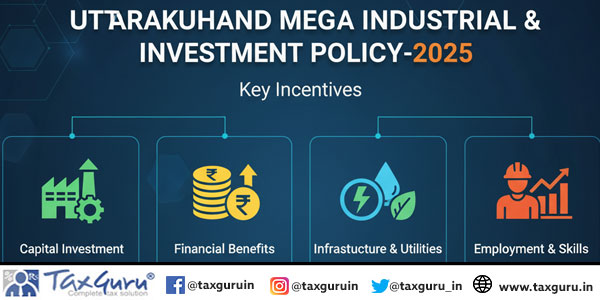
Policy Features and Incentives
The policy categorizes eligible large enterprises based on their Fixed Capital Investment (which means investment made in building, plant, machinery, and equipment, excluding land and other capital investment)
| Large Enterprise Investment Category | Fixed Capital Investment (crore) | Minimum Threshold Permanent Employment | Standard Investment
Period |
||
|---|---|---|---|---|---|
| Minimum | Maximum | Capital
Investment (Rs. crore) |
Permanent
Employment |
||
| 1 | 2 | 3 | 4 | 5 | 6 |
| Large | More Than Rs. 50 crores | Rs. 200 crores | 50 | 50 | 3 Years |
| Ultra Large | More Than Rs. 200 crores | Rs. 500 crores | 200 | 150 | 4 Years |
| Mega | More Than Rs. 500 crores | Rs. 1000 crores | 500 | 300 | 5 Years |
| Ultra-Mega | More Than Rs. 1000 crores | – | 1000 | 500 | 7 Years |
Financial Incentives
Financial incentives are provided to new units and those undertaking substantial expansion of large sector manufacturing enterprises:
1. Stamp Duty Reimbursement
- Reimbursement of 50% of the stamp duty payable on the execution of land purchase deed/lease deed (not applicable on buildings).
- The maximum reimbursement is Rs. 50 lakhs per unit.
2. Capital Subsidy
Capital subsidy is payable on the total eligible fixed capital investment in new plant, machinery, and workshop building.
| Large Enterprise Investment Category | Capital Subsidy Rate
(% of eligible fixed capital investment) |
Total Maximum Capital Subsidy | Payment Period |
|---|---|---|---|
| Large | 10 Percent | Rs. 20 Crore | 8 Years |
| Ultra Large | 12 Percent | Rs. 60 Crore | 10 Years |
| Mega | 15 Percent | Rs. 150 Crore | 12 Years |
| Ultra-Mega | 20 Percent | Rs. 400 Crore | 15 Years |
3. Hill Incentive
Additional Capital Subsidy is provided to encourage the establishment of new large-scale manufacturing enterprises in hilly areas categorized under Category-A and Category-B:
- Category-A: Additional subsidy of 2 Percent of fixed capital investment.
- Category-B: Additional subsidy of 1 Percent of fixed capital investment.
Focused Areas for the Policy (Hill Incentive Categories)
The policy classifies districts/areas to determine the applicability of the Hill Incentive (Section 9):
| Category | Included/Covered Area |
|---|---|
| Category-A | The entire area of Pithoragarh, Uttarkashi, Chamoli, Champawat, Rudraprayag and Bageshwar districts. |
| Category-B | The entire area of Almora and Pauri Garhwal districts. Also includes the mountainous area of Tehri Garhwal district (excluding Dhalwala, Muni ki Reti and its adjoining plain areas), and specific blocks in Nainital (Bhimtal, Dhari, Betalghat, Ramgarh, Okhalikanda development blocks) and Dehradun district (Chakrata development block). |
Reference
The primary reference document for this article is the Uttarakhand Mega Industrial and Investment Policy-2025.
FAQ (Frequently Asked Questions)
Q1: What are the primary eligibility conditions for enterprises?
A: To be eligible, units must be manufacturing enterprises of the large category and satisfy the minimum threshold for both fixed capital investment and permanent employment as prescribed for their category. Furthermore, it is necessary for the eligible enterprise to provide at least 70 percent permanent employment to the permanent residents of the state in its enterprise.
Q2: Are there any restrictions on the type of machinery purchased?
A: Yes. Fixed Capital Investment calculated for incentives must include investment in “new plant and machinery”. Units involving the transfer of plant and machinery previously used for some other purpose to a new unit, or a unit displaced from elsewhere, will not be eligible to receive financial incentives under the policy.
Q3: Are certain sectors prohibited from receiving incentives?
A: Yes. Enterprises mentioned in the “Prohibited List” (Annexure-1) are not eligible for financial incentives. This list includes goods related to tobacco and manufactured tobacco products, pan masala, petroleum or gas refineries, single-use plastic products (polythene of less than 120-micron thickness), brick making units, mining and stone crusher units (with specific exceptions), units not complying with environmental standards, low value addition activities (such as preservation, cleaning, storage), and all service sector activities including tourism.
Q4: How are financial benefits released?
A: Financial benefits will be allocated based on the ‘first-come-first-serve’ basis within the prescribed budget limit of Rs. 1000 crore. Capital subsidy payments are typically made in annual instalments over the stipulated payment period.
Q5: Where must the unit be located?
A: The billing address of the unit must be located in Uttarakhand for capital expenditure and operational purposes.
Q6: Which category of enterprises will be eligible for financial incentives under this policy?
A: Manufacturing enterprises in the large category (fixed capital investment in plant & machinery more than Rs. 50 crore) which are not included in the prohibited list under the Policy will be eligible for financial incentives, provided they fulfil other eligibility conditions.
Q7: If the total fixed capital investment in plant and machinery of an enterprise is less than Rs. 50 crores but the total fixed capital investment in plant and machinery and workshop building is more than Rs. 50 crores, then will the unit be eligible for financial incentives under this policy or not?
A: No. Since the total fixed capital investment in plant and machinery is less than Rs. 50 crores, the unit falls into the category of micro, small, and medium enterprise, and hence will not be eligible for financial incentives under this policy.
Q8: What capital investment will be taken into account for determining ‘large enterprise’ and ‘large enterprise investment category’?
A: For determining the category of enterprise (i.e., large enterprise), the total fixed capital investment in plant and machinery shall be taken into account. For determining the category of large enterprise investment (large, ultra large, mega and ultra-mega), the total fixed capital investment in workshop building and plant & machinery (excluding land and other capital investments) shall be taken into account.
Q9: What type of capital investment will be taken into consideration for calculation of permissible capital subsidy/hill incentives under the policy?
A: For calculation of capital subsidy/hill incentive, the eligible total fixed capital investment in plant, machinery and workshop building will be taken into account.
*****
Prepared by CA P.R. Hathwal, [email protected], 8054706020