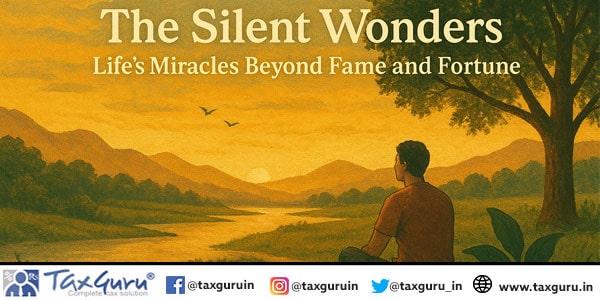
Why Our Fascination with Billionaires and Fame Blinds Us to the Quiet Miracles That Hold the Universe Together
We live in a world obsessed with noise , the noise of achievement, fame, and fortune.
Someone becomes a billionaire, and headlines roar in admiration.
Someone else becomes a celebrity, and the world pauses to applaud.
We scroll endlessly through glowing screens, feeding our minds with stories of the extraordinary , how one person “made it,” how another “rose to the top.”
I’ll be honest: I, too, have felt the pull of these stories. The desire to become someone, the silent competition with others, the fascination with wealth and fame. But lately, I’ve begun to ask myself a question that feels both simple and profound , why am I not equally fascinated by the everyday miracles that surround me, the ones happening quietly without applause, yet orchestrating the rhythm of all existence?
The invisible perfection of nature
Think for a moment about how love emerges for a newborn child.
No manual, no training, no external motivation – it just happens.
A chemical, emotional, and spiritual explosion of attachment between two beings who, moments ago, were strangers. What could be more mysterious than that?
Or consider how no two human beings on this planet are exactly alike.
Billions of faces, each one a unique sculpture of genetic art.
The texture of skin, the pattern of veins, the lining of palms, even the tiny swirls of fingerprints – all crafted with such precision that not one repeats in all of humanity.
And yet, we rarely pause to marvel at it.
Our bodies know when to feel thirst, when to seek food, when to rest.
They heal themselves without our conscious command.
A small cut closes, a wound rebuilds, a cell regenerates , all in silence.
There is a hidden intelligence within us that never went to school, never read a book, yet knows exactly how to keep us alive.
The birds migrate across continents without a GPS, the flowers open at dawn and close at dusk without a clock, the oceans breathe in tides as if the Moon whispers instructions each night.
And we, the so-called intelligent species, rarely look up long enough to notice the harmony we live in.
The floating rock of miracles
Now imagine this: all of us – every human, animal, forest, and ocean , are sitting on a floating rock, drifting through an endless cosmic desert.
A rock that spins around itself at over a thousand miles per hour and circles around a giant ball of fire 150 million kilometers away.
And somehow, this motion — this eternal dance of Earth and Sun – creates the wonders we take for granted:
day and night, dawn and dusk, winter and spring, wind and rain, life and death.
This constant rotation gives birth to our seasons, our agriculture, our weather patterns, even our moods.
Our entire economy — from harvests to holidays, from tourism to trade – is rooted in this simple act of celestial movement.
The Earth’s tilt defines your wardrobe; the Sun’s distance determines your meal.
And yet, we rarely whisper even a thank you to this silent miracle.
Think about it: if the Earth stopped spinning for just a moment, every ocean would swallow continents, every city would crumble, every breath would cease.
But it doesn’t stop.
It spins in perfect rhythm, carrying billions of lives, billions of stories , each one pretending to be the center of the universe, unaware that we all share the same fragile spaceship.
The humble genius of Life
How beautifully simple, yet incomprehensibly complex, life truly is. Rain falls, rivers flow, seeds sprout, trees grow , all without debate, politics, or algorithms. The ant builds a colony, the spider spins its web, the honeybee designs its hexagonal perfection , all with the same grace that sculpted galaxies.
We, too, are products of that same design, though we often forget it amid our pursuits of more.
Every morning, billions of hearts start beating without electricity, billions of lungs inhale air that no one owns, billions of eyes open to light created millions of years ago in distant stars. And yet, our minds stay restless , chasing numbers, followers, awards, and validation.
We marvel at rockets breaking gravity but rarely at the miracle that lets a tree stand upright, defying gravity every single day.
We talk about artificial intelligence as a revolution, while ignoring the intelligence already breathing within us , the one that turns food into energy, fear into action, love into tears.
The consciousness paradox
Perhaps the greatest wonder of all is consciousness itself , the human ability to not only live but also observe living.We can imagine the future, recall the past, question the present, and even contemplate our purpose. No other known species carries this burden and blessing.
It is both our superpower and our suffering , the reason we create art, philosophy, and science, but also anxiety, greed, and ego.
Consciousness gave us the power to invent money, cities, and machines , yet it also disconnected us from the raw intelligence of existence.
We started to measure worth in currencies instead of curiosity, and success in applause instead of awareness. We became so good at building systems that we forgot how to simply be.
Rediscovering awe
Maybe it’s time to unlearn our obsession with the extraordinary and fall in love again with the ordinary , because the ordinary is anything but.
The laughter of a child, the pattern of raindrops on a window, the golden symmetry of a sunrise — these are not coincidences. They are living poetry, reminders that the universe is not a machine, but a masterpiece.
We chase miracles outside of ourselves, when every heartbeat is one.
We search for divine signs, when the very ability to search is divine.
We long to “make it big,” forgetting that we already exist in the grandest creation ever made – a conscious species, on a floating planet, in an infinite cosmos.
Maybe the real miracle was never in becoming someone special. It was always in realizing how special everything already is.