India’s GST Revolution: Two Rates, One Goal Unlocking Consumer-Led Growth
In September 2025, India’s Goods and Services Tax (GST) system underwent a seismic shift, moving beyond mere tax collection to become a powerful engine for national economic transformation. This was no minor tweak; it was a foundational overhaul, simplifying the complex multi-rate structure into a leaner, meaner machine designed to unleash consumer-led demand, smooth the path for businesses, and sharpen India’s competitive edge on the global stage. This rewrite of the tax code is poised to redefine the nation’s growth trajectory, offering a much-anticipated “Diwali bonanza” not just for consumers, but for the economy at large.
Simplified Slabs: The Core of the Reform
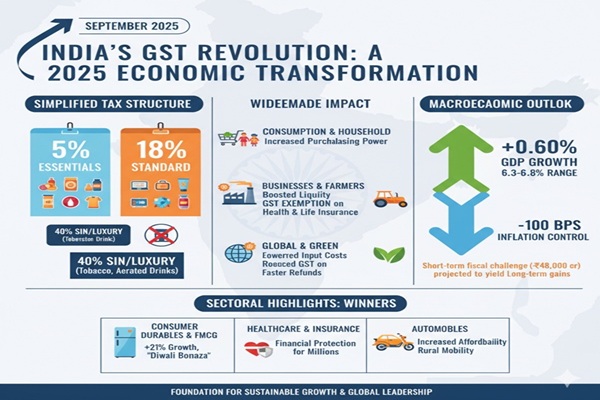
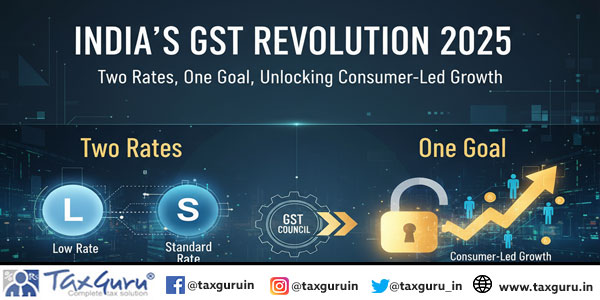
The most impactful change was the bold consolidation of the previous multi-tier GST slabs (which included 0%, 5%, 12%, 18%, and 28%) into a dramatically simplified system with just two primary rates:
- 5% for Essentials: This rate is now applied to crucial everyday goods, making basic necessities more affordable for all citizens.
- 18% as the New Standard: Over 90% of all goods—including consumer durables, white goods, household appliances, and personal care products—have converged on this new, lower standard rate.
Only “sin goods” and luxury items like tobacco and aerated drinks remain at a steep 40%. Crucially, the reform also eliminated the compensation cess on almost all categories, directly lowering the price burden on the middle class and everyday households. This move effectively clears the path for easier compliance and eliminates a significant layer of tax complexity that once hampered trade.
Widespread Impact: Fueling Growth and Affordability
The reverberations of this tax simplification are expected to be felt across the economy, boosting consumption, supporting small businesses, and accelerating the nation’s green shift.
Consumption and the Household Budget
The reduction in GST rates translates directly into increased purchasing power. Hundreds of everyday items are now cheaper, making the festive season purchasing spree even more vigorous. This increased affordability in sectors like automobiles and electronics is expected to drive higher private consumption, acting as the primary fuel for the economy.
Significantly, the exemption of GST on health and life insurance premiums is a major social reform. It instantly makes financial protection accessible to millions, addressing a long-standing gap in social security and promoting inclusive growth.
A Tailwind for Businesses and Farmers
For Micro, Small, and Medium Enterprises (MSMEs) and the agricultural sector, the reforms offer a vital injection of liquidity and a cut in operational costs. Lowered GST on farming inputs and manufacturing components eases cash flow constraints. Furthermore, new institutional frameworks, such as the GST Appellate Tribunal, coupled with faster, automated refund processes, promise a much-needed end to compliance headaches. This simplification is key to bringing more businesses into the formal economy and boosting tax revenue efficiency.
Global Competitiveness and Green Transition
By lowering input costs and aligning the tax structure closer to international best practices—like those in Australia and Canada—India dramatically improves its attractiveness for global investment. Manufacturers gain an immediate edge, and exporters benefit from a streamlined refund mechanism that accelerates working capital recovery.
Moreover, the reduced GST on green technologies like solar panels and wind turbines slashes capital costs for renewable energy projects, cementing India’s commitment to a rapid and sustainable green transition.
Macroeconomic Outlook: A 60 Basis-Point Boost
The financial models are predicting a strongly positive outcome:
- GDP Growth: Analysts estimate a 60 basis-point boost to India’s GDP for the fiscal year 2025-26. With robust consumer spending acting as a powerful fiscal multiplier, the nation could see GDP growth climb into the optimistic 6.3–6.8% range.
- Inflation Control: If businesses fully pass on the tax reductions to consumers, headline retail inflation is expected to drop by as much as 100 basis points, easing pressure on household budgets.
While there are understandable concerns about the immediate fiscal implication—estimated at up to ₹48,000 crore—the government is betting on the long-term gains. An expanded tax base, higher consumption volumes, and improved compliance are expected to ensure fiscal sustainability and allow the government to meet its deficit targets.
The Global Buffer
Amidst rising global trade tensions, including a tariff imposed by the US on Indian goods, the domestic consumption boom created by the GST cuts acts as a crucial economic buffer. This internal demand will soften the impact of external headwinds, providing stability and ensuring India remains a dynamic player in a volatile world economy.
Sectoral Highlights: The Real-World Winners
- Consumer Durables and FMCG: These sectors are bracing for a massive surge, with analysts projecting over 21% growth. Items like refrigerators and ACs moving out of the punitive 28% bracket will lead to an unprecedented ‘Diwali bonanza’ extending throughout the year.
- Healthcare and Insurance: The GST exemption on individual and family health and life insurance is perhaps the most significant social benefit, driving crucial financial protection deeper into the populace.
- Automobiles: Price reductions, particularly for small automobiles and two-wheelers, are set to increase rural mobility and provide wider market access for lower-income consumers, generating industrial growth in related sectors.
Conclusion: A Foundation for Sustainable Leadership
India’s 2025 GST reform is a historic and strategically sound move. It is a direct investment in the Indian consumer and a powerful signal to the world about the stability and transparency of the nation’s economy. Despite the short-term fiscal worries, the projected long-term benefits—unleashed consumer demand, greater global competitiveness, and a more inclusive social fabric—mark this overhaul as a foundational step toward a new era of sustainable, consumer-driven growth and expanded global leadership. The foundation for an even more robust Indian economy has been laid.
*****
(Author can be reached at email address [email protected] or on Mobile No. 9990365673)
Disclaimer: “Neither this article nor the information contained herein shall in any way be construed as forming a contract or shall constitute professional advice required before acting upon any matter. CA Sharad Kumar Sharma has taken all due care in the preparation of this article for accuracy in its contents at the time of publication. However, no liability shall be accepted by him in the event of any direct, indirect or consequential damages arising out of or in any way connected with the use of this article or its contents. “