In re SHV Energy Private Limited (GST AAAR Tamilnadu)
Issues
1. Whether the appellant is eligible for availment of input tax credit of GST paid on goods and services for laying of transfer pipeline and the foundation and structural support for such pipeline which is intended for Unloading propane/Butane from the vessel/Jetty to the Terminal?
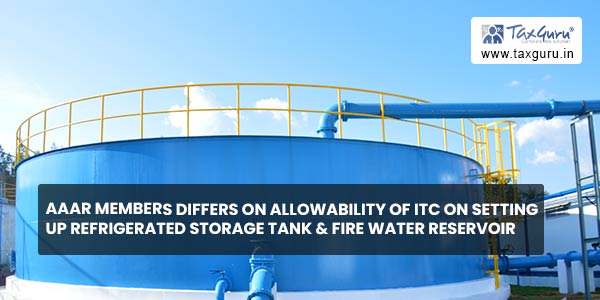
2. Whether the appellant is eligible for availment of input tax credit of GST paid on goods and services used for setting up refrigerated storage tank and input credit of goods and services used for foundation and structural support foundation tanks?
3. Whether the appellant is eligible for availment of input tax credit of GST paid on goods and services for setting up of Fire Water reservoir ( tank and input credit on goods and services used for foundation and structural support for such reservoir?
Held by AAAR
1. In respect of Q.No.1, the subject appeal is disposed as there is no reason to interfere with the Order of Advance Ruling Authority
2. In respect of Q.No.2 and 3, as there is difference of opinion between the members, no ruling is offered as per Section 101(3) of the CGST/TNGST Act 2017.
Read AAR Order: No ITC on pipeline for unloading Propane/Butane from Vessel/Jetty to Terminal
FULL TEXT OF THE ORDER OF APPELLATE AUTHORITY OF ADVANCE RULING, TAMILNADU
At the outset, we would like to make it clear that the provisions of both the Central Goods and Service Tax Act, 2017 and the Tamilnadu Goods & Services Tax Act, 2017 are the same except for certain provisions. Therefore, unless a mention is specifically made to such dissimilar provisions, a reference to the Central Goods and Service Tax Act, 2017 would also mean a reference to the same provisions under the Tamil Nadu Goods and Service Tax Act, 2017.
The subject appeal is filed under Section 100 (1) of the Tamilnadu Goods & Services Tax Act, 2017/Central Goods & Services Tax Act 2017 by M/s. SHV Energy Private Limited (herein after referred as the Appellant), having their registered office at LPG Storage Terminal, (Near Red Gate), New Harbour, Tuticorin 628 004. They are registered in India and the primary business comprises of supply of Liquified Petroleum Gas (LPG) in Bulk and in cylinders to domestic/ other Business’ segments under the brand name of “SUPER GAS”. SHV also supplies bulk LPG for Industrial and Auto LPG. SHV is the subsidiary of SHV Energy N.V., a Dutch Multinational Company in Netherlands. They are registered under GST with GSTIN. 33AACCS8676D1Z9. The appeal is filed against the Order No. 10/AAR/2021 dated 31.03.2021 passed by the Tamil Nadu State Authority for Advance ruling on the application for advance ruling filed by the appellant.
2.1 The appellant has stated that they import LPG from outside India and stores/ processes the same at various terminals located in India. The terminals are in Tuticorin (Tamil Nadu), Porbandar (Gujarat) and Mumbai (Maharashtra). They operate in 16 states in India through 3 terminals, 4 Regional offices, 24 filling plants and 6 depots in India. Their Tuticorin terminal is contemplating expansion to increase the LPG capacity from 3,50,000 Metric Tons Per Annum (MTPA) to 12,00,000 MTPA. The expansion will involve suitable augmentation of existing facilities including Utilities and Offsite systems. The following expenditure is proposed to be incurred by them in the process of expansion amongst others:
1. Construction of transfer Pipeline
2. Construction of refrigerated atmospheric storage tank
3. Construction of water tank which is a part of firefighting system
4. Construction of foundation/ structural support through piling
Transfer Pipeline: This is basically laid to connect the unloading point (jetty) to the storage tanks within factory premise. These are generally long distance pipelines covering various road, rail and river crossing sometimes also across the sea. The existing unloading arms and transfer Pipelines shall continue to be available for unloading LPG from ships. As part of proposed expansion, new Propane and Butane unloading arms (one each) shall be installed at the Jetty. The new loading arms shall be designed to handle 500 MT/hr each of refrigerated Propane and Butane. The approximate linear length of each new pipeline shall be 4.1 km and shall be installed adjacent to the existing piping corridor. The unloading line 16″ size adequacy and hydraulics is based on ship pump head of 120 mlc (meter of liquid column). Two 16″ pipelines and two 6″ precooling lines with necessary insulation are considered.In order to reduce the ambient heat ingress and fire protection of the unloading, pipeline, 80mm thick Polyurethane foam (PUF) inner insulation and 50 mm thick Cellular glass outer insulation are recommended. For pre-cooling, the unloading lines, one insulated 6″ pipeline is considered. Liquid propane and Butane are admitted into the respective unloading line to affect a slow cooling down of the unloading pipeline (approx. 3-50C per hour). During the pre-cooling process, gas compressors will have to run continuously. Propane and Butane shall be received in refrigerated ship tankers with their own refrigerated system in parcel sizes of 22,500 MT at Port jetty of Tuticorin. The refrigerated liquid cargo shall be pumped by ship’s pumps at a rate of 500 MT/h of Propane and Butane in each loading arm. This will be done through two marine unloading arms of 12″ diameter and transferred to the storage tank via 16″ diameter pipelines each having a total length of about 4.0 to 4.7 kms. The above mentioned is the process of transportation of Propane/ Butane from Jetty to the storage tank by using transfer pipeline, as transportation through tankers is cumbersome process.
Storage Tank : Post expansion of the terminal, the Appellant envisages unloading of Propane and Butane from the ship using pipelines and storing in two refrigerated storage tanks of 15,000 MT capacity each. The tank normal operation pressure shall be 700 mm WC at a temperature of approximately (-) 450 C in case of propane and (-) 50 C in case of Butane. Propane and Butane pumps are submersible ‘centrifugal type pumps kept inside tank. These pumps are provided for following functions:
√ Transfer of propane/ butane for heating and blending for production of LPG for tanker loading and;
√ Pre cooling of unloading lines prior to ship unloading
Each pump is provided with automatic flow control valve meant for minimum flow return and these pumps are designed for the necessary flow to facilitate production of LPG of different ratios of Propane/ Butane. They are heated in separate heating trains to 150 C in two steps using dedicated air heaters followed by trim heaters. They are mixed in Static Blender (2000-FM-01) at a certain predetermined ratio in order to make LPG as per IS-4576. The ratio depends upon the composition of Propane and Butane stored in storage tank. Online blending control system is provided to make LPG as per IS specifications. The vapor pressure of the mixture is monitored by online measurement at the downstream of static blender with the help of online vapor pressure analyzer. The blended LPG is filled into road tanker via unloading arms for their customers. It is important to note that these tanks are constructed for specific usage of storage of Propane and Butane. These storage tankers cannot be used for any common storage.
Fire Water reservoir (tank) as part of Fire fighting system: The current expansion project is proposed to have firefighting system in compliance with Oil Industry Safety Directorate (OISD) standards 236. To meet the requirements, it is proposed to have provisions for fire tank, fire detection, fire alarm and fire extinguishing facilities to cover entire terminal and jetty. Water is stored to meet the requirement of firefighting for 4 hours duration, with pumps of adequate capacity. Hence two tanks of capacity 4000KL each is proposed. Further, water stored in the tanks will be used for direct fire extinguishing, cooling down surrounding structures & equipment as water curtain to complete cut-off of fire zones. Thus, water reservoir (tank) is integral part of firefighting system which is connected with Hydrant lines sprinklers and water curtain. As part of existing safety system at Terminal, the system has a firewater system with the following facilities:
2 Nos of Firewater Pumps
2 Nos of Jockey Pumps
2 interconnected Firewater reservoirs with the total capacity of 2817m3.
Firewater ring main with single and double headed hydrants, monitors and deluge spray systems for Compressor, LPG Pumps, Heaters & Condensers, Tank Truck Gantry and Transformers are available. Due to proposed Terminal expansion and to meet the fire water demand new water tanks are to be constructed. The minimum fire protection measures envisaged and to be constructed for the terminal expansion are firewater pump house with firewater main pumps and jockey pumps, firewater storage tanks and firewater main ring. Firewater system shall be integrated with the existing facility. Firewater demand shall be calculated for a single largest fire scenario, considering composite plant of old and new terminals. The existing firewater and jockey pumps shall be replaced to suit the new fire water demand.
Foundation and structural support through Piling: Piling means a heavy stakes or posts installed to support the foundation of a structure. A pile foundation is defined as a series of columns constructed into the ground to transmit loads to a hard soil beneath. A pile is a long cylinder made up of a strong material, such as concrete. Piles act as a steady support for structures built on top of them. Piles transfer the loads from structures to hard strata, rocks, or soil with high load bearing capacity. As the Appellant’s Project site is located close to the sea, the soil is filled up with clay with a very high ground water table (<1 m), this would mean that the load bearing capacity (weight per sqm the soil can withstand) is very low. Since the tanks are quite heavy, the Appellant needs to increase this load bearing capacity. ‘Once the location of the piles has been identified, a hydraulic rig shall dig a hole up to the required depth, once the depth has been achieved a reinforcement cage(prefabricated) shall be placed inside the borehole and then filled up with concrete of required grade. These piles are finished at ground level. While many methods are available for laying foundation, piling is one of the proven and affordable method to do so. Also, the storage tanks need a stable base, which can take the weight of entire tank with the product in it. Since their storage tanks need an elevated base, the piles are further extended to another 1.5m above the ground level upon which a pile cap/ concrete foundation is made joining all the piles together to form a load bearing plat form.
3. Appellant had sought Advance Ruling on the following questions:
1. Whether the appellant is eligible for availment of input tax credit of GST paid on goods and services for laying of transfer pipeline and the foundation and structural support for such pipeline which is intended for Unloading propane/Butane from the vessel/Jetty to the Terminal?
2. Whether the appellant is eligible for availment of input tax credit of GST paid on goods and services used for setting up refrigerated storage tank and input credit of goods and services used for foundation and structural support foundation tanks?
3. Whether the appellant is eligible for availment of input tax credit of GST paid on goods and services for setting up of Fire Water reservoir ( tank and input credit on goods and services used for foundation and structural support for such reservoir?
4. AAR pronounced the following rulings:
1. The appellant is not eligible for availment of input tax credit of GST paid on goods and services for laying of transfer pipeline and the foundation and structural support for such pipeline which is intended for unloading propane/butane from the vessel/Jetty to the Terminal.
2. The appellant is eligible for availment of input tax credit of GST paid on goods and services used for setting up refrigerated storage tank including the structural support thereon as per the Purchase Order No.4500405026 dated 11.3.2020 subject to the condition that the tanks are capitalized in their books of accounts as plant and machinery and not as immovable property and the appellant are not eligible to avail input credit of goods and services used for pile foundation as per the purchase order no.4500401679 dated 10.02.2020
3. The appellant is eligible for availment of input tax credit of GST paid on goods and services for setting up of fire water reservoir (tank) including the structural support thereon as per the Purchase Order No.4500405071 dated 11.3.2020 subject to the condition that the tanks are capitalized in their books of accounts as plant and machinery and not as immovable property and the appellant are not eligible to avail input credit of goods and services used for pile foundation.
5. Aggrieved with the above ruling, the Appellant has filed the present appeal. The grounds of appeal are paraphrased as follows:
A. The Impugned Ruling has erred in not allowing the credit of taxes paid on construction of transfer pipelines
They have referred to Para 9.3 to 9.6 of the Impugned Ruling and submitted that the above observation of the Ld. Authority is completely incorrect for the following reasons:
> Transfer pipelines should be considered as part of the factory premises. They had vide their application as well as the additional submissions, made detailed submissions on how the pipelines must be considered as a. part of the factory.
Ld. Authority has, without properly appreciating their contentions and merely on the ground that the definition of factory under the Factories Act is not applicable to the present case, has rejected their submissions.
> The term factory is not defined under the CGST Act. It is a settled principle of law that when a word is not defined under a statute, reliance can be placed on the definition in allied laws. It is also a settled principle of law that an interpretation of a particular statute should not ordinarily be in conflict with another statute unless and’until specifically provided so by the other statute. Normal rule of interpretation should be to harmoniously read different statutes to ensure there is no conflict in relation to same transaction. Reliance in this regard can be placed on Asst. Commr. Of I.T., Bharuch V. Narmada Chematur Petrochem. Ltd. 2012 (278) E.L.T. 178 (Guj.).
> Further, the Ld. Authority has held that the definition under Factories Act cannot be relied upon by merely referring to the Apex Court’s judgment in the matter of M/s MSCO Pvt. Ltd, supra, without substantiating the applicability of the decision in the present facts. Merely relying on a judgment without providing its applicability to present matter cannot be held to be correct. Also, the Ld. Authority has not pointed to any conflict between the Factories Act and GST law. Thus, unless a conflicting intention is shown between the two legislations, meaning of factory can be understood from factories act. Having concluded that the Appellant’s reliance of definition of factory from Factories Act is not tenable, the LA has failed to define what a factory would mean as per the Ld. Authority. The Ld. Authority has merely proceeded to reject the contention of the Appellant stating that the pipeline is outside the factory.
This is clearly erroneous and the Impugned Ruling therefore merits to be set aside on this ground.
> In any case, they would like to place reliance on the definition of ‘factory’ provided under Section 2(e) of the Central Excise Act, 1944. The definition is reproduced below for reference:
“(e) “factory” means any premises, including the precincts there-of wherein or in any part of which excisable goods other than salt are manufactured, or wherein or in any part of which any manufacturing process connected with the production of these goods is being carried on or is ordinarily carried on;”
Central Excise law has been subsumed into GST and GST law is to much extent a production of Central Excise Act, 1944 only. Hence, it can be concluded that it is apt to place to reliance on the definition of factory provided in the Central Excise Act, 1944.
> With respect to the Ld. Authority’s contention that the pipeline has not been added as additional place of business in the GST registration, it is hereby submitted that, even if assuming that it was required to be added in the registration, the same is merely a procedural lapse and the credit eligibility cannot be rejected merely on this ground as eligibility to avail credit is not based on registration as a place of business. From a perusal of the above definition, it is clear that the term factory includes any premises and precincts thereof. The term “precincts” has been defined under • various dictionaries as below:
Cambridge International Dictionary of English “area around building” Collins English Dictionary “the surrounding region or an area”
Merriam webster “the region immediately surrounding a place’
On perusal of aforesaid meanings, precinct would mean an area around building or a place. Therefore, a conjoint reading of the term “factory” and “precincts” makes it abundantly clear that the factory includes the surrounding areas which in the case of the Appellant is pipeline laid from Jetty to Terminal. Therefore, pipeline should be regarded as situated within the premise of the factory and hence eligible for input tax credit. In this regard, they that these pipelines qualify as precincts of the factory. It may be noted that these pipelines are just adjacent to the factory and spread upto 4 krns from factory to the Jetty. They have also received Right of Way approval from the V.O. Chidambaranar Port Trust. This means that this area is allotted to them for the pipelines and leads to an extension of the factory. Thus, making the pipelines within factory precincts.
> The transfer pipelines under consideration here are short distance pipes as against cross country pipelines which may stretch to over 100 of kms. In many businesses, it is required to lay down long distance pipelines which may pass through many cities or even beyond state boundaries. The pipes to be laid down by them are distinguished from such cross-country pipelines and should be considered more as pipes. As explained above, these pipes are used as unloading arms for unloading Propane/ Butane from ship tankers and transfer it to the storage tanks. Once such transfer is done, the other end of the pipelines at the jetty is disconnected. Thus, it lies disconnected once the transfer has been completed. This fact pattern clearly indicates that the transfer pipes work as a part of the factory itself. Consequently, the impugned ruling holding that the pipelines are laid outside the factory premises is erroneous and is liable to be set aside.
> They further rely on the interim relief granted by Chhattisgarh High Court in the matter of NMDC Limited Versus Union Of India [WPT No. 77 of 20211 In this matter, the Hon’ble High Court has issued a stay order against the revenue order in a similar matter for allowance of input tax credit on goods and services used for laying of pipelines considering the provisions of Section 16 of the CGST Act.
> The transfer pipelines are an important part of the complete manufacturing process in their business. Thus, such pipelines should be considered as part of the plant and machinery. Reliance can also be placed on the judgment of the Hon’ble Supreme Court of India in the case of State of Bihar & Ors. Vs. Steel City Beverages Ltd. & Ors. [AIR 1998 SC 2351 wherein a wide connotation has been given to the word ‘plant’ and the term ‘plant’ has been held to mean apparatus which is used by the industry for carrying on its industrial process of manufacture. It has been explained how these pipelines are used in the manufacturing process and are an important part thereof for the manufacture process. Thus, it should be considered as part of the plant and hence eligible for input tax credit. They place further reliance on the judgment of Bombay High Court in the matter of Reliance Industries ITS-226-HC-2017(BOM)-EXCI, wherein MODVAT credit was allowed in respect of `Single Point Mooring’ system situated in the seabed, used for unloading of imported and coastal consignments and pumping of raw materials holding that this should be considered as an extension to the `factory’.
> They in their Application had relied upon the meaning of factory from the Factories Act, 1948. Section 2(m) of the Factories Act, 1948. However, the Ld. Authority has held that adopting the definition of ‘factory’ from a different statute is not tenable. It is to be noted that the term ‘factory’ has not been defined under the GST law and the IA. Authority in the Impugned Ruling has not suggested any alternate source for deriving the definition or meaning of the term ‘factory’. They have now placed reliance on definition provided in Central Excise Act, 1944 also. It is a well settled legal principle that in case of absence of the definition of a term in the statue under litigation, the definition can be derived from other relevant statutes.
> Transfer Pipelines are used in the course or furtherance of business. The main objective and purpose of laying of pipeline is for unloading of Propane/ Butane. Propane/ Butane are the key raw material the process of manufacture of LPG. It is clear from the above that laying of pipeline constitutes an integral and inseparable part in the manufacturing process in as much as without the aforesaid activity of transportation of Propane/Butane for which pipelines are used, there cannot be manufacturing of LPG. Based on above, it is submitted that pipelines are used in course of or furtherance of business. The pipelines constitute an integral part of the manufacture carried out by them; credit of taxes paid by them should be eligible to them. Based on the decision in the case of Commissioner v. GSPL India Transco Ltd 12016 (43) S.T.R. J23 (Guj.)] by the Hon’ble High Court, it can be concluded that even in their case, transportation of Propane/Butane is not possible without laying of pipeline for transport. Therefore, laying of pipelines is an integral part of their business operations and hence used in course of furtherance of the business. Thus, it can be concluded that laying of pipeline for transport of Propane/ Butane from Jetty to Terminal is eligible for input tax credit under Section 16 of CGST Act and credit should not to be restricted under Section 17 of CGST Act. The Impugned Ruling has not disputed this ground, and this means that the Ld. Authority has accepted that the transfer pipelines are used in the course or furtherance of business. The exclusion from credit eligibility applies only to the pipelines laid outside the factory premise which is used for making outward supply of goods.
> Having considered the factual background, they wish to highlight specific provision in this regard. Section 17(5) of the CGST Act in its explanation has specifically described the expression plant and machinery. Decoding the above provision following inference can be drawn:
> The provision restricts the input tax credit on immovable property other than plant and machinery;
> Plant and Machinery means any equipment fixed to earth by foundation or structural support; and
> The provision excludes the credit on pipeline laid outside the factory premise which is used for making outward supply of goods
In ‘the current scenario, they receive Propane and Butane through refrigerated ship tankers with their own refrigerated systems. The refrigerated liquid cargo shall be pumped by ship’s pumps at a rate of 500 MT/hr each of refrigerated Propane and Butane in each loading arm. This will be done through two marine unloading arms installed at Jetty and transfers the refrigerated Propane and Butane to their refrigerated storage tanks at Terminal via 16″ diameter transfer pipelines each having a total length of about 4.3 kms from Jetty to the Terminal. The above referred process of procurement of Propane and Butane from Jetty to their terminal through, transfer pipeline is the unique mode of transportation without which they cannot manufacture LPG which is their outward supply. Section 17 (5) restricts pipelines laid outside the factory premise which are used for making outward supply of goods or services not inward supply of goods or services. Hence, they believe that the transfer pipelines laid outside the factory premise for procurement of Propane and Butane is eligible for availing credit.
B. The impugned Ruling has erred in holding that credit is not eligible on input and input services used for laying Pile foundation.The Impugned Ruling at paragraph 10.5 and 11.3 has denied the credit of taxes paid on pile foundation. In this regard, they submit that the above ruling of the Ld. Authority is incorrect for the following reasons:
> The Impugned Ruling has been passed without providing any proper reasoning and accordingly, the impugned Ruling vitiates the principles of natural justice and therefore, is bad in law. They had made detailed submissions to substantiate that pile foundation is essential for the storage tanks to bear the load. The Ld. Authority has, without providing any proper reasoning whatsoever has passed the impugned Ruling holding that pile foundation cannot be attributed as a foundation or structural support for an equipment/ apparatus. The Authority has not analysed or provided any observations for rejecting the submissions made by the Appellant that pile foundation is essential to bear the load of the tanks and therefore they form foundation of the storage tanks. This represents a flamboyant and prejudiced attempt of the Authority to frivolously deny the credit without any application of mind. Such order cannot be held to be sustainable in law. It is a settled principle of law that the order has to be passed by the Authority by providing a proper reasoning. Reliance in this regard can be placed on the following decisions: