Active Income vs Passive Income: Meaning, Tax Implications and Wealth Creation Strategy
In personal finance and taxation, income is broadly classified into active income and passive income. Active income requires continuous personal effort and time, whereas passive income is earned with minimal ongoing involvement after an initial setup. Understanding this distinction is important for tax planning, financial stability, and long-term wealth creation, especially in an era of job uncertainty and rising inflation.3
1. Active Income
Active income is income earned through regular and direct involvement in work or business activities. The income stops once the activity stops.
Examples of Active Income
- Salary and wages
- Professional income (CA, doctor, lawyer, consultant)
- Business income with active participation
- Commission, incentives, bonuses
Example:
Mr. A earns ₹80,000 per month as salary. If he resigns or stops working, his income becomes nil. This is active income.
2. Passive Income
Passive income is income earned regularly with little or no active involvement after an initial investment of money, time, or skill.
Examples of Passive Income
- Rental income from property
- Interest from fixed deposits and bonds
- Dividend income from shares and mutual funds
- Royalty from books, music, or patents
- Income from REITs and InvITs
Example:
Mrs. B owns a rented flat earning ₹18,000 per month. Even without daily effort, the income continues. This is passive income.
3. Dependency of Income on Time
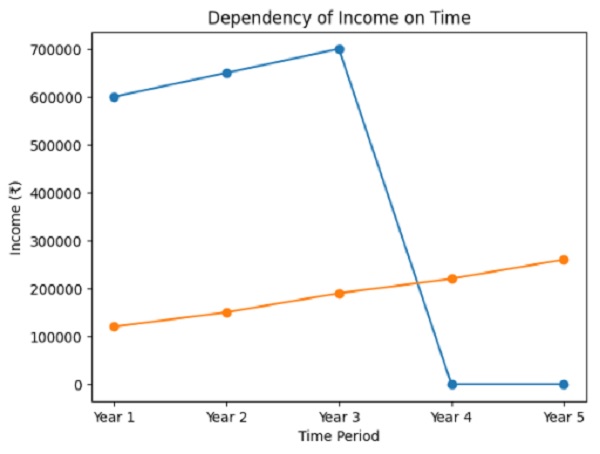
The chart highlights the fundamental difference between active and passive income. The blue line (active income) shows a complete dependency on continuous work and falls to zero once active effort stops. In contrast, the orange line (passive income) continues over time and demonstrates steady growth, emphasizing the long-term sustainability and time-independent nature of passive income streams.
4. Income Composition for Financial Stability
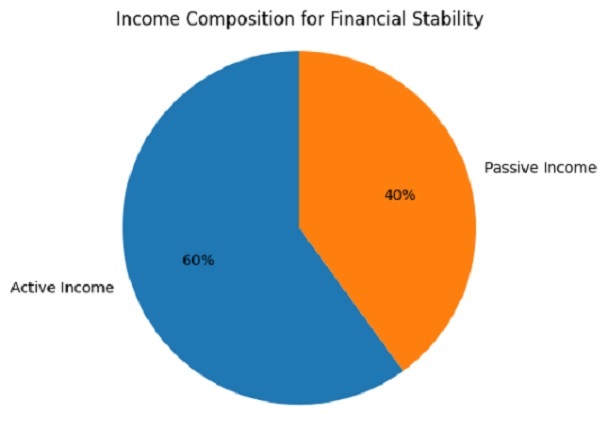
The pie chart shows the composition of income for financial stability. The blue segment (Active Income – 60%) represents earnings dependent on regular employment or effort, while the orange segment (Passive Income – 40%) reflects income generated with minimal ongoing involvement. A higher share of passive income enhances financial security and reduces long-term dependence on active work.
5. Tax Treatment – Active vs Passive Income
Active Income
- Taxed under Income from Salariesor PGBP
- Taxed at slab rates
- Limited deductions
Passive Income
- Rental income → Income from House Property
- Interest & dividend → Income from Other Sources
- Allows deductions, exemptions, and tax planning opportunities
6. Why Is Passive Income Important?
Relying only on active income exposes individuals to risks such as:
- Job loss
- Health issues
- Economic slowdown
Benefits of Passive Income
- Financial security
- Inflation protection
- Early retirement planning
- Multiple income streams
- Wealth creation without time pressure
Passive income turns earnings into assets
7. Growth of Passive Income over Time
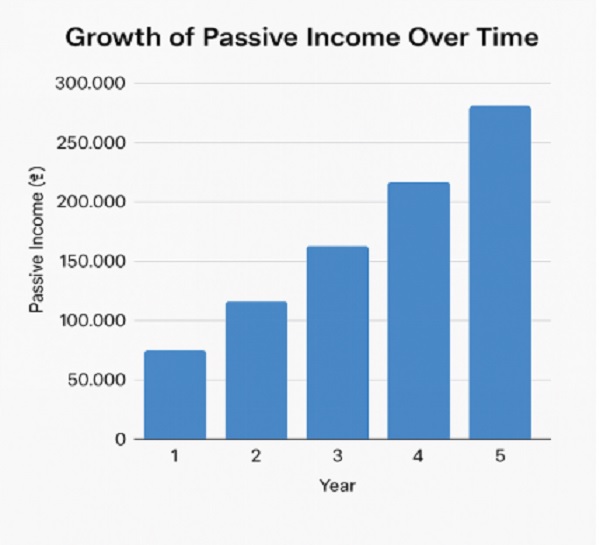
Key Insights
- Year 1:₹50,000 – the starting point.
- Year 2:₹85,000 – a noticeable jump due to reinvestment.
- Year 3:₹1,30,000 – compounding begins to accelerate.
- Year 4:₹1,90,000 – growth momentum strengthens.
- Year 5:₹2,75,000 – the compounding effect becomes very clear.
The chart demonstrates how passive income doesn’t just grow linearly — it compounds. By reinvesting earnings, each year’s income builds on the previous year, resulting in exponential growth over time.
8. Where Can You Invest to Earn Passive Income?
Low-Risk Options
- Fixed deposits
- Government bonds
- Post Office schemes
- Debt mutual funds
Moderate-Risk Options
- Rental real estate
- Dividend-paying shares
- Balanced mutual funds
- REITs and InvITs
High-Risk / High-Return Options
- Equity mutual funds
- Growth stocks
- Business investments with limited involvement
- Royalty-based digital assets
Active income is necessary for meeting day-to-day expenses, but passive income is essential for long-term financial independence. A well-planned combination of both not only ensures steady cash flow but also protects against uncertainties. Building passive income may take time, but its benefits are permanent.