Gold prices in India have risen sharply over the past few years, reflecting a sustained global trend rather than a sudden spike. From below ₹50,000 per 10 grams in 2020, prices crossed ₹75,000 by 2024 and surged to around ₹1.59 lakh in 2026, nearly doubling in just two years. This consistent rise highlights gold’s role as a safe-haven asset during periods of heightened uncertainty. Escalating geopolitical conflicts, weakening confidence in major economies, rising government debt, and expectations of lower interest rates—particularly in the US—have driven investors toward gold as a store of value. Historically, gold tends to outperform during wars, financial crises, and pandemics, and the current environment mirrors those conditions. For Indian households and investors, the surge has made jewellery costlier while reinforcing gold’s appeal as an inflation hedge. Overall, soaring gold prices signal deeper global economic stress and declining faith in traditional financial systems.
Why Gold Prices Are Rising Sharply
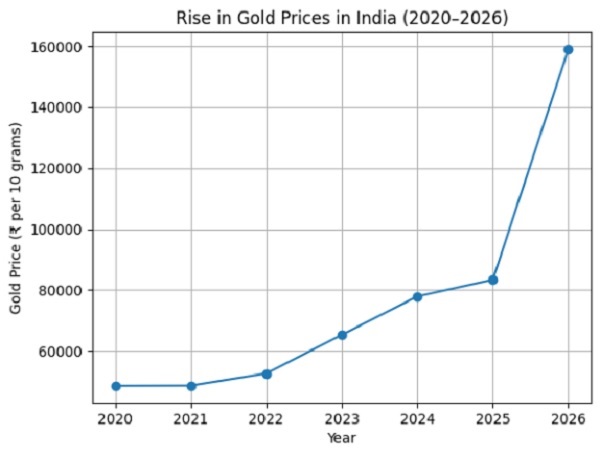
The chart shows the steady rise in gold prices from 2020 to 2024, followed by a sharp jump in 2026. This clearly indicates that the rise is not sudden, but part of a growing global trend driven by fear and uncertainty
Gold has historically been regarded as a stable store of value and a hedge against economic uncertainty. In periods of financial stress, geopolitical instability, or declining confidence in monetary systems, investors tend to shift towards gold to preserve purchasing power. The consistent upward movement in gold prices over recent years reflects rising global risks and weakening trust in conventional financial assets. Therefore, movements in gold prices often serve as an important indicator of broader economic and geopolitical conditions.
Gold Price Data: Year-wise Comparison (India)
(24-carat gold, per 10 grams)
| Year | Price (₹) |
|---|---|
| 2020 | 48,651 |
| 2021 | 48,720 |
| 2022 | 52,670 |
| 2023 | 65,330 |
| 2024 | 77,913 |
| 2025 | 83,400 |
| 2026 (Current) | ~1,59,000 |
What does this table show?
- In 2020, gold was below ₹50,000
- By 2024, it crossed ₹75,000
- In 2026, it is around ₹1.59 lakh, almost double in just two years
This makes it clear that gold has outperformed many traditional investments in recent years.
Why Is Gold Rising So Much?
1. Global Conflicts and Fear
Wars and tensions in the Middle East and other regions make investors nervous. When the world looks unsafe, people prefer gold because it holds value in crises.
2. Weakening Trust in Big Economies
Concerns about political pressure on central banks and rising government debt have reduced trust in paper currencies. Gold is trusted because it cannot be printed or controlled by any government.
3. Slowdown in the US Economy
Signs of economic slowdown and expected interest rate cuts make gold more attractive. When interest rates fall, keeping money in gold becomes more beneficial.
4. Gold as a Traditional Safe Asset
History shows that during:
- wars
- financial crises
- pandemics (like COVID-19)
Gold prices usually rise. The current situation appears similar.
What This Means for Indians
- Gold jewellery has become very expensive
- Investors are using gold to protect money from inflation and uncertainty
- Rising gold prices often indicate stress in the global economy
The sharp rise in gold prices is not just about demand for jewellery or investment.
It reflects global fear, economic uncertainty, and falling confidence in traditional systems.
As long as these concerns remain, gold prices are likely to stay high.