Across jurisdictions, sustainability reporting is no longer a peripheral disclosure topic; it is rapidly becoming embedded in regulatory frameworks, lending policies, contractual requirements, and corporate governance standards. For legal and compliance professionals advising Indian businesses, particularly MSMEs, this shift has direct legal, operational, and financial implications.
Latest trends show that sustainability information is now treated as part of a company’s overall risk profile. Investors and financial institutions rely on structured ESG data to assess creditworthiness, regulatory exposure, and long-term viability. As a result, ESG compliance has evolved from an optional practice into a legal and commercial requirement.
This development is reshaping the legal responsibilities of boards and senior management.
Regulatory Convergence Is Making ESG Compliance Unavoidable
Legal frameworks around the world from the EU’s Corporate Sustainability Reporting Directive (CSRD) to ISSB’s global standards, SEBI’s BRSR in India, and climate-related financial disclosure rules are converging toward mandatory ESG transparency. These regulations have extraterritorial reach, meaning Indian MSMEs that export or supply to regulated markets must meet the sustainability reporting expectations of their buyers.
Recent reports mention this explicitly; companies outside a jurisdiction are increasingly required to comply because they operate within its economic influence. For legal functions, this introduces several compliance triggers:
1. Contractual Obligations: Large buyers are incorporating ESG or sustainability clauses, reporting mandates, and due-diligence requirements into supplier agreements.
2. Liability Exposure: Inaccurate or misleading disclosures can expose companies to greenwashing claims, regulatory penalties, and reputational damage.
3. Board Accountability: Global frameworks emphasise board-level oversight and sign-off of sustainability disclosures, creating governance duties similar to those associated with financial reporting.
4. Value-Chain Due Diligence: Human rights, environmental impacts, and supply-chain risks are becoming part of legal due-diligence protocols, especially under emerging European due-diligence directives.
For MSMEs, the legal obligation may not always arise directly from legislation but it arises functionally through contracts, financing arrangements, and market expectations.
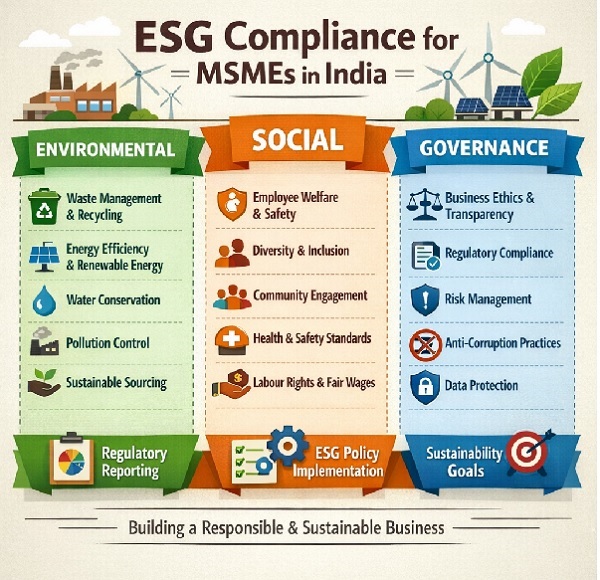
ESG Reporting Is Now Integral to Lending and Financial Due Diligence
India’s financial ecosystem is undergoing a parallel transformation. Banks, NBFCs, and impact lenders are developing risk-based lending models that integrate ESG indicators into credit assessment. For legal teams supporting MSMEs, this shift has critical implications:
- Loan documentation now includes ESG / sustainability covenants and disclosure requirements.
- Lenders request ESG data to determine credit exposure and relevant risks.
- Companies with incomplete ESG data may face higher interest rates or reduced access to credit.
- Sustainability-linked loans and green finance options require verifiable ESG performance indicators.
There are evidences to show that financial institutions are becoming subject to their own sustainability reporting rules, which they transmit to borrowers through due-diligence prerequisites and information requirements. This means ESG reporting is effectively becoming a regulatory compliance function within the financing process.
Legal Functions Must Guide ESG Materiality Assessments
A key element emerging across global ESG frameworks is the concept of materiality, specifically double materiality (analysing both financial risks to the company and impacts caused by the company). This assessment is not merely operational; it is a legally significant exercise because it shapes the company’s disclosure responsibilities.
Legal teams must help:
- Define reporting boundaries
- Assess regulatory applicability in multiple jurisdictions
- Identify potential legal liabilities arising from sustainability impacts
- Ensure disclosures meet accuracy, completeness, and audit-readiness standards
There is a rising need for clear methodologies and defensible rationales when determining what a company reports. A poorly executed materiality assessment can expose an organisation to compliance failures, contractual disputes, and in some regions statutory penalties.
Strengthening Internal Controls and Governance
As sustainability reporting aligns more closely with financial reporting, legal functions must support the creation of internal control systems comparable to those used for statutory financial disclosures.
This includes:
- Documentation of data sources
- Verification and audit trails
- Establishing cross-departmental reporting responsibilities
- Ensuring alignment of sustainability and financial reporting boundaries
- Preparing the organisation for external assurance requirements
The LSE guide notes an increasing regulatory focus on accuracy, auditability, and verification, which will place direct demands on legal and compliance frameworks.
In this environment, sustainability reporting becomes part of the corporate governance architecture not an isolated corporate responsibility project.
Contracting, Procurement, and Supply-Chain Governance Will Transform
One of the fastest-moving areas in ESG compliance is supply-chain due diligence. European and international regulations compel companies to demonstrate that their supply chains are free from significant human rights, labour, and environmental risks.
This shift affects MSMEs in two ways:
1. They are required to provide ESG data to their buyers.
2. They must also implement their own due-diligence measures for their suppliers.
Legal teams will increasingly need to revise:
- Supplier agreements
- Vendor onboarding protocols
- Codes of conduct
- Audit rights
- Termination clauses
- Grievance mechanisms
As supply-chain transparency becomes a legal requirement rather than a voluntary standard, MSMEs without documented ESG systems risk may get excluded from procurement lists.
For MSMEs, ESG Compliance Is Now a Competitive and Bankable Asset
For the leadership of MSMEs often operating with limited margins, limited staff capacity, and limited compliance budgets sustainability reporting might appear burdensome.
However, its legal and financial benefits are becoming evident:
- It reduces exposure to compliance risk.
- It increases eligibility for credit, grants, and blended finance.
- It enhances commercial standing with global buyers.
- It improves negotiating power with financiers.
- It strengthens corporate governance frameworks.
- It provides defensible transparency for stakeholders.
In a legal landscape where regulators, investors, and buyers prioritise companies with clear ESG governance, MSMEs with documented sustainability practices will consistently outperform those without them.
Conclusion: ESG Reporting Is Part of Modern Legal and Financial Compliance
For CEOs, COOs, General Counsels, and Chief Compliance Officers, ESG reporting must be approached not as a voluntary communication exercise, but as an emerging legal obligation and a critical determinant of financial access.
The legal profession’s role is clear: to help organisations interpret evolving regulations, establish robust reporting systems, minimise liability, protect governance integrity, and support the company’s bankability in an increasingly ESG-driven economy. Sustainability reporting is now intertwined with compliance, risk management, and corporate strategy. For MSMEs that embrace it early, it offers a decisive competitive edge in both regulated and financial markets.