Income Tax : The FAQs explain the revised CBDT guidelines on compounding offences under the Income-tax Act effective from 17 October 2024. They...
Income Tax : The article explains who can file appeals before the Income Tax Appellate Tribunal, the orders that are appealable, applicable tim...
Income Tax : The Tribunal held that additions cannot stand without a clear link between seized material and the assessee. It ruled that third-p...
Income Tax : Judicial rulings clarify that satisfaction for initiating action against other persons in search cases must be recorded promptly. ...
Income Tax : CBDT's new Compounding of Offence Guidelines (2024) simplify the process but maintain strict compliance rules. Learn about eligibi...
Income Tax : Learn about the new block assessment provisions for cases involving searches under section 132 and requisitions under section 132A...
Income Tax : Gujarat High Court held that rejection of a Vivad se Vishwas declaration was invalid because final assessment arose from survey pr...
Income Tax : The Tribunal held that an addition under Section 69 could not be sustained solely on the basis of a seized loose sheet without ind...
Income Tax : The ITAT held that assessments under Section 153A were invalid because no search warrant was issued in the assessee’s name. As t...
Income Tax : The ITAT Hyderabad held that the assessment orders were time-barred under Section 153 despite the DRP process. Both assessments we...
Income Tax : The ITAT held that limitation under Section 153B had to be computed from the searched person's last panchanama, making the assessm...
Income Tax : Central Government has decided to extend the time limits to 30th June, 2021 in the following cases where the time limit was earlie...
Income Tax : Availability of Miscellaneous Functionalities related to ‘Selection of Case of Search Year’ and ‘Relevant Search...
ITAT Mumbai held that addition towards unexplained and undisclosed income sustained as assessee itself claim payment of cash in the civil suit and failed to explain the source of the cash payment.
In present facts of the case, the Tribunal held that Assessment Order issued without DIN is null and void as it is in violation of CBDT Circular No. 19/2019 dated 1 4th August, 2019.
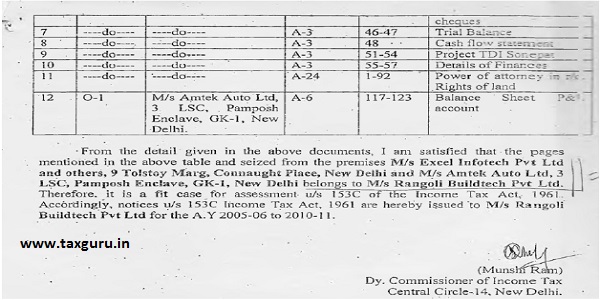
ITAT Delhi held that initiation of proceedings u/s 153C of the Income Tax Act based on seized dumb documents found in the premises of third party is unsustainable in law as the seized documents are merely loose sheets not forming part of the books of account of the assessee and that they do not constitute admissible evidence.
Analysis of the ITAT Lucknow case Mahendra Lalka Vs DCIT on Sec 69 of the Income Tax Act. Key findings, implications, and legal insights included.
ITAT Jaipur held that in absence of a valid satisfaction note the notice issued under Section 153C of the Income Tax Act 1961 is bad in law. Resultantly the assessment order passed u/s 143(3) r.w.s. 153C of the Act is void ab initio and liable to be quashed.
ITAT Delhi held that addition based on incriminating material found during the search carried out of ‘some other person’ i.e. third person/ party and assessing the same by invoking provision of section 147 instead of section 153C is unsustainable.
ITAT Chennai held that in the present case AO himself referred the matter for special audit u/s 142(2A), however, report of special auditor was later rejected without assigning any reasons for the same is in explicable.
ITAT Delhi held that issuance of notice u/s 153C of the Income Tax beyond six Assessment Year immediately preceding the Assessment year from the date of recording of satisfaction note/ handling over of relevant material is not in accordance with law.
Discover the major changes in ITR forms for FY 2023-24 (AY 2024-2025). Highlights include new sections for retirement benefit accounts, disclosure of arrears, updates on Trading Account sections, and provisions for reporting Virtual Digital Asset (VDA) profits. Stay prepared for filing your ITR with insights into changes specific to ITR-1, ITR-2, ITR-3, ITR-4, ITR-5, ITR-6, and ITR-7.
ITAT Delhi held that presumption u/s. 132(4A) of the Income Tax Act is only against the person in whose possession the search material is found and not against any other person. Addition based on dumb documents without corroborative evidence is unsustainable in law.