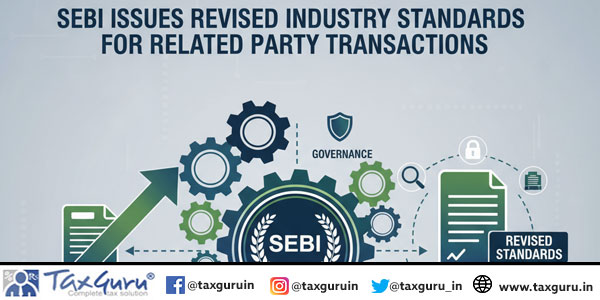
The Securities and Exchange Board of India (SEBI) has taken another decisive step in strengthening corporate governance by revising the Industry Standards for Related Party Transactions (RPTs). These new standards, effective from 1 September 2025, aim to simplify compliance, enhance transparency, and ensure that listed companies disclose material information in a structured and uniform manner.
BACKGROUND
Under the SEBI (Listing Obligations and Disclosure Requirements) Regulations, 2015 (LODR), RPTs must be approved by the Audit Committee and, where material, by the Shareholders. While SEBI’s Master Circular of November 2024 laid down broad disclosure requirements, it lacked a prescribed format. To address feedback from stakeholders, SEBI through the Industry Standards Forum has now introduced a detailed framework of minimum information requirements for Audit Committees and Shareholders.
APPLICABILITY
The Revised RPT Standards are applicable to:
1. All RPTs placed for review and approval by the Audit Committee under Regulations 23(2) and 23(3) of the LODR Regulations.
2. Material RPTs as defined under Regulations 23(1) and 23(1A) of the LODR Regulations, which require approval from both the Audit Committee and shareholders.
As per Regulation 23(1) and 23(1A), an RPT would be considered to be material –
- based on the materiality policy formulated by the listed entity, including clear threshold limits which are duly approved by the Board of Directors.
- individually or taken together with previous transactions during a financial year, that exceed the lower of INR1,000 crore or 10 per cent of annual consolidated turnover of the listed entity; or
- individually or taken together with previous transactions during a financial year exceed 5 per cent of annual consolidated turnover for brand usage/royalty payments.
Non-applicability of the Revised RPT Standards would not apply to:
1. Exempted transactions under Regulation 23(5) of SEBI(LODR)*
2. Quarterly reviews of RPTs by the Audit Committee for the transactions entered into by the listed entity or its subsidiary with regard to each omnibus approval given (as required by Regulation 23(3)(d)).
3. Transactions with a related party (individually or cumulatively during a financial year) that do not exceed INR1 crore, including those approved via ratification.
The following summarises the transition requirements for RPTs at various stages of approval before effective date i.e. 1 September 2025:
1. If the Audit Committee and/or shareholders have granted approval before effective date, for RPTs to be executed on or after effective date, then it will not be necessary for the listed entity to seek approval during the validity of the approval unless there is any material modification to such RPTs which is presented to Audit Committee after effective date.
2. If omnibus approval has been granted before effective date for RPTs for the financial year 2025-26, then the listed entity is not required to seek fresh approval with disclosures as per the RPT Industry Standards. However, any material modification to such RPTs on or after effective date, shall be subject to the RPT Industry Standards.
3. If a Material RPT is approved by Audit Committee before effective date, the RPT Industry Standards shall not apply, irrespective of whether the notice to shareholders is sent either before or on or after the effective date.
4. If date of execution of RPT is on or after effective date, Revised RPT Standards are applicable.
The Revised RPT Standards provide guidelines for listed entities to obtain necessary approvals from the Audit Committee and Shareholders.
Steps for compliance:
1. Identify related parties and RPTs: Identify RPTs as per LODR Regulations. Additionally, determined the RPTs that are exempt as per the Revised RPTs Standards.
2. Determine material RPTs: After step 1, determine material RPTs as per Regulations 23(1) and 23(1A) of the LODR Regulations.
3. Framework for ‘minimum information’: The Revised RPT Standards have structured the information to be provided to Audit Committees in three parts: Part A, Part B and Part C. These parts are explained below:
| PART A
Minimum information of the proposed RPT, applicable to all RPTs Note |
PART B
Information to be provided only if a specific type of RPT as mentioned below is proposed to be undertaken and is in addition to Part A, |
PART C
Information to be provided only if a specific type of RPT mentioned below proposed to be undertaken is a MATERIAL RPT and is in addition to Part A and B |
|---|---|---|
| This part requires disclosure in sub-para(s) (A1 to A5) under the following headings in case of all Related Party Transaction(s): | Information to be provided only if a specific type of RPT as mentioned below is proposed to be undertaken and is in addition to Part A: | This part requires disclosure under sub-para C1 to C6, as may be applicable, in addition to disclosures in Part A and Part B, only in case of MATERIAL RPTS relating to: |
| A(1): Basic details of the related party | B(1): Sale, purchase or supply of goods or services or any other similar business transaction and trade advances | C(1): Transactions relating to any loans and advances (other than trade advance) or inter-corporate deposits given by the listed entity or its subsidiary. |
| A(2): Relationship and ownership of the related party | B(2): Loans and advances (other than trade advances) or inter-corporate deposits given by the listed entity or its subsidiary | C(2): Investment made by the listed entity or its subsidiary. |
| A(3): Details of previous transactions with the related party | B(3): Investment made by the listed entity or its subsidiary | C(3): Guarantee (including performance guarantee in nature of security/contractual commitment or which could have an impact in monetary terms on the issuer of such guarantee), surety, indemnity or comfort letter, by whatever name called, made or given by the listed entity or its subsidiary. |
| A(4): Amount of the proposed transaction(s) | B(4): Guarantee (including performance guarantee in nature of security/contractual commitment or which could have an impact in monetary terms on the issuer of such guarantee) ), surety, indemnity or comfort letter, by whatever name called, made or given by the listed entity or its subsidiary. | C(4): Borrowings by the listed entity or its subsidiary. |
| A(5): Basic details of the proposed transaction | B(5): Borrowings by the listed entity or its subsidiary | C(5): Sale, lease or disposal of assets of subsidiary or of unit, division or undertaking of the listed entity or disposal of shares of subsidiary or associate. |
| B(6): Sale, lease or disposal of assets of subsidiary or of unit, division or undertaking of the listed entity or disposal of shares of subsidiary or associate | C(6): Transactions relating to payment of royalty | |
| B(7): Transactions relating to payment of royalty |
Guidelines for placing information to the Audit Committee:
1. The management of the listed entity, while providing the information to the Audit Committee, shall:
√ Provide information in the format specified in the RPT Industry Standards. Where a field is not applicable, it shall be indicated as ‘NA’, and the reason for non-applicability shall be disclosed to the Audit Committee, unless it is self-evident.
√ Provide Certificate from the Chief Executive Officer (CEO)/Managing Director/Whole Time Director/ Manager and Chief Financial Officer (CFO) of the Listed Entity confirming that the terms of RPTs proposed to be entered into are in the interest of the Listed Entity.
√ Provide a copy of the valuation or other report of external party, if any.
√ If the audited financial statements of the related party are not available for immediately preceding financial year, it shall provide the financial extracts as relevant to/for the minimum information to be provided under the RPT Industry Standards, duly certified by the related party, as drawn from its books of accounts.
√ When the related party follows a different financial year, such fact shall be disclosed.
√ In case of multiple types of proposed transactions, details to be provided separately for each type of the proposed transaction – for example, (i) the sale of goods and the purchase of goods would need to be treated as separate transactions; (ii) the sale of goods and the sale of services would need to be treated as separate transactions; (iii) the giving of loans and the giving of guarantee would need to be treated as separate transactions.
2. The Audit Committee may, at its discretion, comment on information provided by the management. Such comments and the rationale for not approving a RPT shall be recorded in the minutes of the meeting of the Audit Committee.
3. The Audit Committee may seek any additional information from the management, as it deems necessary and reasonable, to evaluate the proposed RPT.
Minimum Information to be provided to the shareholders for approval of Material RPTs:
(1) The explanatory statement contained in the notice to the shareholders for seeking their approval for an RPT shall provide the minimum information so as to enable the shareholders to take a view whether the terms and conditions of the RPT are favorable to the listed entity.
(2) The notice to the shareholders seeking approval for any material RPT shall, in addition to the requirements under the Companies Act, 2013, include the following information as a part of the explanatory statement:
√ Information as placed before the Audit Committee in the format as specified in the RPT Industry Standards, to the extent applicable.
√ Justification as to why the proposed transaction is in the interest of the listed entity, basis for determination of price and other material terms and conditions of RPT.
√ Disclose the fact that the Audit Committee has reviewed the certificates provided by the CEO/ Managing Director/ Whole Time Director/ Manager and CFO of the Listed Entity as required under the RPT Industry Standards.
√ Disclosure that the material RPT or any material modification thereto, has been approved by the Audit Committee and the Board of Directors recommends the proposed transaction to the shareholders for approval.
√ Provide web-link and QR Code, through which shareholders can access the valuation report or other reports of external party, if any, considered by Audit Committee while approving the RPT.
√ The Audit Committee and Board of Directors, while providing information to the shareholders, can approve redaction of commercial secrets and such other information that would affect competitive position of listed entity and affirm that, in its assessment, the redacted disclosures still provide all the necessary information to the public shareholders for informed decision making.
√ Any other information that may be relevant
Implications for Listed Companies
The revised standards are expected to:
- Enhance transparency by standardizing disclosures.
- Strengthen oversight by ensuring Audit Committees and shareholders receive comprehensive information.
- Improve investor confidence through structured disclosures and CEO/CFO certifications.
- Reduce ambiguity by clarifying transitional requirements.
Conclusion
SEBI’s revised RPT standards mark a significant evolution in India’s corporate governance framework. By prescribing uniform disclosure formats and strengthening the approval process, SEBI has sought to balance compliance requirements with transparency expectations. Listed companies must gear up to realign their internal processes and ensure readiness by 1st September 2025, when the new framework comes into effect.
Notes:
1 The following transactions are not subject to shareholders’ approval under the specified sub-regulations:
- Public sector transactions: Transactions entered into between a public sector company on one hand and the Central Government or any State Government or any combination thereof on the other hand.
- Holding-subsidiary transactions: Transactions between a holding company and its wholly owned subsidiary, provided their accounts are consolidated and presented to shareholders for approval.
- Subsidiary-subsidiary transactions: Transactions between two wholly owned subsidiaries of a listed holding company, with consolidated accounts placed before shareholders for approval.
- Statutory payments: Payments of statutory dues, fees, or charges made to or received from the Central or State Government.