Perfect Thread Mills Ltd Vs. DCIT (ITAT Mumbai)
No deduction allowable when creditor gets overriding title and payments are directly paid to creditors without routing through owner’s accounts
Conclusion: Since there was no diversion of sale proceeds by overriding title, but on the contrary, there was only a mere application of the sale proceeds realised on sale of plots towards the discharge of outstanding loan liability of assessee thus, the consideration from sale of property to the extent of principal component of loan adjusted by the bank could not be treated as ‘diversion of income by overriding title’ and was thus not deductible from the total consideration accrued to assessee from sale of property.
Held: Assessee took a corporate term loan of Rs. 306 lakhs from Kotak Bank (KMBL). Assessee complied with the repayment schedule and repaid the loan till July 2009 however, he became a defaulter from August 2009 onwards. Bank classified the company’s account as NPA and a notice was served as per the provisions of section 13(2) of Securitization and Reconstruction of Financial Assets of Security Interest Act (SARFAESI) on assessee company and its personal guarantors. Bank took over possession of the factory land of assessee and received directly the consideration amounting to Rs. 2,18,00,262/-. The bank adjusted the said realisation ie a sum of Rs. 1,48,24,633/- was adjusted against the principal segment of the loan and Rs. 69,75,629/- was adjusted against the interest segment of this loan. Assessee claimed this interest liability as an allowable expenditure in the accounts of the assessee. Also claimed the net amount of Rs. 1,48,24,633/- as deductible u/s 48 along with the indexed cost of acquisition and improvements. AO contended that when the sale proceeds of mortgaged property were paid to the creditor of assessee, the same were not deductible in computing the capital gains on the said property. AO held that mere making payment by the buyer directly to the creditors without routing through the bank accounts of the land owner, did not grant any right for making claim of deduction. It was held the amount recovered by KMBL could by no stretch of imagination be treated as ‘diversion of income by overriding title’. The principle of ‘diversion of income by overriding title’ applies when the transaction is beyond the control of the assessee due to which assessee has to make commitment to either divert it’s income or part with income earned by it in a particular manner. The principle of ‘diversion of income by overriding title’ has been laid down by the courts to overcome the situation wherein an assessee does not have a free hand on the amount earned by it or is in fact not received by an assessee due to circumstances beyond it’s control. Such principle would not be attracted in cases wherein assessee by his own past action creates a future obligation for himself to utilize the amount in a particular manner. Thus, the claim of the assessee could not be accepted in the facts of the present case. Section 13 of the SARFAESI Act cannot come to the rescue of the assessee. At the time of entering into mortgage agreement assessee was well aware of the consequences of non-payment of loan amount which, inter-alia, included procedure of recovery of amount and sale of mortgage asset by the secured creditor. It was not something new or some unforeseen event which assessee was not aware of. The legal position prevailing prior to SARFAESI Act was also germane even after the enactment of SARFAESI Act. In the present case there was no diversion of sale proceeds by overriding title, but on the contrary, there was only a mere application of the sale proceeds realised on sale of plots towards the discharge of outstanding loan liability of assessee. Thus, the consideration from sale of property to the extent of principal component of loan adjusted by the bank could not be treated as ‘diversion of income by overriding title’ and was thus not deductible from the total consideration accrued to assessee from sale of property.
FULL TEXT OF THE ITAT JUDGEMENT
This appeal was initially heard on 29-07-2015. The Hon’ble Members, who constituted the bench, have passed the following dissenting orders:-
PER P. KARUNAKARA RAO, AM:
This appeal filed by the assessee on 1.7.2013 is against the order of the CIT(A)- 17, Mumbai dated 29.4.2013 for the assessment year 2010-2011. In this appeal, assessee raised the following grounds which read as under:
“1. On the facts and in the circumstances of the case, the Ld CIT (A) has erred in upholding the order passed by the Ld DCJT, which is bad in law and against justice and liable to be quashed.
2.(a) On the facts and in the circumstances of the case and in law, the Ld CIT (A) has erred in upholding the order passed by the Ld ACIT, who has erred in disallowing the deduction of Rs. I,48,24,633/- being claimed as expenses while determined the capital gain.
(b) The Ld CIT (A) has failed to appreciate the fact that the sale of land area was effected by Kotak Mahindra Bank Ltd (KMBL) and out of the sales consideration received by them they had deducted the said amount towards principal amount of loans as the bank had existing overriding title on the company’s assets.
(c) The Ld CIT (A) has failed to appreciate the judicial pronouncement of Hon’be Calcutta High Court in the case of Gopee Nath Paul & Sons vs. Deputy CIT [2005] 278 ITR 240 where it was held that on the sale of firm’s business as a going concern the amount paid to banks to have the charge lifted was treated the expenses in relation to transfer. “
2. Briefly stated relevant facts of the case are that the assessee is a manufacturer of cotton / polyster sewing and industrial threads and also engaged in processing of cotton yarn. Assessee is in this business for a long time and filed the return of income for the year under consideration declaring the total loss of Rs. 64,93,9277-. After completing the scrutiny assessment u/s 143(3) of the Act, the total income is determined at Rs. 49,25,990/-. In the assessment, AO made adjustment to the claim relating to capital gains and made addition of Rs. 2,14,50,679/-. This is the point of contention before the Revenue Authorities as well as in Tribunal. The facts relating to this issue are given in the following paragraph.
3. Assessee took a corporate term loan of Rs. 306 lakhs from M/s. Kotak Mahindra Bank Ltd (KMBL) during the Financial Year 2008-2009 relevant to the assessment year 2009-2010. The loan was repayable in 36 monthly installments and the assessee complied with the repayment schedule and repaid the loan till July 2009. However, assessee became a defaulter from August 2009 onwards.
The bank (KMBL) classified the company’s account as NPA (Non-performing Asset) on 21.11.2009. In this regard, a notice was served on 30.11.2009 as per the provisions of section 13(2) of Securitization and Reconstruction of Financial Assets of Security Interest Act (SARFAESI) on the assessee company and its personal guarantors viz Mr. H.S. Bapna and Mrs. Urmila Bapna. The total outstanding liabilities at that point of time is 3,40,61,488/-. On 7.1.2010, the bank took over possession of the factory land of the assessee admeasuring 6,883.517 sq mts. Land was sub-divided into 7 plots and 6 of these sub-plots were sold by the bank in March, 2010. The bank received directly the consideration amounting to Rs. 2,18,00,262/-. The bank adjusted the said realization against the loan of the assessee ie a sum of Rs. 1,48,24,633/- was adjusted against the principal segment of the loan. Rs. 69,75,629/- was adjusted against the interest segment of this loan. Assessee claimed this interest liability as an allowable expenditure in the accounts of the assessee. Accordingly, the net amount of Rs. 1,48,24,633/-, which was appropriated towards principal segment of the loan was shown in the computation of capital gains arising of those 6 plots of land. However, the said amount was claimed as deductible u/s 48 of the Act along with the indexed cost of acquisition and improvements (Rs. 3,43,583;- and other incidental expenses of Rs. 6000 relating to sales). The manner of computation given by the assessee in the return of income is extracted as under:
Long Term Capital Gains:
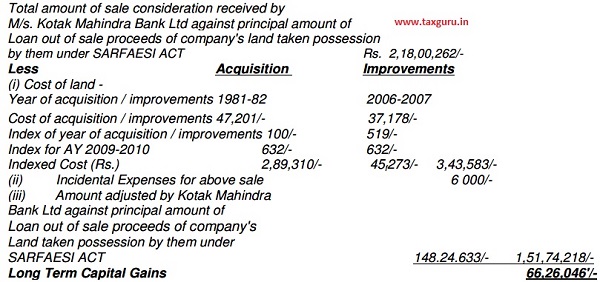
4. In the assessment, AO issued a show cause notice proposing to tax the said claim of deduction amounting to Rs. 1,48,24,633/- as capital gains. In the reply, dated 21.11.2012 and 23.11.2012, assessee submitted the KMBL has overriding title on the mortgaged asset (the said factory land), the bank invoked the SARFAESI Act and took possession of the said land. Eventually, the bank sold the said land and transferred the same to the buyers with any participation of the assessee and received sale proceeds directly to the account of the bank. Assessee has no role to play in all these events. In principle, the bank has become the owner of the land. Therefore, it is the case of the “diversion of income at source by overriding the title”. Since, the assessee has lost the title as well as has never received the sale proceeds to his account, the sale proceeds are not taxable in the hands of the assessee. It is a case of diversion of income at source. Therefore, in the aforementioned computation, assessee reflected the same as an allowable deduction. Regarding Rs. 69,75,629/-, it is the case of the assessee that since the assessee claimed interest payable to the bank as deduction in past, to that extent the same is offered now as taxable portion. However, the Assessing Officer analyzed the provisions of section 48 of the Act and held that the claim is not sustainable in law as the gains arose on the sale of the factory land of the assessee. AO also mentioned that the assessee received the sale consideration on sale of the said 6 plots of land. He also mentioned that what is allowable u/s 48(i) of the Act is only expenditure incurred wholly and exclusively in connection with such transfer, and not the expenditure of this type. Without much discussion in para 7.8 of the assessment order, AO rejected the assessee’s contention that it is a case of “diversion of income at source by overriding the title”. Contents of para 7.10 of the assessment order are extracted as under:
“7,10. Accordingly, the bank has recovered its dues, and the liability of the assessee was reduced by an amount of sale consideration received by the bank on behalf of the company. Therefore, the assessee has actually repaid its loan to the bank by selling the land and, therefore, cannot be considered as allowable expenditure within the meaning of section 48(1) of the Act.”
4.1. Accordingly, the amount of Rs. 1,48,24,633/- was added back to the total income of the assessee. Aggrieved with the said addition made by the AO, assessee carried the matter in appeal before the first appellate authority.
5. During the proceedings before the first appellate authority, assessee agitated against the said addition and made a written submission vide letter dated 26.4.2013, the contents of which are extracted in para 5.2 of the CIT (A)’s order. In the said submissions, assessee narrated the facts of the case and submitted that the assessee created charge on the asset in favour of the bank in connection with the loan of Rs. 306 lakhs. The bank invoked the SARFAESI Act and took possession of the land. Considering the powers conferred to the bank by the said SARFAESI Act vide the provisions of section 13(4), the bank sold the property and realised the proceeds directly without any involvement of the assessee. Assessee relied on the judgment of the Calcutta High Court in the case of Gopee Nath Paul & Sons vs. Deputy CIT [2005] 278 ITR 240, which is relevant for the proposition that “the expenditure incurred for perfection of title necessary for effecting sale / transfer is an allowable expenditure”. This is the case, where the liabilities of the bank were cleared by the sale proceeds of the assets. It was considered as an expenditure incurred wholly and exclusively in connection with the transfer. Assessee also relied on the view of the Andhra Pradesh High Court in such cases. Further, assessee relied on the judgment of the Apex Court in the case of R.M. Arunchalam Etc vs. CIT [1997] 227 ITR 222 (SC) to support its case. Thus, the assessee submitted that AO failed to the fact that there was a pre-existing overriding title in favour of the bank by virtue of joint equitable mortgage created on 5.2.2009 on immovable properties of the assessee. On considering the above written submissions of the assessee, CIT (A) did not go with the said submission. The arguments relating to “diversion of income by overriding title” was also not entertained. Relying on the judgment of the Hon’ble Supreme Court in the case of CIT vs. Attili N Rao [2001] 252 ITR 880 (SC), as well as the judgment of the Allahabad High Court in the case of CIT vs. Sharad Sharma (2008) 305 ITR 24 (All), CIT (A) opined that it a case of application of income and not diversion of income by overriding charges. Eventually, CIT (A) is of the opinion that the assessee is not entitled to deduction. CIT (A) also rejected the assessee’s argument that it is a case of explaining in connection with the transfer of the asset / perfection of the title before the sale of transaction. He also discussed in para 5.5, the applicability of the provisions of section 45(5)(b) and 45(5)(c) of the Act. CIT (A) also rejected adopting the cost of acquisition of the asset as on 1.4.1981 in view of the fact that the assessee became the owner of the land only after the date. Further, on the application of the provisions of section 47(xii) of the Act, the CIT (A) is of the opinion that the assessee-company is not managed by the worker’s cooperative. Therefore, the same is outside the scope of the said provisions. Accordingly, CIT (A) dismissed the appeal of the assessee. Aggrieved with the said decision of the CIT (A), assessee is in appeal before the Tribunal.
6. During the proceedings before us, Ld Counsel for the assessee filed written submissions and the same are extracted as follows:
“3.9.The principles of diversion of income by overriding title were explained by the Hon’ble Supreme Court in the case of Sitaldas Tirathdas (41 ITR 367) by referring to the judgment of Hon ‘ble Privy Council in the case of Raja Bejoy Singh Dudhuria vs. CIT (1 ITR 135) and P.C. Mullick (6 ITR 206) with the following observations.
“In our opinion, the true test is whether the amount sought to be deducted, in truth, never reached the assessee as his income. Obligations, no doubt, there are in every case, but it is the nature of the obligation which is the decisive fact. There is a difference between an amount which a person obliged to apply out of his income and an amount which by the nature of the obligation cannot be said to be a part of the income of the assessee. Where by the obligation income is diverted before it reaches the assessee, it is deductible; but where the income is required to be applied to discharge an obligation after such income reaches the assesse, the same consequence, in law, does not follow. It is the first kind of payment which can truly be excused and not the second. The second payment is merely an obligation to pay another a portion of one’s own income, which has been received and is since applied. The first is a case in which the income never reaches the assessee, who even if he were to collect it, does so, not as part of his income, but for and on behalf of the person to whom it is payable “.
3.10 The honourable Calcutta High Court held in the case of Gopinath Paul and Sons vs. D.C.I.T. (278ITR 24O)
5. Section 48(1), as it stood in 1992-93, while providing for computation of capital gains permitted in clause (i) deduction of the “expenditure incurred wholly and exclusively in connection with such transfer”. The expression ‘in connection with such transfer’ is wider than the expression ‘[or the transfer’. Any amount the payment of which is absolutely necessary to effect the transfer will be an expenditure covered by clause (i) of section 48(1). In other words, if without removing any encumbrance, sale or transfer could not be effected, the amount paid for removing that encumbrance will fall under clause (i).
5.1 From the facts as disclosed above, it appears that the amount was received out of the sale of assets of both the firms under orders of this Court subject to meeting of the liability of the Allahabad Bank since confirmed only upon prior payment. Inasmuch as, unless this liability was met, the transferee could not derive any title. In other words, the sale consideration receivable by the assessee was less the liability of the Allahabad Bank. Thus, meeting this liability of one of the firms, when the entire assets were being sold, was an absolute necessity to effect the transfer. In other words, it was an encumbrance without removing which the sale or transfer could not be effected and the amount spent for removing this encumbrance would definitely attract clause (i) of section 48(1).
5.2 From the Assessment Order (page 37 of the paper book), it appears that earlier the assessee used to conduct its business under the name and style of Gobindo Sheet Metal Works & Foundry. CIT (Appeals) at pages 43-44 of the paper book have found that the short-term capital gain arising out of the sale of the assets pertaining to the erstwhile business of the appellant in the name and style of Gobindo Sheet Metal Works & Foundry and on the sale of the factory and assets of the erstwhile business through public auction, the total consideration received was Rs.3,66,24,005. From the details of the expenses and liabilities claimed, it was seen that an amount of Rs,27,85,523 had been shown as payable to the Allahabad Bank. However, the CIT (Appeals) found that there was no pre-condition that the appellant could not sell its assets without settling the dues of the Allahabad Bank and even if it was, it would be a case of application of the income.
5.3 As discussed above, in this case the sale could not be effected without meeting the liability, as it appears from the different orders passed by this Court in the latter suit wherefrom it is apparent that the former suit was transferred to this Court and was ultimately settled between the parties through Lok Ada/at.
5.4 But from the facts as discussed above, we are of the view that the orders passed by this Court directing the sale of the assets of the two firms and its confirmation thereof are staring on the face of the inference drawn by the CIT (Appeals). Thus, we are of the view that the liability met by the assessee towards the dues of the Allahabad Bank was an expenditure incurred wholly and exclusively in connection with the transfer.
3.11 From the facts relating to the assessee’s case explained in Para No. 3.1 to 3.5, it is quite manifest that once Kotak Mahindra Bank Ltd. invoked powers u/s.l3(4) of the Securitisation and Reconstruction of Financial Assets and Enforcement of Security Interest Act, 2002 (SARFAESI), the title over Plot No.P/1, P/2f P/3A, P/3B and P/4 was automatically divested from the assessee company and vested in Kotak Mahindra Bank Ltd. on 07.01.2010. Further, when the plots were sold by the bank in March, 2010, the sale deeds were executed between the buyer and the bank and the entire consideration received from buyer was appropriated towards the outstanding liability of the bank. The assessee was not at all involved in either the sale of plots or the execution of sale deeds. Therefore, the sale proceeds to the extent of amount appropriated towards loan never reached the assessee as its income and was diverted towards discharge of bank’s obligation.
3.12 As regards reliance placed by the Cl. T.{A). while rejecting the assessee’s claim upon the judgements of the honourable Supreme Court in the case of Cl. T. vs. Attili N. Rao (252 ITR 880) and the honourable Allahabad High Court in the case of CL T. vs. Sharad Sharma (305 ITR 24), it is submitted that these judgements are not applicable to the facts of the assessee’s case.
3.13 In the case of CI.T. vs. Attili N. Rao, the assessee was carrying on abkari business. He mortgaged his immovable property to the Excise Department of Andhra Pradesh to secure payment of kist He could not pay the kist Therefore, the excise department sold the immovable property by way of public auction, deducted its dues towards kist and interest and paid the balance amount to the assessee. There was no court order for auction of the property and appropriation of proceeds towards kist and interest. It was simply a case of recovery of mortgage assets by its auction to recover government dues under the provisions of Andhra Pradesh State Excise Act. There was no divesting of title from the assessee and vesting thereof with the State Excise Department. On these facts, the honourable Supreme Court held that the capital gain was to be computed on the full price realized as reduced by the admitted deduction. The payment made to the Central Excise Department towards kist and interest was not a deductible expenditure.
3.14 In the case of CI. T. vs. Sharad Sharma, M/s. Shanker Traders took loan from bank against mortgage of house property belonging to the partner, Shri Sharad Sharma. The bank enforced the recovery of loan against M/s. Shanker Traders. Under agreement with the bank, the house was auctioned by the assessee and after payment of bank loan of Rs.1,50,000/-, the remaining amount was received by the assessee. It was simply a case of sale of mortgage property and recovery of outstanding loan of the bank. There was no divesting of ownership of house from assessee and vesting thereof with the bank. On these facts, the honourable High Court held that it was not a case of diversion of income by overriding title but application of income towards repayment of bank loan. In 3 case of inheritance/acquisition along with the mortgage perfecting his title by getting mortgage discharged, the assessee would be entitled to get the deduction of the mortgage debt but where the charge is created by the assessee himself, it cannot be said that the amount of mortgage debt out of the sale proceeds be deductible while calculating the capital gains.
3.15 The ratio of the aforesaid judgements is not applicable because in the assessee’s case, Kotak Mahindra Bank Ltd. took possession of 6 plots under SARFAESI Act, 2002. The land was divested from the assessee and vested with Kotak Mahindra Bank Ltd. After taking possession, the bank converted these plots into 7 plots. Further, when the plots were sold by the bank in March, 2010, the sale deeds were executed between the buyer and the bank and the entire consideration received from buyer was appropriated towards the outstanding liability of the bank. The assessee was not at all involved in either the sale of plots or the execution of sale deeds. 3.16 In view of the above, we request your honour to allow the assessee’s claim and exclude the principal amount of Rs.1,48,24,633/- appropriated by Kotak Mahindra Bank Ltd. towards its dues while computing Logn-term Capital Gains.”
7. Further, Ld Counsel for the assessee also submitted that the SARFAESI Act, 2002 takes away all the rights of the possession including right to sale the secured property of the assessee. In this regard, Ld Counsel for the assessee brought our attention to the provisions of section 13 relating to “Enforcement of Security Interest” and submitted that vide clause (a) of sub-section 4 of section 13, bank has right to transfer by way of lease, assignment or sale for realising the secured asset. Further, bringing our attention to sub-section (6) of section 13, Ld Counsel for the assessee read out such transfer of secured asset by the bank shall have the effect as if the transfer was made by the owner of the secured asset.
8. On the other hand, Ld DR relied heavily on the order of the AO and the CIT (A). Elaborating the same, Shri S.K. Mahapatra, Ld DR for the Revenue submitted that if the case of the assessee is considered as diversion of income by overriding the title”, the situation may become that the every loan defaulter of the financial institutions such as Banks shall not make any payment of taxes u/s 48 of the Act on the gains arose on transfer of the capital asset, given as security, which is eventually sold by the Banks. Further, he mentioned that it is a case of application of income as assessee’s loans are eventually squared up with the bank. Further, replying to the Ld DR, Ld Counsel for the assessee submitted that it is a case where the agreements to transfer the secured assets were signed by the bank and the transferees never made TDS while making payments to the bank. No liability on account of stamp duty was also incurred by the assessee. However, Ld DR has nothing to say on the fact that the assessee lost all the rights in the property on becoming a defaulter. The title is therefore not perfect. Referring to the AO’s erroneous assumption of the fact given in para 7.8 of his order, Ld DR mentioned that the proceeds were not received by the assessee and they are received by the Bank. In principle the assessee lost the capital asset and now, in addition, the assessee needs to pay taxes too if the sale proceeds are subjected to tax.
Decision of the Tribunal:
9. We have heard both the parties on this issue and perused the orders of the Revenue Authorities, the paper book, written submissions filed before us. Undisputed facts in this case include (a) the secured asset in question is a factory land mortgaged to the bank; (b) Considering the undisputed default of the assessee in making the payments of installments, the assessee’s account was declared as NPA by the bank; (c) the bank invoked the provisions of the SARFAESI Act, 2002 on the assets mortgaged to the bank; (d) Thus, there is no dispute on the fact that the said land in question is not free from encumbrance. The ownership title of the land is not perfect; (e) Under the SARFAESI Act, when the bank takes possession of the secured land, the bank gets the ‘right to transfer’ by way of sale for the purpose of realizing the secured asset vide section 13(4)(a) of the Act. Thus, the assessee lost the right on the said property secured to the bank as the assessee is declared as ‘defaulter’ under the said Act. The Bank acted as a transferor in the said transfer transaction in matters of executing the transfer deeds and registration deeds. The Bank got the superior rights on the property and assessee had no say in the matter in view of its undisputed default and the provisions of SARFAESI ACT. Further, it is also an undisputed fact that the transferee of the impugned property made the payment to the bank directly no amount was received by the assessee on account of the impugned sale transactions. Thus, we shall now under take to discuss various facets of the doctrines of (i) Over riding Title, (2) Application of Income; and (3) Diversion of Income (Dol) in the following paragraphs.
10. Doctrine of Over-riding title: this doctrine visualises the situation that, to start with, a property is actually owned by the assessee with proper ownership title. However, in the course of time when the same is secured/mortgaged with the creditor, the said title undergoes change by virtue of process of law or legal provisions and the creditor or the Bank gets the ‘overriding title’. In the past, the Banks may knock the legal forums for getting such overriding title before the sale/auction. However, with the legislation of the SARFAESI ACT, 2002, such legal requirements are dispensed with and the creditor gets the over-riding title subjected to conditions discussed in the following paragraphs. Therefore, we now proceed to examine the said legislation as follows.
10.1 Provisions of section 13 of the SARFAESI ACT are relevant the same relating INFORCEMENT OF SECURIT INTEREST read as follows, –
i. SEC J.3. Enforcement of security interest
(2)…. ,
(3)….
(3A)…….
(4) In case the borrower fails to discharge his liability in full within the period specified in subsection (2), the secured creditor may take recourse to one or more of the following measures to recover his secured debt, namely:–
(a) take possession of the secured assets of the borrower including the right to transfer by way of lease, assignment or sale for realising the secured asset;
(b) take over the management of the business of the borrower including the right to transfer by way of lease, assignment or sale for realising the secured asset: PROVIDED that the right to transfer by way of lease, assignment or sale shall be exercised only where the substantial part of the business of the borrower is held as security for the debt:
PROVIDED FURTHER that where the management of whole of the business or part of the business is severable, the secured creditor shall take over the management of such business of the borrower which is relatable to the security for the debt.
(c) appoint any person (hereafter referred to as the manager), to manage the secured assets the possession of which has been taken over by the secured creditor;
(d) require at any time by notice in writing, any person who has acquired any of the secured assets from the borrower and from whom any money is due or may become due to the borrower, to pay the secured creditor, so much of the money as is sufficient to pay the secured debt. (5) Any payment made by any person referred to in clause (d) of sub-section (4) to the secured creditor shall give such person a valid discharge as if he has made payment to the borrower.
10.2 Interpretation of the above provisions: The provisions of section 13 of the SARFAESl ACT, 2002 provides for enforcement of security interest. According to the said provisions, in case the “borrower (of loan) fails to discharge his liabilities in full’ to the secured creditor/Bank, the same may take to following recourses to recover the dues, namely, rt take possession of the secured assets of the borrower including the right to transfer by way of lease, assignment or sale for realising the secured asset; or (b) take over the management of the business of the borrower including the right to transfer by way of lease, assignment or sale for realising the secured asset” or (c) appoint any person (hereafter referred to as the manager), to manage the secured assets the possession of which has been taken over by the secured creditor (d) require at any time by notice in writing, any person who has acquired any of the secured assets from the borrower and from whom any money is due or may become due to the borrower, to pay the secured creditor, so much of the money as is sufficient to pay the secured debt”. There are conditions specified section 13(4)(a) of the Act are relevant for the cases of takeover of the management of the business of the borrower’. Of course, the provisions of this clause (b) are irrelevant to the facts of the present case, where only the secured assets of the borrower is taken possession of as per the provisions of the said clause (a). We shall elaborate the provisions of the said clause (a) as under;
10.3 The above provisions of section 13(4)(a) of the Act explains the various rights available to the bank when it takes over the possession of the secured asset of the borrower. To elaborate the said clause (a), the same is extracted as follows,-
“13(4) In case the borrower fails to discharge his liability in full within the period specified in sub-section (2), the secured creditor may take recourse to one or more of the following measures to recover his secured debt, namely:–
(a) take possession of the secured assets of the borrower including the right to transfer by way of lease, assignment or sate for realising the secured asset;……………. “
10.4 The Bank is empowered by the said Act to take possession of the secured assets of the borrower. This right to take possession includes the Right to transfer’. This right to transfer includes various modes of transfer. The said Act empowers the Bank to transfer the asset by way of sale of the secured asset. However, the Bank is under statutory obligation to fulfil certain obligations and one such obligation relates to establishing the fact of ‘borrower’s fa/lure to discharge his liability in ft///’as mentioned in subsection (4) of section 13 of the SARFAESI ACT, 2002. In other words, the bank assumes the right to take possession, right to transfer, right to sale for realising the secured asset on establishing the “borrower’s failure to discharge his liability’. Of course, there are administrative and legal procedures to be followed by the Bank involving the principles of natural justice such as issuing the notices, declaring in books the said unrealised liabilities as NPAs and consequent write-off etc. Of course, the assessee-borrower has certain rights and can question the initiatives of the Bank to take possession of the secured asset.
10.5 However, in the instant case, the borrower gave in the said rights and has not questioned the bank’s initiatives to sell the secured property in any legal forums. In other words, on the facts of the borrower’s failure to discharge the liability to the lender-bank, the assessee’s title of ownership is subjected to the rights of the Bank, conferred by the said SARFAESI ACT. Thus, the provisions of the said Act provides to the lender-bank the ‘over riding title’ on the secured property. This is done by the process as per the provisions of law ie the SARFAESI ACT, 2002. These are the ingredients of the doctrine of overriding title.
10.6 Prior to the legislation of the SARFAESI ACT, 2002: It is not out of place to mention that in the period prior to the said Act, the lender banks are under obligation to get such over-riding title on such secured or mortgaged assets from the courts through the process of judgmental law. In other words, in cases of litigation, the Bank needs to obtain the orders from the Courts or DRT, as the case may be, before initiating the ‘act of transfer’ of the secured assets of the borrower for realising the liabilities.
11. In the instant case, the bank intimated the borrower’s failure to discharge its liabilities in full as the ‘principles of justice’ and they are in tune with the provisions of the SARFAESI ACT. Borrower has not objected to the same and the same is evident from the fact that it did not start any litigation in any court of law against the steps of the lender-Bank. Thus, in effect, the assessee subjected its rights on the ownership title of the said property to the Bank. The Bank took possession of the same and sub-divided the lands before the same are transferred to the buyers in the open market. It is also relevant to mention that the assessee was not signatory to the sale deeds and it is the bank which transferred the property to the buyers. This fact cements the Bank’s undisputed fact of overriding title over the property. Assessee has not played any role, whatsoever, in the sale transactions of the secured/ possessed land by the lender-Bank. Therefore, we are of the opinion, this is undoubtedly a case of the overriding title. Thus, having dealt with the doctrine of ‘over-riding title’ till now, we shall now take up the other limb ie doctrine of ‘diversion of income’ (DOI).
12. The provisions of the said clause (a) to section 13(4), extracted above, expressly mention that the bank has the right to take possession of the asset of the borrower, the assessee. This right to take possession includes right to transfer also. The said transfer can be affected by way of sale. These are the undisputed facts in the present case. When the right to take possession, right to transfer, right to sale are with the bank, nothing is left with the assessee, the borrower, except the weak ownership title on the said asset. Thus, the ownership title is overridden by the Bank’s power conferred by SARFAESI Act. In that sense of the mater, we find the legal provisions are very clear that the bank has got overriding title on the asset. This SARFAESI Act secures / guarantees the rights of the transferee, who purchases the assets from the banks.
13. Doctrine of Diversion of Income: We have also gone through the various decisions cited by both the parties relating to the diversion of income (DOI) versus application of income (Aol). In matters relating to claim of deduction for property are not deductible as the case of DOI by ORT.
It is the case there is no process of law involved and the Government never got an absolute overriding title. There is dispute over the sale of land, and assessee never objected to the said sale in any court of law. In this case, AP Government acted on the concessions of the assessee and it never got any overriding title on the land by way of any judgment from any Court/Tribunal. Para 13 of the said High Court’s judgment is relevant.
19. Therefore, the legal proposition of law is that when the sale proceeds of mortgaged property are paid to the creditor of the assessee, the same are not deductible in computing the capital gains on the said property. Therefore, the payments made by the buyers of the property to the creditors directly does not make in any difference so long as there is never a overriding title over the mortgaged property. The underlying rationale of the same, in our opinion, is that, in all the above cases, the creditor/ Bank/Government never got the overriding title on the said property either by way of process of law or by an act of law such as the SARFAESI ACT, which provides for unfettered powers over the property to the creditor/Banks. Mere making payment by the buyer directly to the creditors without routing through the bank accounts of the land owner, does not grant any right for making claim of deduction. No claim of deduction is allowed unless the creditor gets the overriding title and payments are directly paid to the creditors without routing through the owner’s accounts. Otherwise, it will be a case of ‘application of income’ only and not deductible. Therefore, the Hon’ble courts have rightly held against the assessees in the said cases. As such, there are not judgmental law involving the sale of secured property, which are mortgaged under the provisions of the SARFAESI ACT. In our opinion, the only objection of the DRs for Revenue is that it may become a tax planning device for some tax payers, (ie to become a defaulter of taxes, allow the properties to be sold by the Banks / creditors and avoid paying capital gains tax on the sale proceeds), is not sustainable in law. It is commonsensical to think that no assessee wilfully wants to lose their properties for tax reasons.
20. Therefore, the provisions of section 13 of the said SARFAESI ACT, 2002 makes all the difference for such transaction of sale of the mortgaged properties these days. Diversion of income by overriding title has two clear limbs required for the assessees to fulfil when they successfully want to claim deduction/exemption of capital gains. These two limbs are interlinked and both the limbs are required to be fulfilled before any taxpayer claiming deduction/ exemption.
21. It is relevant to mention here that procedurally, most of the sale transactions of the mortgaged properties by the Banks prior to the year 2002, are executed with the active involvement of the assessee, who is often a signatory to the said sale transactions of the said properties and therefore, the creditors/Banks per $e, do not have the power either to sign on the transfer deeds and to register them in the names of the transferees. Thus, the creditors/Banks are never the transferors.
22. Therefore, considering the above settle legal propositions by virtue of the judgmental laws and also in view of the binding statutory provisions of section 13 of the SARFAESI ACT, 2002, and on the facts of this case (ie Bank got the overriding title and the payments are directly received by the bank from the buyer of the secured properties with they were first credited to the accounts of the assessee), we are of the opinion in principle, the doctrine of ‘diversion of income by overriding title’ applies to the facts of the present case. Therefore, the claim of deduction is sustainable in law. Accordingly, the grounds raised by the assessee are
23. In the result, the appeal of the assessee is allowed.
Order pronounced in the open court on September, 2015.
xxxx
(AMIT SHUKLA)
JUDICIAL MEMBER ACCOUNTANT MEMBER
Mumbai; .9.2015
sd/-
(D. KARUNAKARA RAO)
PER AMIT SHUKLA, JM:
I have gone through the order proposed by my learned Brother in this appeal and have also discussed the issue with him. However, I am unable to persuade myself to subscribe to the view proposed by my learned Brother and also unable to agree with the conclusion arrived at on the issue involved. I, therefore, consider it appropriate to express my view and conclusion on the issue by way of passing a separate order.
2. So far as the facts of the case and arguments put forth by the parties, as discussed in the draft order, there is not much dispute. However, to put succinctly, the relevant facts qua the issue involved are that, the assessee company had a taken a corporate term loan of Rs. 3.06 crores from Kotak Mahindra Bank Ltd. during the relevant financial year 2008-09 for its business purpose, which was repayable in 36 monthly installments. The said loan was secured by mortgaging a part of assessee’s factory land. The interest paid on such loan was otherwise allowed to the assessee or was allowable u/s 36(l)(iii) r.w.s. 43B. Since, assessee due to cash losses and liquidity constraints could not pay the installments, therefore, the Kotak Mahindra Bank Ltd. classified the assessee’s account as Non-performing Asset (NPA) and initiated the recovery proceedings u/s 13(2) of the Securitization And Reconstruction of Financial Assets and Enforcement of Security Interest Act, 2000, (SARFAESI Act) on the assessee company and personal guarantors. The Bank took possession of the mortgaged part of the factory land on 07.01.2010, which was divided into 7 plots, out of which 6 plots were sold in March, 2010 for a total sale consideration of Rs. 2,18,00,262/- and was appropriated by the Bank in the following manner :-
Towards interest dues :- Rs. 69,75,629/-
Towards principal amount :- Rs. 1, 48,24, 633/-
Rs. 2,18,00,262/-
The assessee had duly shown the sale proceeds from the mortgaged asset in its books of account and also offered the income as ‘Long-term capital gain’ as per the computation of income, incorporated at page 3 of the Draft order.
3. However, the main bone of contention was the claim of amount adjusted by the Bank against the principal amount of loan of Rs. 1,48,24,633/- (out of the sale proceeds) as deduction u/s 48(i) as cost by the assessee in the computation of LTCG, being ‘expenditure incurred wholly and exclusively in connection with such transfer’. The assessee’s claim was based on the principle that, act of the Bank taking possession of the land under SARFAESI Act, constitutes “diversion of income by overriding title”. This claim had been denied by the AO on the ground that it cannot be reckoned as expenditure u/s 48(i) to be allowed as cost of acquisition as it was an application of income. In the first appellate proceedings, Ld. CIT(A) too has rejected the assessee’s contention for the claim for deduction mainly relying upon the decision of Supreme Court in the case of CIT vs. Attili N. Rao [2001] 252 ITR 880; and Allahabad High Court in CIT vs Sharad Sharma [2008] 305 ITR 24 (All.) and held that there is no diversion of income by overriding title .
4. The contention made by the Ld. Counsel and Id. DR has been elaborately dealt with in the draft order of the Ld. Brother, which are not being reiterated. The core argument of Ld. Counsel had been that, by virtue of statutory provisions of section 13 of SARFAESI Act, there is a clear cut overriding title on the mortgaged property in favour of the bank and the income realized by the bank and appropriated from the sale of such property directly, amounts to diversion of income and, therefore, the said principal amount cannot be held to be taxable in the hands of the assessee and or is allowable as deduction. He also submitted that, in wake of the SARFAESI Act, the earlier judicial decisions will no longer be applicable. At the time of hearing, following decisions were referred and relied upon, some of them will be discussed herein later in this order:-