GST Refund Can’t Be Denied on Limitation Alone Because Section 54 Is Directory; Money Paid Without Authority of Law Must Be Refunded Despite Time Bar; Rule 86B Refunds Depend on When Excess Payment Actually Arose; Ocean Freight GST Refund Allowed Because Invalid Levy Is Not ‘Tax’; Pre-Deposit Refunds Follow Appeal Provisions, Not Section 54
The article examines how GST refund claims involving Section 54, Rule 86B, and payments made without authority of law have evolved through recent judicial interpretation. It explains that while Section 54 prescribes a two-year limitation for refunds, courts have held this period to be directory, allowing legitimate and bona fide claims beyond two years in appropriate cases. It further distinguishes payments made under invalid or ultra vires provisions—such as compulsory cash payments under Rule 86B or GST on ocean freight later struck down—from regular tax payments, holding that such collections are not “tax” at all and therefore fall outside Section 54’s limitation framework. In these cases, constitutional principles under Article 265 apply, preventing the State from retaining money collected without legal authority. The article also clarifies that refunds of pre-deposits are governed separately under appellate provisions and not Section 54. Overall, it underscores that refund outcomes depend on the nature of payment, the correct “relevant date,” and whether substantive justice outweighs procedural technicalities.
When legitimate claims meet technical objections—untangling the complexities of Section 54, Rule 86B, and the doctrine of “tax without authority”
A chartered accountant receives three calls in a single day. First, a manufacturer who first paid tax through ITC but later again in cash under Rule 86B pressure. Second, an exporter who paid GST on ocean freight in 2017, now vindicated by a 2022 Supreme Court judgment. Third, a trader who wants his pre-deposit back after winning an appeal. All three have the same question: “Can I get my money back?”
The answer to each is different—not because the law discriminates, but because GST refund jurisprudence has evolved into a complex web where identical situations can yield opposite outcomes based on subtle distinctions in legal interpretation.
The Section 54 Framework: Directory or Mandatory?
At the heart of every refund claim lies Section 54(1) of the CGST Act:
“Any person claiming refund of any tax… may make an application before the expiry of two years from the relevant date…”
For years, tax authorities treated this two-year window as an iron gate. File beyond two years? Reject. No exceptions, no explanations.
Then came the Madras High Court’s 2023 judgment in Lenovo India Pvt. Ltd.
The Court examined a simple but profound question: Does “may” mean “must”? Its answer reshaped GST refund law:
“The time limit fixed under Section 54(1) is directory in nature and it is not mandatory. Therefore, even if the application is filed beyond the period of two years, the legitimate claim of refund by the assessee cannot be denied in appropriate cases.“
This wasn’t judicial overreach. The Court relied on a 1955 CBDT Circular (still valid today) that instructs officers:
“Officers must not take advantage of ignorance of an assessee as to his rights. It is their duty to assist a taxpayer in every reasonable way, particularly in claiming and securing reliefs.”
The principle: Substantive rights cannot be defeated by procedural technicalities when the claim is legitimate and bonafide.
The January 2026 Supreme Court Test
In State of Jharkhand vs. BLA Infrastructure, the Jharkhand High Court applied the Lenovo principle to allow a refund beyond two years. The State challenged this before the Supreme Court.
The Supreme Court’s response was measured but significant. While it clarified that pre-deposit refunds fall under Section 107(6) read with Section 115 (not Section 54), it did not disturb the broader principle that Section 54(1)’s limitation is directory. The Court directed the refund to be processed within four weeks with interest—a clear message that technical objections should not defeat legitimate claims.
What Makes a Case “Appropriate”?
The Lenovo judgment doesn’t open the floodgates for delayed refunds. It requires the taxpayer to demonstrate:
- The claim is legitimate and bonafide
- No unreasonable delay attributable to the taxpayer
- No loss caused to Revenue
- Valid reasons for the delay
- The denial would result in unjust enrichment of the government
When these factors align, the two-year boundary becomes permeable.
The Rule 86B Quagmire: Refunds After Invalid Payments
Rule 86B, inserted in December 2020, restricts ITC utilization to 99% of tax liability when monthly turnover exceeds ₹50 lakhs. Thousands of taxpayers paid cash despite having legitimate credit.
The Constitutional Challenge
In 2024, the Himachal Pradesh High Court in A.M. Enterprises delivered a judgment with far-reaching implications:
“Rule 86B of the Act has no statutory backing and appears to be ultra vires the provisions of the HPGST Act, 2017.”
The Court’s reasoning: While Section 49(4) empowers the government to prescribe “manner, conditions, and time” for ITC utilization, it doesn’t authorize quantitative restrictions like the 99% cap. The words relate to procedural aspects, not substantive limitations on quantum.
The Refund Riddle
Now consider a typical scenario:
- FY 2022-23: Taxpayer discharges liability using ITC
- October 2025: Audit memo demands cash payment under Rule 86B
- October 2025: Taxpayer pays ₹1.30 lakh through DRC-03
- November 2025: Files refund claim
- Department’s objection: Time-barred—relevant date is due date of March 2023’s GSTR-3B (April 20, 2023)
But here’s the critical insight: When did the “excess payment” actually arise?
In April 2023, the taxpayer paid tax using legitimate ITC. No excess existed. The excess arose only in October 2025 when the same liability was paid again in cash. The “relevant date” under Section 54’s Explanation (h)—”in any other case, the date of payment of tax”—should logically be the date when excess payment was created, not the original tax period.
From October 2025, two years extends to October 2027. The November 2025 refund? Comfortably within time.
The Article 265 Dimension
There’s a deeper constitutional issue. Article 265 declares:
“No tax shall be levied or collected except by authority of law.”
If Rule 86B is ultra vires, any payment made pursuant to it is without authority of law. This transforms the analysis entirely.
The Gujarat High Court in Comsol Energy Pvt. Ltd. held:
“Section 54 of the CGST Act is applicable only for claiming refund of any tax paid under the provisions of the CGST Act. The amount collected by the Revenue without the authority of law is not considered as tax collected by them and, therefore, Section 54 is not applicable.”
The Court held that in such cases, the general limitation law (three years under the Limitation Act) applies instead of Section 54’s two-year period.
Practical Strategy for Rule 86B Refunds
1. Calculate from the correct date: Relevant date is the DRC-03 payment date, not the original tax period
2. Invoke Lenovo: Even if beyond two years from original period, Section 54(1) is directory
3. Challenge the validity: Cite A.M. Enterprises on Rule 86B being ultra vires
4. Article 265 argument: Payment under invalid provision isn’t “tax”—general limitation applies
5. No unjust enrichment: No loss to Revenue; taxpayer paid the same liability twice
Ocean Freight Refunds: When Supreme Court Rewrites History
The ocean freight saga illustrates another refund complexity: What happens when the Supreme Court declares a levy invalid years after payment?
The Mohit Minerals Bombshell
In 2022, the Supreme Court in Union of India vs. Mohit Minerals struck down Notifications that imposed GST on ocean freight for goods imported into India. The Court held these notifications exceeded the government’s rule-making power.
Thousands of importers who had paid GST on ocean freight between 2017-2022 suddenly had valid refund claims. But when they filed in 2023-24, departments rejected them as time-barred under Section 54.
The Louis Dreyfus Principle
The Andhra Pradesh High Court in Louis Dreyfus Company Pvt. Ltd. (2025) confronted this exact situation. Its analysis was both profound and practical:
“Where the levy of tax itself is found to be invalid… any payment made in discharge of such a liability cannot be treated as an exaction of a tax at all. In such circumstances, payment of such an invalid tax would not be collection of tax and can be treated only as payment made… under a mistake of law.”
The Court continued:
“Once the payment of money is not treated as payment of tax, the question of applying any period of limitation set out in any provision of the Act cannot be applied.”
The logic is impeccable: Section 54 prescribes limitation for refund of “tax.” But if the Supreme Court declares that no tax was legally due, the payment never constituted “tax” in the first place. It was merely money paid under a mistake of law—believing an invalid notification to be valid.
The Court directed authorities to process refund applications without going into the question of limitation.
Why This Matters Beyond Ocean Freight
The Louis Dreyfus principle extends to any levy subsequently declared invalid:
- Notifications struck down by courts
- Demands based on ultra vires rules (like Rule 86B)
- Collections under provisions later amended retrospectively
In each case, the payment was “without authority of law” under Article 265, transforming it from a “tax refund” (governed by Section 54) to a “money recovery” (governed by general law).
Pre-Deposit Refunds: A Different Animal Altogether
The BLA Infrastructure case before the Supreme Court involved a different scenario entirely: refund of pre-deposit made for maintaining an appeal.
The Statutory Framework
Section 107(6) of the CGST Act requires a person filing appeal before the Appellate Authority to pre-deposit:
- 10% of disputed tax for first appeals
- 20% for further appeals
Section 115 provides that when the appellant succeeds, amounts deposited shall be refunded with interest.
The BLA Infrastructure Clarification
The taxpayer in BLA Infrastructure paid ₹1,13,454 as pre-deposit in 2021. The appeal was allowed in February 2022. However, the refund application filed in September 2024 was rejected as time-barred under Section 54(1).
The Jharkhand High Court allowed the refund, holding Section 54(1) to be directory. The State appealed to the Supreme Court.
The Supreme Court’s January 2026 order made a crucial distinction:
“The subject refund was relatable to Section 107(6) read with Section 115 of the Jharkhand GST Act, and to that extent, the exercise undertaken by the High Court with regard to Section 54 thereof was unnecessary.”
The Court clarified that pre-deposit refunds are governed by Sections 107(6) and 115, not Section 54. However, it did not disturb the High Court’s observation about Section 54 being directory—it merely said that observation was made in the wrong context.
Most significantly, the Supreme Court directed:
“The amount to be refunded shall be refunded with interest thereon in accordance with law within four weeks.”
The Synthesis: A Framework for Refund Claims
Distilling these judgments into actionable principles:
1. For Standard Refunds (Section 54 applies):
- Two-year limitation is directory, not mandatory (Lenovo)
- In “appropriate cases” with legitimate claims and valid reasons for delay, refunds can be allowed beyond two years
- Burden on taxpayer to demonstrate bonafide nature and absence of Revenue loss
2. For Payments Under Invalid Provisions:
- If the provision itself is ultra vires or struck down, payment isn’t “tax” (Louis Dreyfus, Comsol)
- Section 54 limitation may not apply; general limitation law (3 years) governs
- Article 265 argument strengthens the claim
- For Rule 86B: cite A.M. Enterprises on invalidity + calculate relevant date from DRC-03 payment
3. For Pre-Deposit Refunds:
- Governed by Sections 107(6) and 115, not Section 54 (BLA Infrastructure)
- Interest is statutorily provided under Section 56
4. For Excess Payment Cases:
- Relevant date is when the excess arose, not the original tax period
- If tax already discharged through ITC and later paid in cash, excess arises on cash payment date
- Compute two years from that subsequent payment
Conclusion: The Shifting Sands of Refund Law
GST refund jurisprudence is at an inflection point. The rigid formalism of “two years means two years” is giving way to a more nuanced approach that balances procedural discipline with substantive justice.
The Lenovo principle—that Section 54(1) is directory—isn’t a free pass for delayed claims. It’s a safety valve for legitimate cases where technical limitation shouldn’t trump constitutional rights.
The Louis Dreyfus doctrine—that payments under invalid provisions aren’t “tax”—isn’t an attack on limitation laws. It’s an application of Article 265’s fundamental principle that governments cannot retain money collected without legal authority.
The BLA Infrastructure clarification—that pre-deposits have their own regime—isn’t a contradiction. It’s a reminder that different refund types have different governing provisions.
For tax practitioners, the message is clear: Don’t assume refund avenues are closed based on simplistic limitation calculations. Examine:
- What type of refund? (Standard/ultra vires levy/pre-deposit/excess payment)
- What’s the correct relevant date for this type?
- If beyond two years from original period, can you demonstrate “appropriate case” factors?
- Is there a constitutional dimension (Article 265) that transforms the analysis?
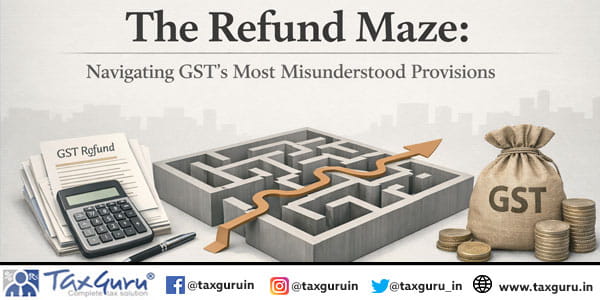
The refund maze has multiple exits. Finding the right one requires understanding not just Section 54’s text, but the constitutional and equitable principles underlying the entire GST edifice.
After all, as the Madras High Court reminded us: “The legitimate claim of refund by the assessee cannot be denied in appropriate cases.”
The evolution continues. And with it, the hope that tax administration will increasingly prioritize substance over form, justice over technicality, and taxpayer rights over bureaucratic convenience.