India and the EU Finally Seal Their Massive Free Trade Deal: What It Really Means for Tariffs and Market Access
Just a few days ago, on January 27, 2026, India and the European Union put pen to paper on what many are calling the biggest trade deal in recent memory. After years of stop-start negotiations, this agreement links two huge economies, covering about two billion people and a quarter of the world’s GDP. At its heart, though, it’s really about one thing: slashing tariffs, the taxes governments slap on imported goods that have kept trade between the two sides more expensive than it needed to be.
India has long kept higher duties to shield its local industries, while the EU’s tariffs are generally lower but still bite in certain areas like textiles or cars. This new FTA changes the game completely. Both sides have promised to wipe out or heavily cut duties on the overwhelming majority of goods they trade. Here’s a straightforward look at what each is putting on the table, with the spotlight on those tax cuts and the easier market access they create.
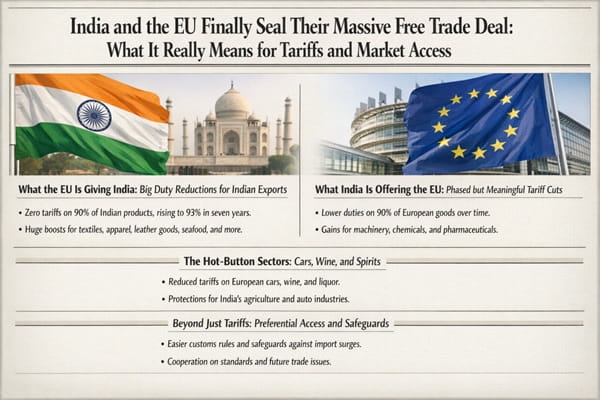
What the EU Is Giving India: Big Duty Reductions for Indian Exports
The EU has agreed to drop tariffs to zero right away on 90% of Indian products (counting by tariff lines), and that figure climbs to 93% of Indian exports within seven years. In real money terms, nearly 99.5% of trade between the two will benefit from some kind of tariff relief. The EU’s average duty on Indian goods falls from around 3.8% to basically nothing(0.1%).
That’s great news for Indian exporters. Sectors like textiles, clothing, leather goods, footwear, marine products, chemicals, plastics, rubber, base metals, and gems and jewellery all get major boosts. Tariffs that used to run as high as 17% on apparel or 26% on seafood disappear completely. Engineering goods, handicrafts, and spices also become much more competitive in Europe.
Overall, India gets preferential access for more than 99% of its exports to the EU by value worth roughly $33 billion in labor-intensive industries alone. It’s the kind of opening that could really help create jobs and grow those traditional export sectors.
What India Is Offering the EU: Phased but Meaningful Tariff Cuts
India is being a bit more gradual, but the concessions are still substantial. Duties drop to zero immediately on about 30% of EU goods, and over time more than 90% of European exports will face lower or no tariffs. EU companies could save up to €4 billion a year in duties once everything kicks in.
The biggest winners for Europe are industrial products: machinery and electrical equipment (duties as high as 44% go to zero), chemicals (up to 22% eliminated), and pharmaceuticals (11% tariffs scrapped). That makes European machines, equipment, and medicines much more affordable in India’s fast-growing market.
But India has protected some sensitive areas. Beef, poultry, rice, sugar, and dairy products are largely kept out of the full liberalization to safeguard local farmers and producers. On the flip side, Indian agricultural exports like tea, coffee, spices, fruits, and vegetables get better access and lower duties in Europe, which should help those farmers too.
The Hot-Button Sectors: Cars, Wine, and Spirits
Cars were one of the thorniest issues. India’s duties on EU vehicles which are sometimes over 100% are coming down, but not all at once and not without limits. Tariffs will phase down to 10% over five to ten years, but only for a limited quota: 250,000 vehicles a year (160,000 petrol/diesel and 90,000 electric). Cars cheaper than €15,000 are excluded from the cuts, and there’s no relief for completely knocked-down kits. It’s a compromise that protects India’s domestic auto industry while letting brands like BMW, Mercedes, and Volkswagen sell more here.
Wine, spirits, beer, olive oil, and certain processed foods also get sharp reductions. India’s tariffs on premium wines, for example, drop from 150% to 20–30% (starting at 75% in the first year), and similar cuts apply to whiskey, gin, and other European favorites. That should make them a lot more accessible to Indian consumers.
Beyond Just Tariffs: Preferential Access and Safeguards
The deal isn’t only about cutting taxes. It includes rules of origin to make sure goods really come from one side or the other, easier customs procedures, and safeguard mechanisms so either side can step in temporarily if a sudden flood of imports threatens local jobs.
There’s also talk of technical cooperation on things like the EU’s carbon border rules, though no immediate exemptions for India.
The agreement is expected to start rolling out sometime in 2026 once both sides ratify it, with some cuts phased in over years to give industries time to adjust.
In short, this FTA is a huge tax-relief package disguised as a strategic partnership. For India, it opens doors to one of the world’s richest markets and supports export growth in jobs-heavy sectors. For the EU, it gives better access to India’s booming economy at a time when global trade feels uncertain. Whether it delivers on all the promises will come down to how it’s actually implemented, but the tariff cuts alone are one of the most significant trade-tax reductions we’ve seen in a long time.