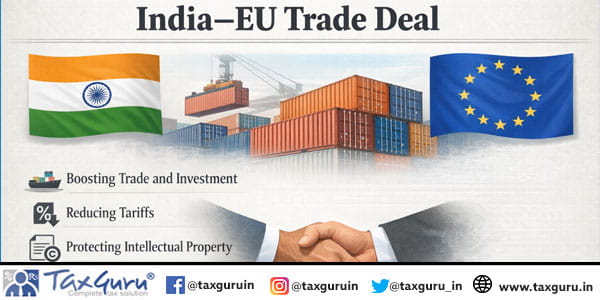
India and the European Union (EU) on 27 January 2026, jointly announced the conclusion of the India–European Union Free Trade Agreement (India-EU FTA) at the 16th India–EU Summit held in New Delhi. This landmark deal integrates the world’s 2nd and 4th largest economies, covering a quarter (25%) of global GDP with a combined market estimated at over US$ 24 trillion and triggering unparalleled opportunities for over 2 billion people of India and the EU.
The EU and India currently trade goods and services worth more than €180 billion annually, supporting approximately 800,000 jobs across the European Union. The new agreement is expected to significantly accelerate this exchange, with EU goods exports to India projected to double by 2032.
Under the agreement, India will eliminate or reduce tariffs on 96.6% of EU goods exports, resulting in estimated annual savings of around €4 billion in duties for European exporters. This represents the most extensive market opening India has ever granted to a trade partner.
The deal provides EU companies with preferential access to India’s rapidly expanding market of 1.45 billion people, supported by an economy valued at approximately €3.4 trillion.
Tariffs on cars will be progressively reduced from 110% to as low as 10%, while duties on car components will be fully eliminated over a five-to ten-year period. High tariffs on machinery, chemicals, and pharmaceuticals—currently reaching up to 44%, 22%, and 11% respectively—will also be largely phased out.
The agreement also significantly lowers barriers for EU agri-food exports, where Indian tariffs average over 36%. Duties on wines will be reduced from 150% to 75% upon entry into force and further lowered to around 20% over time. Tariffs on olive oil will fall from 45% to zero within five years, while tariffs on processed food products such as bread and confectionery will be eliminated.
The “GSP Gap”: A critical development for exporters is the EU’s withdrawal of Generalized System of Preferences (GSP) benefits for India, effective January 1, 2026. This creates a challenging “gap period” where tariffs may rise before the FTA is fully implemented (likely in 2027).
Indian exporters in textiles, chemicals, and engineering must act immediately. Companies leveraging schemes such as SEZ (Special Economic Zones), EOU, or MOOWR can mitigate these temporary costs through operational incentives.
Opportunities For Foreign Investors (FDI): The FTA aligns perfectly with the “China Plus One” strategy, encouraging a surge in European Direct Investment into India. Enhanced provisions for investment protection make India an attractive destination for long-term commitments.
Sensitive sectors like agriculture and dairy have been excluded to protect Indian farmers.
Strong protections for intellectual property rights form a central pillar of the deal. The agreement enhances enforcement mechanisms for copyrights, trademarks, designs, trade secrets, and plant variety rights, aligning EU and Indian IP frameworks more closely and facilitating innovation-driven trade and investment.
Impact & Benefits *For Indian exporters
♦ India has gained preferential access to EU markets across 97% of tariff lines, covering 99.5% of trade value.
♦ Key Sectors AND Analysis of Tariff benefits as below:
1. Leather and Footwear -Elimination of tariffs from up to 17% to zero across all tariff lines.
2. Marine Reducing tariffs of up to 26% across 100% trade value.
3. Medical Instruments,
-
-
- Appliances, and vital
- Supplies
- Tariffs elimination of up to 6.7% across 99.1% of trade lines
-
4. Gems and jewellery Tariffs elimination of up to 4% across 100% trade value
5. Textiles and Apparel Zero duty in textiles and clothing, covering all tariff lines and reducing tariffs by up to 12%
6. Chemicals Zero duty on 97.5% of trade value
7. Mines and Minerals Zero duty across 100% tariff lines.
8. 90.7% of India’s exports to the EU will move to zero tariff immediately, covering major sectors such as:
-
-
Textiles, Leather, Tea and coffee and Jewellery
-
9. An additional 2.9% of exports will see tariffs removed within 5 years, including:
-
-
Marine products and Processed food
-
10. Around 6% of exports will receive partial tariff cuts, including:
-
-
Poultry and Steel
-
11. On services, the EU has opened 144 out of 155 sub-sectors for Indian businesses, including:
-
-
IT and Professional and business services
-
12. India, in return, is liberalising norms in 102 services sub-sectors, including telecom, financial, maritime, and environmental services.
India has prudently safeguarded sensitive sectors such as dairy, cereals, certain fruits and vegetables
Impact & Benefits For EU exporters
-
49.6% of tariff lines on EU imports into India will move to zero duty immediately.
-
Another 39.5% of tariff lines will be phased out over 5, 7, or 10 years.
-
A limited number of products will be subject to a mix of tariffs and quotas rather than full elimination.
♦ Key sectors and Product VS Current tariffs VS Future tariffs as below:
| Key Sector / Product | Current Tariffs | Future Tariffs |
|---|---|---|
| Motor vehicles | Up to 110% | 10% (with a quota of 2,50,000 vehicles per year) |
| Machinery and electrical equipment | Up to 44% | 0% for almost all products |
| Aircraft and spacecraft | Up to 11% | 0% for almost all products |
| Optical, medical and surgical equipment | Up to 27.5% | 0% for 90% of the products |
| Plastics | Up to 16.5% | 0% for almost all products |
| Chemicals | Up to 22% | 0% for almost all products |
| Iron and steel | Up to 22% | 0% for almost all products |
| Pharmaceuticals | 11% | 0% for almost all products |
| Wine | 150% | 20% (premium range); 30% (medium range) |
| Spirits | Up to 150% | 40% |
| Beer | 110% | 50% |
Exporter Benefits: Zero Duty Access to EU Market
Indian exporters gain duty-free access to a large EU market across several sectors that currently face tariffs:
| Sector | Current EU Duty | Final Duty |
|---|---|---|
| Marine products | Up to 26% | 0% |
| Leather | Up to 17% | 0% |
| Chemicals | Up to 12.8% | 0% |
| Textiles & garments | Up to 12% | 0% |
| Home décor & furniture | Up to 10.5% | 0% |
| Base metals | Up to 10% | 0% |
| Toys & sports goods | Up to 4.7% | 0% |
| Gems & Jewellery | Up to 4% | 0% |
Trade in service
- Boost service exports in EU across 144 services sub-sectors, including IT/ITeS, professional services, education, and other business services
- India has offered access to 102 sub-sectors such as professional, telecommunication, maritime, financial etc.
- FTA establishes assured regime for temporary entry and stay for professionals, including business visitors, intra-corporate transferees, contractual service suppliers and independent professionals.
Conclusion of this negotiation has been termed as the ‘mother of all deals’ by both the parties and is expected to unfold significant benefits to both India and EU.
- As a next step, the agreement will now move into technical closure and for legal scrubbing.
- Once the same is adopted by the Council, both the parties will sign the agreement.
- This will be followed by a ratification by Indian Cabinet and the EU Parliament.
Implementation Timeline of India–EU Trade Deal
The agreement is expected to move through several stages:
-
Within 2 weeks – Text cleanup
-
5–6 months – Legal vetting, translation, and signing
-
Around 12 months – Approval by the European Parliament
The deal is expected to come into effect in 2026, subject to completion of these processes.
Businesses should treat this as a transition window and should focus on the following:
- Business impact analysis on existing as well as proposed business operations involving exports and imports of covered products between both parties
- Analysis of sourcing patterns considering the current deal and the need for change/redesigning the sourcing strategy
- Review investment decisions made and repurpose the same by aligning with the newly announced trade deal
- Evaluate the impact on mobility of professionals and on social security coordination, as these could materially reduce operational friction and cost.